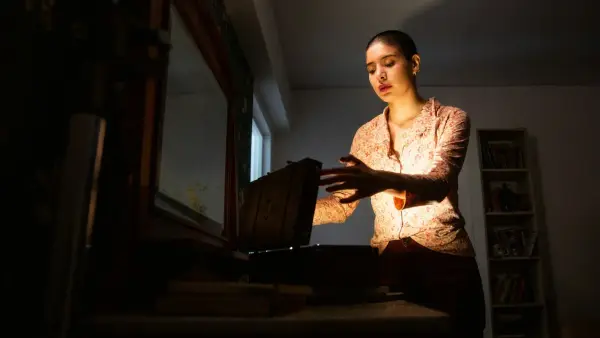
Children who always noticed when a lightbulb was about to burn out - who saw the flicker before the dark, who kept a quiet inventory of every light source in the house the way other children tracked baseball cards - often become adults who can sense when a friendship is dimming, when a colleague is about to leave, when the warmth in a room has shifted, because a child who learned that darkness arrives one bulb at a time and nobody warns you when the last one goes built a monitoring system that tracks the brightness of everything she loves

I was nine the first time I changed a lightbulb by myself.
Not because someone asked me to. Because I had been watching the one in the upstairs hallway for three days, tracking the way it stuttered when you flipped the switch - a faint hesitation, like the filament was catching its breath before deciding whether to stay on. I knew what that hesitation meant. I had seen it before in the kitchen, in the bathroom, in the lamp beside my mother’s reading chair. A bulb that flickers is a bulb that’s leaving.
So I dragged a chair from my bedroom, climbed up, and unscrewed it while it was still warm. I had already found the replacement in the closet behind the towels. I knew where every spare bulb in that house lived.
I did not think this was unusual. I thought everyone kept a mental map of the light in their home - which rooms were bright, which were dimming, which were one power surge away from going dark. It was not until decades later, in a graduate seminar on developmental adaptation, that I understood what I had really been doing in that hallway. I was not changing a lightbulb. I was managing the environment so that darkness - the kind that came with yelling, with silence, with a door slamming so hard the pictures shook - could not arrive unannounced.
I was a child who monitored light because I had learned what the dark cost.
The Inventory Nobody Asked Her to Keep
Some children count baseball cards. Some memorize dinosaur species or the starting lineups of their favorite teams. And some children keep a different kind of inventory - one that nobody teaches them and nobody rewards them for maintaining.
They track the warmth in a room. The brightness. The sources of light, literal and otherwise.
This child knows which lamp her father turns on when he is in a good mood. She knows the sound of the porch light being left on versus switched off. She knows that when her mother stops opening the curtains in the morning, something has shifted in the house that has nothing to do with sunlight.
She is not anxious in the way people mean when they use that word casually. She is precise. She has built a sensory catalog of every signal that precedes emotional change in her household, and light - its presence, its flicker, its absence - became the most reliable variable she had.
A 2005 study published in the journal Development and Psychopathology found that children raised in unpredictable home environments develop what researchers call “enhanced perceptual sensitivity” - a heightened ability to detect subtle environmental changes that most people miss. These children were not merely nervous. They had trained their nervous systems to function as early warning networks, scanning constantly for the micro-shifts that preceded disruption.
The lightbulb was never really about the lightbulb. It was about the fact that in a volatile home, the physical environment becomes a proxy for emotional safety. A dim hallway feels dangerous not because of the dark, but because of what happens in homes where nobody is paying attention to what is falling apart.
Learning That Darkness Arrives One Bulb at a Time
Here is what the child understood that the adults around her did not: nothing goes dark all at once.
A house does not lose its light in a single dramatic blackout. It loses it gradually. The bulb in the guest room burns out and nobody replaces it, because nobody goes in there anymore. The lamp in the living room starts flickering, but everyone has gotten used to it. The hallway light dims so slowly that the family adjusts their eyes without realizing they are walking through a house that is getting darker by the week.
The child sees it because the child has no choice. She cannot adjust. She needs the light on - not for reading, not for comfort, but because light means that someone is still present, still tending to things, still holding the structure of this household together. When the lights start going out one by one and nobody fixes them, she knows what follows. The house is being abandoned from the inside.
This is the origin story of a very specific kind of adult - the one who can feel a friendship fading three months before the other person sends the apologetic text. The one who notices when a colleague stops laughing at meetings, when a partner’s goodnight texts get shorter, when the energy in a family group chat has gone from warm to polite.
She is not psychic. She is not even particularly intuitive in the mystical sense people sometimes mean. She is a woman who spent her childhood calibrating her senses to detect the exact moment when something alive began to die, because in her house, by the time everyone else noticed, it was already too late.
The Adult Who Reads Every Room She Enters
Dr. Elaine Aron’s research on sensory processing sensitivity describes a trait present in roughly 15 to 20 percent of the population - a nervous system wired to process stimuli more deeply than average. But what Aron’s framework sometimes underemphasizes is how experience shapes the direction of that sensitivity. A child born with a reactive nervous system and raised in a stable home might become an adult who notices beautiful details - the quality of afternoon light, the texture of a conversation. The same child raised in chaos becomes something different. She becomes a scanner.
You know her. You might be her.
She walks into a dinner party and within forty-five seconds she has mapped the room. She knows which couple is fighting quietly. She knows which friend is performing happiness. She knows that the host has been crying recently - not because of smudged makeup or red eyes, but because of the way she is holding her wine glass slightly too tightly, laughing half a beat too quickly.
She is reading the room the way she once read her house - tracking every source of warmth, noting which ones are steady and which ones are starting to flicker.
This does not always feel like a gift. It is exhausting to walk through the world with your perceptual system set to maximum sensitivity. A 2019 study in the Journal of Personality and Social Psychology found that individuals with high environmental sensitivity reported significantly more emotional fatigue in social settings - not because they were introverted, but because they were processing vastly more information than the people around them.
She is tired because she is doing more work than anyone realizes. She is monitoring the brightness of every relationship, every room, every interaction - and she cannot turn it off.
When the Flicker Means Something Real
The painful part of this pattern is not the monitoring itself. It is the fact that she is almost always right.
She is the friend who said, quietly, in January, “I think Marcia is pulling away from us.” Everyone else shrugged. By April, Marcia had stopped returning calls. She is the employee who told her manager, gently, “I think David is looking for another job.” Her manager dismissed it. David gave notice three weeks later.
She sees the flicker. She knows what it means. And most of the time, she cannot do anything about it except watch.
This is the cruelest echo of her childhood. The girl who replaced the lightbulb at nine was trying to prevent the dark. The woman who sees a friendship fading at forty-five is trying to do the same thing - but human connections are not lightbulbs. You cannot unscrew someone’s withdrawal and replace it with a fresh one from the closet behind the towels.
And so she sits with the knowing. She holds the awareness that something is dimming, and she carries it alone, because when she tries to name it - “I think something is wrong” - people look at her like she is overreacting. Like she is reading too much into things. Like she is the problem for noticing what everyone else is determined to ignore.
But she was not wrong about the lightbulb in the hallway. She was not wrong about the lamp in the kitchen. And she is not wrong now.
What She Is Really Tracking
Here is what I want you to hear, if this is your story.
You are not tracking lightbulbs. You never were. You are tracking love.
You are tracking the presence or absence of care. Of tending. Of someone showing up to maintain the warmth in a shared space. When you walk through your house at night making sure the porch light is on, you are not being compulsive. You are performing a ritual that your childhood taught you means: someone is still here. Someone is still paying attention. The lights are still on.
When you notice that a friend has gone quiet, you are not being clingy or paranoid. You are registering a change in the emotional current that most people genuinely cannot feel. Your nervous system was built - or, more accurately, rebuilt - to detect exactly this. The slow, almost imperceptible dimming that precedes loss.
Gabor Mate has written extensively about how early stress shapes not just our psychology but our neurobiology - how children raised in emotional unpredictability develop nervous systems that are fundamentally wired for detection. Not because something is wrong with them, but because their environment demanded it. The adaptation was necessary. The sensitivity was earned.
You earned yours in a hallway with a flickering light and a house that was getting darker and nobody was doing anything about it.
She Is Still the Girl Checking Which Lights Are On
I am in my forties now, and I still walk through the house before bed making sure every light that should be on is on. My husband thinks it is a quirk. My daughter thinks it is funny. Neither of them knows that I am not checking the lights.
I am checking the warmth. I am making sure nothing has gone dark when I was not looking.
I still notice when a friend’s voice changes on the phone - that barely perceptible shift from open to guarded, from warm to careful. I still feel it when the energy in a meeting drops half a degree, when someone’s enthusiasm has been replaced by something performative. I still walk into rooms and map them, instantly, unconsciously, the way I mapped my childhood home every evening - which rooms were bright, which were dim, which had gone dark entirely.
I used to think this made me exhausting. Too much. Too sensitive. Too aware of things that nobody else seemed to notice or care about.
But I have come to understand something different about the girl in the hallway with the lightbulb. She was not anxious. She was devoted. She loved her home so fiercely that she refused to let it go dark without a fight. She could not control the yelling. She could not fix the silences. But she could change the bulb in the hallway, and so she did, because it was the one form of tending that was available to a nine-year-old who understood that someone had to keep the lights on.
If you are still that person - still the one scanning the room, still the one who feels the flicker before anyone else does, still the one holding a quiet inventory of every source of warmth in your life - I want you to know something.
You are not broken. You are not too much. You are not imagining things.
You are a person who learned, very young, that light requires maintenance. That warmth is not permanent. That someone has to pay attention, or the whole house goes dark.
And you decided, before you were old enough to articulate it, that the someone would be you.
That is not a disorder. That is a kind of love so deep it rewired your entire nervous system.
You are still the girl walking through the house, checking which lights are on. And the answer, tonight, is: enough of them. Enough of them are on.