Children who always sat in the back seat directly behind the driver and watched their mother's face in the rearview mirror - who studied the reflection because it was the only angle where her expression was not yet arranged for an audience, the only place her worry was visible before she turned around and smiled - often become adults who trust what they see from the corner of their eye more than what anyone tells them directly, because a child who learned to read the truth in a reflection learned that the most honest version of a person is the one they do not know you can see
I remember a very specific rectangle of glass.
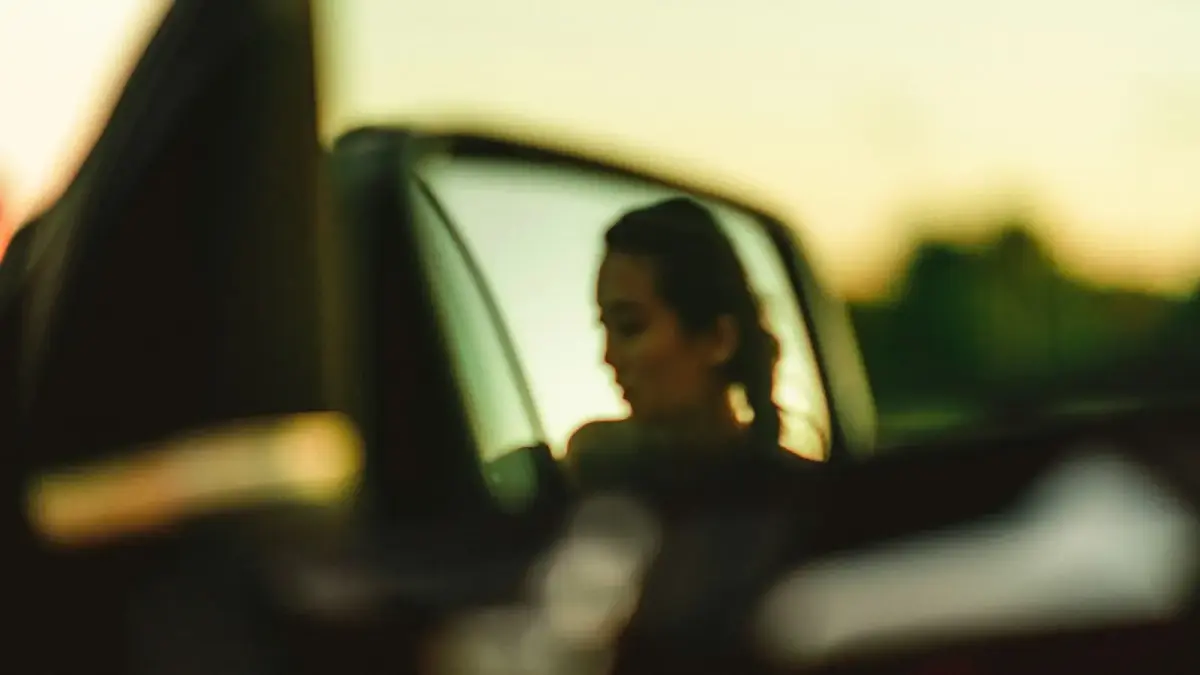
It was maybe four inches wide, slightly angled, mounted above the dashboard of my mother’s car. I sat behind her every time - not the passenger side, not the middle. Directly behind the driver’s seat, where the geometry of the mirror gave me something I didn’t have anywhere else in my life.
A view of her face when she didn’t know I was looking.
I must have been seven or eight when I started watching. Not consciously at first. But something in me understood that the face in the mirror was different from the face that turned around at red lights to check on me. The mirror face had a crease between the eyebrows that disappeared the moment she shifted her gaze to meet mine. The mirror face held its jaw differently. The mirror face was where her worry lived before she packed it away and replaced it with a smile that was meant to tell me everything was fine.
I learned to read the weather of my household in that small rectangle of reflected light. And I have spent the rest of my life trusting reflections more than faces.
The only honest angle
There is a particular kind of childhood that unfolds not in what is said but in what is almost hidden.
The child in the back seat is not being abused. She is not being neglected in any way a teacher or counselor would flag. She is loved. But somewhere in the architecture of her family, there is a gap between what the adults feel and what they are willing to show. The rearview mirror is where that gap becomes visible.
A 2019 study published in Developmental Psychology found that children as young as five demonstrate what researchers call “emotional eavesdropping” - the ability to read emotional states from indirect cues, including overheard conversations, body language observed from a distance, and facial expressions caught in unguarded moments. The children who scored highest on these measures were not the ones from overtly distressed homes. They were the ones from homes where emotions were managed, contained, and selectively displayed.
The rearview mirror child grew up in a household where feelings were real but curated. Mom was stressed but smiled. Dad was angry but said everything was fine. The adults performed composure, and the child - with no vocabulary for what she was sensing and no permission to name it - found the one angle where the performance hadn’t started yet.
That small rectangle of glass became the most honest window in the house.
Learning to read what was never meant to be read
Here is what the mirror taught the child: people have two faces.
Not in a sinister way. Not in a manipulative way. But in the way that all humans manage how they present themselves to the people they love. The mother furrowing her brow at a stoplight was not lying when she turned around and smiled. She was protecting. She was choosing which version of herself her child would receive.
But the child saw both.
And because she saw both - the worry and the reassurance, the tension and the manufactured calm - she learned something that most people do not fully understand until much later in life, if they understand it at all. She learned that the most honest version of a person is the one they don’t know you can see.
This is not a small lesson. This is an entire operating system for reading the world.
Dr. Edward Tronick, whose research at the University of Massachusetts Boston explored the emotional communication between parents and infants, described what he called “moments of meeting” - those brief, unscripted seconds when genuine emotional states pass between two people before the social performance resumes. The rearview mirror child became an expert in those moments. Not because anyone trained her. Because survival required it.
She needed to know the emotional temperature of the car before the car arrived at its destination. She needed to know whether the silence between her parents was comfortable or loaded. She needed to know whether the cheerful voice asking about her day at school was real or rehearsed.
And the mirror told her every time.
The peripheral perception system
These children grow into adults with a very specific gift that often feels more like a curse.
They read rooms the way weather forecasters read satellite imagery - not by looking directly at the storm, but by tracking pressure changes, wind shifts, and the movement of systems that haven’t arrived yet.
They notice the exact moment a friend’s laugh changes texture. They hear the half-second pause before someone says “I’m fine.” They catch the micro-expression - the flicker of hurt or irritation that crosses a face before the social mask resettles - and they cannot unsee it.
A 2021 study in the Journal of Personality and Social Psychology found that individuals who reported high levels of “ambient emotional monitoring” in childhood - defined as habitually tracking the emotional states of caregivers through indirect observation - showed significantly enhanced accuracy in detecting deceptive emotional displays in adulthood. They were not better at reading emotions that people were openly expressing. They were better at reading emotions that people were trying to hide.
This is the legacy of the rearview mirror.
The child who watched her mother’s reflection did not grow up to become someone who stares at faces and demands honesty. She grew up to become someone who trusts the peripheral signal over the direct statement. The tone someone uses when they think the important part of the conversation is over. The posture shift that happens when a person believes they are no longer being observed. The text message that says the right words but arrives thirty minutes later than it should.
She reads the world the way she read that mirror: from an angle the other person doesn’t know exists.
Why they know before you tell them
If you are in a relationship with someone like this, you have probably had the experience of being seen before you were ready to be seen.
You are upset about something. You haven’t decided whether to bring it up. You are still composing the narrative in your head - what you’ll say, how you’ll frame it, whether it’s even worth mentioning. You walk into the room with a neutral face and a casual tone.
And they say, “What’s wrong?”
Not because you told them. Not because you did anything visible. But because something about the angle of your shoulders, or the rhythm of your breathing, or the way you set your keys down on the counter was different from how you do it when you are genuinely at ease.
They caught the unguarded moment. The one you didn’t know you were broadcasting.
This can feel like intimacy at its finest - the relief of being known without having to explain yourself. It can also feel invasive, like living with someone who has access to a frequency you didn’t consent to sharing. Both reactions are valid.
But here is what I want you to understand about the person who does this: they are not trying to catch you in a lie. They are not suspicious by nature. They are doing the only thing they know how to do, which is read the version of you that exists before you’ve arranged yourself for an audience.
They learned, as children, that the arranged version was incomplete. Not false - incomplete. And they have spent their entire lives filling in the gaps.
This is not distrust
I want to be very clear about something, because this is where the reframe matters.
The rearview mirror child does not grow up distrustful. She grows up with a different relationship to trust than most people have.
Most people trust declarations. “I love you.” “I’m happy.” “Everything is fine.” They take the words at face value, and for many people, the words are enough.
The mirror child trusts differently. She trusts behavior over language. She trusts patterns over promises. She trusts the moment right before someone is ready to show her something, because she learned that the moment right before is where the truth lives.
This is not cynicism. This is a child’s precise, brilliant adaptation to an environment where the emotional weather was real but the forecast was always sunny.
Susan Cain, in her work on introverted and highly observant temperaments, described what she called “alert attention” - the heightened sensitivity to environmental cues that develops in children who are more attuned to subtlety than spectacle. The rearview mirror child is the embodiment of alert attention. She built an observation system so precise, so finely calibrated, that it became a kind of emotional genius.
She does not need you to tell her how you feel. She already knows. Not because she is psychic. Because she has been watching the mirror since she was seven years old, and she never stopped.
The reflection that never goes away
I am in my forties now, and I still do it.
I still watch people in the moments they think no one is paying attention. I still trust the peripheral signal - the exhale, the glance away, the slight tightening around the eyes - more than the words that follow.
I used to think this made me difficult. Too observant. Too hard to fool, which sounds like a compliment but often isn’t, because people want to be taken at their word and I was always reading the footnotes.
But I have come to understand something about that child in the back seat. She was not developing a flaw. She was developing a fluency. A fluency in the unspoken, in the almost-hidden, in the version of people that lives just underneath the surface they prepare for the world.
And if you were that child - if you spent your childhood reading the weather in a four-inch rectangle of glass, if you learned to track the emotional temperature of a room before anyone acknowledged there was weather at all - I want you to know something.
You are not paranoid. You are not distrustful. You are not “too much.”
You are someone who learned, very early, that the most important truths are the ones people haven’t decided to tell you yet. And you built an entire perceptual system - quiet, precise, almost invisible - to catch those truths in the half-second before they disappear.
That is not a wound. That is a gift you gave yourself when no one else knew you needed one.
And the mirror was never lying to you. Not once.