Children who can still describe the exact smell of their grandmother's house forty years later - the specific combination of lavender soap and something always cooking slowly on the back burner and a closet that smelled like cedar and old wool coats - often become adults whose most powerful memories arrive not through photographs or stories but through scent, because a child's nervous system does not merely remember safe places but encodes them chemically, and the person who tears up in a candle aisle at fifty-three is not sentimental but being ambushed by a body that found the one room where it truly relaxed and has never stopped looking for the way back
I was standing in the candle section of a home goods store last November when it happened. I picked up a jar labeled “Autumn Harvest” - something with cinnamon and clove and a warm base note I couldn’t name - and for about four seconds, I wasn’t in a store at all.
I was seven. I was standing in the doorway of my grandmother’s kitchen in bare feet on linoleum that was always slightly warm. She was at the stove. There was something with apples. The radio was on but turned down low, and I remember the specific quality of the light coming through the window above the sink - yellow and slow, the way afternoon light gets in October.
Then someone bumped my cart, and I was fifty-one years old again, holding a candle in a fluorescent-lit aisle, and my eyes were wet.
I put the candle down and stood there for a moment, feeling ridiculous and also feeling something I don’t have a clean word for. Not sad. Not happy. Something underneath both of those - something the body knows but the mind can’t quite organize into language.
I’ve spent the last year trying to understand what happened to me in that aisle. What I found changed the way I think about memory, childhood, and what it actually means when your body won’t let go of a place you haven’t visited in decades.
The catalog no one taught you to keep
Ask someone to describe their grandmother’s house, and most people will start with the layout. The porch. The living room with the plastic-covered furniture. The bedroom where they slept when they stayed over.
But press a little further, and almost everyone shifts to smell.
The cedar closet where the winter coats lived. The lavender sachets tucked between folded sheets. The particular brand of coffee - always percolated, never dripped - that turned the kitchen air thick and dark by six in the morning. The soap in the bathroom that nobody uses anymore. The fabric softener baked into quilts that had been folded and unfolded a hundred times.
These aren’t vague impressions. People describe them with the precision of a sommelier. They can separate the layers - the mothballs underneath, the furniture polish on top, the cooking that lived in the walls themselves, decades of oil and garlic and Sunday roasts absorbed into plaster and curtains until the house itself became a kind of flavor.
I’ve talked to people in their sixties and seventies who can still identify the exact brand of hand lotion their grandmother used. They haven’t smelled it in forty years. But they could pick it out of a lineup without hesitation.
This is not sentimentality. This is neuroscience.
The only sense that doesn’t knock first
Here is the thing about smell that makes it different from every other sense you have: it cheats.
When you see something, that visual information travels through the thalamus - a relay station in the center of your brain that sorts and filters before sending signals along to the cortex for processing. Sound does the same thing. Touch, taste - they all pass through the thalamus, where your brain gets a chance to contextualize, moderate, and prepare a response.
Smell skips the line entirely.
The olfactory bulb - the structure that processes scent - connects directly to the amygdala and the hippocampus. No relay. No filter. No thalamic checkpoint where your brain gets to decide how to feel about what it’s receiving.
The amygdala processes emotion. The hippocampus consolidates memory. And when a scent arrives, it hits both of these structures simultaneously, without warning, without the cognitive buffer that every other sense gets.
A 2004 study published in the journal Neuropsychologia found that memories triggered by smell were significantly more emotional, more vivid, and more likely to be experienced as a feeling of being physically transported to the original event than memories triggered by words or images. The researchers described olfactory memories as having an almost “time-travel” quality that visual memories simply don’t produce.
This is why a scent doesn’t remind you of the past. It puts you there. It doesn’t give you a picture of your grandmother’s kitchen - it puts you in your grandmother’s kitchen. Your body temperature shifts. Your shoulders drop. Your breathing changes. For a moment, you are not remembering. You are there.
What a child’s body is actually doing in a safe place
When a child walks into a grandparent’s home - assuming that home is a place of warmth and safety, which for many people it was - something specific happens in their nervous system that has nothing to do with conscious thought.
The child’s body scans the environment. It registers temperature, sound, light. But the most powerful data it collects is olfactory, because smell is the oldest sense, evolutionarily speaking. Long before our ancestors could process complex visual scenes or interpret language, they could smell danger and smell safety.
A child in a safe environment - one where they are fed, held, unhurried, and loved without conditions - enters a parasympathetic state. Their nervous system downshifts. Heart rate slows. Cortisol drops. The muscles in their face and belly soften.
And while all of this is happening, the brain is doing something remarkable: it is binding the olfactory signature of that environment to the physiological state of safety itself.
Dr. Rachel Herz, a neuroscientist at Brown University and one of the leading researchers on olfactory memory, has written extensively about how scent becomes paired with emotional states through a process that is essentially classical conditioning. The child doesn’t decide to memorize the smell of cedar and lavender and slow-cooked stew. The nervous system does it automatically, encoding the chemical signature of the environment alongside the feeling of being completely, cellularly safe.
This is not a memory the way we usually think of memories. It’s more like a bookmark in the body. A physiological waypoint. The nervous system saying: this is what safe smells like. Remember this. You may need to find your way back.
The grandmother’s house as nervous system sanctuary
Not every child had this. Some children’s strongest scent memories are bound to fear - cigarette smoke and a specific cologne that meant someone was home and angry. The mechanism works the same way regardless of the emotional valence.
But for the millions of people whose grandparent’s home represented the one place in their childhood where expectations dissolved and they were simply welcome - those people carry a specific kind of olfactory archive that is unlike anything else in their memory.
The grandmother’s house, for many, was the only place where the child’s nervous system fully relaxed. Home might have had tension. School had performance pressure. But grandmother’s house had a pace and a warmth that asked nothing of you.
A 2016 study in the journal Cognition and Emotion found that nostalgic scent memories were not just emotionally powerful but specifically self-relevant - they connected to memories of identity formation, of feeling accepted, of belonging. The scents didn’t just trigger memories of a place. They triggered memories of who the person was allowed to be in that place.
This is why the catalog is so precise. The child’s body wasn’t casually noting the environment. It was performing a kind of survival mapping - marking every sensory detail of the one location where the nervous system could fully stand down. The cedar. The lavender. The specific weight of the air in a house where something was always cooking, where warmth wasn’t metaphorical but literal, rising from the stove and settling into everything.
What is actually happening in the candle aisle
When you are fifty-three and you pick up a candle and your eyes fill, you are not experiencing nostalgia in the way our culture frames it - a soft, optional, slightly embarrassing tenderness for the past.
What is happening is much more physical than that.
Your olfactory system has detected a chemical signature that matches - even partially - the signature your nervous system bookmarked decades ago as the smell of safety. And because that signal bypasses the thalamus, your conscious mind gets no warning. There is no cognitive preamble. No gentle lead-in where you think about your grandmother and then feel something.
Instead, your body responds first. Your nervous system shifts toward the parasympathetic state it entered in that kitchen forty years ago. Your shoulders drop before you know why. Your breathing deepens before you’ve formed a single thought about the past. And then, a half-second later, the hippocampus delivers the context - the kitchen, the light, the sound of someone moving slowly at the stove - and your conscious mind catches up to what your body already knows.
The tears are not about missing someone, though you may also be missing someone. The tears are the body’s response to finding, for a moment, the exact neurochemical state it has been searching for since the last time it stood in that kitchen.
You are not being sentimental. You are being called back by your own nervous system to the one place where it fully let go.
The search that never stops
Here is the part that changed the way I think about everything.
The nervous system does not forget the bookmarks it set in childhood. It doesn’t archive them or let them fade the way visual memories blur over the years. Olfactory-emotional associations remain remarkably stable across a lifetime - a phenomenon researchers have documented repeatedly.
A 2021 study published in Psychological Science found that scent-evoked memories were not only older on average than memories triggered by other cues but maintained their emotional intensity across decades in a way other memories did not. A forty-year-old scent memory could produce the same physiological response as the original experience.
What this means in practice is that your nervous system is still looking for that smell. Not consciously. Not in a way you could articulate. But when you walk into an antique shop and something in the back smells like old wood and dust and faintly of lavender, and your whole body sighs before you know why - that is your nervous system running a match against its archive.
It is scanning every room you enter for the chemical signature of safety.
This is why certain people become quietly obsessed with recreating specific scents in their own homes. The woman who burns the same brand of vanilla candle every evening. The man who won’t switch fabric softeners even though his wife finds the scent old-fashioned. They are not being particular. They are building something. They are trying to reconstruct, molecule by molecule, the olfactory conditions under which their body last fully relaxed.
They are trying to build the room their nervous system has never stopped looking for.
The reframe you might need today
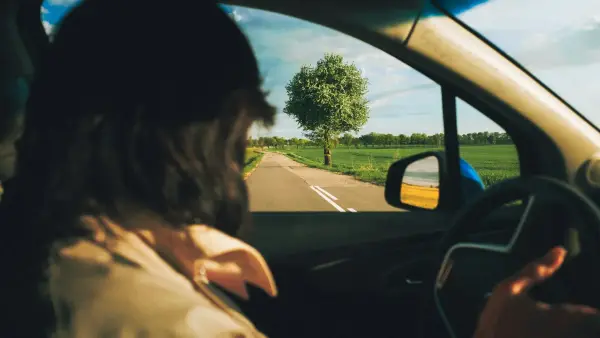
If you are someone who gets ambushed by scent - if a particular soap stops you in your tracks, if the smell of bread baking makes your chest ache, if you once pulled over because the air coming through your car window smelled exactly like a summer that ended forty years ago - I want you to know something.
You are not overly emotional. You are not stuck in the past. You are not being ridiculous.
You are carrying proof that somewhere in your history, someone built a room where your body felt safe enough to memorize everything about it. Someone’s home was so consistently warm, so reliably gentle, that your nervous system encoded it as the template for what safety smells like.
That is not a small thing. That is, in many ways, the greatest gift a person can receive in childhood - not advice, not lessons, not even words, but a place where the body could rest so completely that it memorized the air.
The tears in the candle aisle are not a sign of weakness. They are your body recognizing something it has been looking for. They are the nervous system saying: I found it. For a second, I found the way back.
And the fact that you can still feel it - still be moved by a scent from four decades ago, still have your whole body respond to a trace of cedar or lavender or bread rising in a warm kitchen - means that the safety was real. It was deep enough to last. It was written into you at a level that nothing has been able to erase.
Your grandmother’s house is not gone. Your body kept it. Every molecule. Every warm, slow, unhurried afternoon. It is all still in there, waiting for the next time the air smells exactly right and your nervous system gets to go home, just for a moment, to the safest place it ever knew.