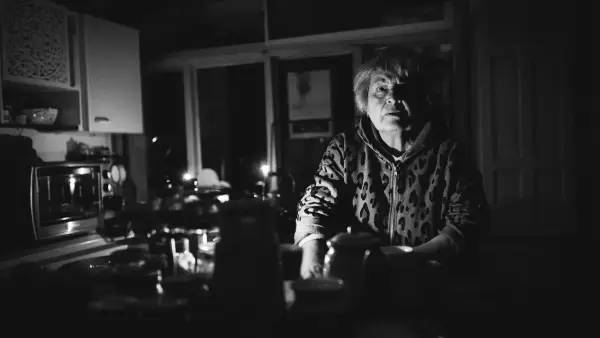
She is 60 and has never once sat in a room where someone was crying without immediately reaching for something to do - a tissue, a glass of water, a blanket, a cup of tea - not because she does not feel for them but because a girl who watched her mother cry in the kitchen and had no idea what to do with her own helplessness learned that the only tolerable response to another person's pain was motion, and the woman who cannot simply sit beside grief without her hands finding a task is not unemotional but still the girl converting the unbearable feeling of watching someone hurt into something she can carry to them
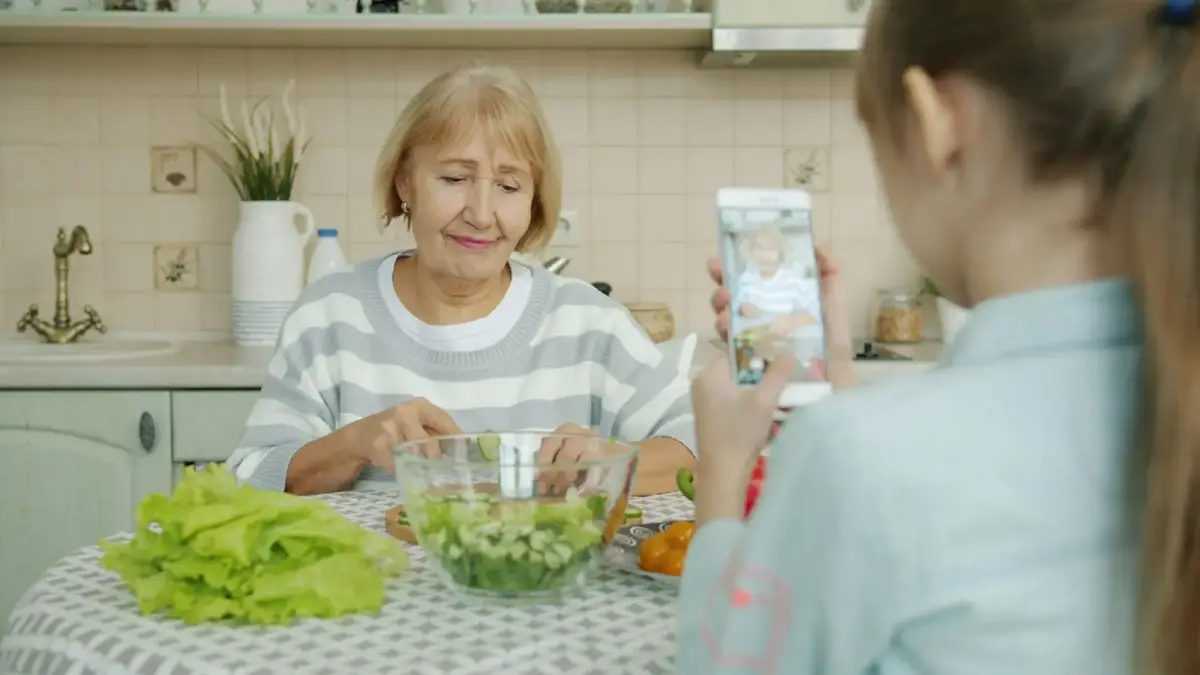
The last time my friend broke down in my living room - really broke down, the kind of crying where her whole body folded forward and the sound that came out of her wasn’t even recognizable as her voice - I was on my feet before I knew I was standing.
I was already in the kitchen. Already filling the kettle. Already pulling a mug from the shelf and reaching for the chamomile, the one she likes, the one in the yellow box.
My hands were busy. My hands were solving something.
And it wasn’t until I was standing at the counter waiting for the water to boil that I realized I had left her alone in the next room. Crying. Without anyone beside her.
I was sixty years old and I had done this my entire life.
Every funeral. Every hospital room. Every late-night phone call where someone’s voice cracked open and I could hear the grief pouring through. My body responded the same way every single time - not by sitting down, not by being still, but by finding something to do. A glass of water. A blanket pulled from the closet. A tissue pressed into a shaking hand. Always motion. Always a task.
And I had always believed that made me a good person. A caring person. Someone who shows up.
It took me six decades to understand what it actually made me: a girl who never learned how to sit with pain she couldn’t fix.
The Kitchen Where It Started
I was eight the first time I walked into the kitchen and found my mother crying.
She was standing at the sink. The water was running but she wasn’t washing anything. Her shoulders were shaking and there was a sound coming from her that I had never heard before - this low, ragged breathing that didn’t match the mother I knew. The mother I knew was composed. Put together. She handled things.
I stood in the doorway and I didn’t know what to do with my body.
I remember that feeling with absolute clarity - the paralysis of it, the way my chest tightened and my stomach dropped and my arms hung at my sides like they belonged to someone else. I was a child watching an adult fall apart and I had no script for it. No instructions. Nobody had ever told me what you do when the person who holds everything together stops being able to hold it.
So I got her a glass of water.
I walked to the cabinet, pulled down a glass, filled it from the tap, and brought it to her. She took it. She said thank you. She wiped her eyes.
And something in my nervous system recorded that moment as a blueprint. The pain didn’t stop - but the helplessness did. For those few seconds when I was walking to the cabinet and reaching for the glass and filling it and carrying it across the kitchen, I wasn’t frozen anymore. I was doing something. I was useful. The unbearable feeling of watching someone I loved hurt had been converted into a task my hands could complete.
I didn’t know it then, but I had just taught myself the only coping mechanism I would use for the next fifty-two years.
When Care Becomes a Way to Leave the Room
Here’s what nobody tells you about being the person who always gets the tissue, always makes the tea, always finds the blanket.
It looks like love. It feels like love. People will thank you for it. They will call you thoughtful and attentive and say things like “she always knows exactly what you need.”
But there’s a version of that attentiveness that isn’t about the other person at all. There’s a version where the glass of water is not for them - it’s for you. It’s the thing that gets you out of the room. It’s the thing that gives your hands a job so they don’t have to hang empty at your sides the way they did when you were eight and your mother was crying and you had no idea what to do.
A 2017 study published in the Journal of Personality and Social Psychology found that people who grew up in emotionally unpredictable households often develop what researchers call “compulsive caregiving” - a pattern of responding to others’ distress not primarily out of empathy but out of an urgent need to regulate their own anxiety. The care is real. The love is real. But underneath the impulse to help is something older and more desperate: the need to not feel helpless.
I spent decades thinking I was showing up for people.
I was showing up for the eight-year-old in the doorway who couldn’t bear to stand there and feel what she was feeling.
The Difference Between Doing and Being There
There is a profound difference between comforting someone and managing your own discomfort in their presence. And I say that as someone who confused the two for most of her life.
When you genuinely comfort someone, your attention is on them. You are reading their face, feeling their rhythm, following their lead. You give them what they need - which might be a tissue, yes, but it also might be absolutely nothing except the weight of your body on the couch beside theirs and the silence that says I’m not going anywhere.
When you are managing your own discomfort, your attention is on the feeling inside you - that rising tide of anxiety, that old childhood dread - and every action you take is designed to push it back down. The tea is a project. The blanket is a distraction. The glass of water is an escape route disguised as generosity.
Brene Brown has written extensively about how difficult it is for many people to simply witness suffering without trying to fix it, and how the impulse to fix often comes from our own inability to tolerate vulnerability - not someone else’s, but our own. We rush to action because stillness requires us to feel something we learned long ago was too big to hold.
I think about that constantly now.
Every time my hands start moving before I’ve even checked in with the person in front of me, I know what’s happening. The girl in the doorway is awake. The girl in the doorway wants a task.
What Helplessness Teaches a Child
When you are a child and you see a parent in pain, you experience a kind of existential emergency that most adults never fully appreciate.
Your parent is your world. They are the floor you stand on. When the floor cracks, you don’t think “my mother is having a hard day.” You think - though not in words, because you’re too young for words - that the entire structure of reality is coming apart.
A 2020 study in Frontiers in Psychology found that children who witness parental distress without adequate support or explanation frequently develop hypervigilant caregiving behaviors that persist well into adulthood. These children learn to scan for emotional danger, to anticipate need before it’s expressed, and to respond to distress with action because passivity in the face of a parent’s pain once felt like a threat to survival.
That’s not an exaggeration. For a child, it is a threat to survival. If your parent collapses and you cannot help, you are alone in a way that your developing brain interprets as genuinely dangerous.
So you learn to help. You learn to move. You learn that the feeling of helplessness can be outrun if your body is busy enough, if your hands are full enough, if you are carrying something - anything - toward the person who is hurting.
And fifty years later, you are still running.
The Woman at Sixty Who Is Still That Girl
I am sixty years old and I have sat beside dying friends, grieving neighbors, heartbroken daughters, overwhelmed colleagues. I have been in rooms full of some of the deepest pain a human life produces.
And in almost every one of those rooms, I was the woman getting up. Finding something. Fetching. Preparing. Arranging.
I was praised for it, too. “Julia always knows what to do.” “Julia’s so good in a crisis.” “You’re so calm,” people would tell me, and I would accept the compliment without ever explaining that what they were seeing wasn’t calm. What they were seeing was a fifty-year-old coping mechanism performing flawlessly.
The calm was motion. The motion was management. The management was a little girl’s only strategy for surviving the terror of watching someone she loved fall apart.
Gabor Mate has spoken about how many of the behaviors we develop in childhood to keep ourselves safe become the very patterns that keep us disconnected in adulthood. The adaptation that protected us at eight suffocates us at sixty. The glass of water that saved us in the kitchen becomes the glass of water that takes us out of the room when someone needs us to stay.
That’s the cruelest part. The thing that made me feel like a good person was the same thing that kept me from being fully present with the people I love most.
Learning to Let Your Hands Be Empty
I am not going to tell you I’ve fixed this. I haven’t.
Last week my daughter called, crying about her marriage, and I was halfway to the kitchen before I caught myself. I stood in the hallway with my phone pressed to my ear and I made myself stop walking. I made my hands hang at my sides. I let them be empty.
It was one of the most uncomfortable moments of my life.
Because without the task, without the motion, without something to carry - there was just the feeling. The old feeling. The one from the kitchen doorway when I was eight and my mother was crying and I was small and useless and terrified.
It turns out that feeling never went away. It just got buried under decades of tea and tissues and blankets and glasses of water.
If you recognize yourself in this - if you are the person whose hands are always moving when someone near you is in pain - I want you to know something. You are not cold. You are not avoidant. You are not incapable of sitting with someone’s grief.
You are someone who learned very early that the worst feeling in the world was watching someone you love suffer and being unable to do anything about it. And you found a way to survive that feeling. You converted it into motion. You turned unbearable helplessness into something your small body could manage.
That was brilliant. That was resourceful. That was a child doing the very best she could with what she had.
And now, at sixty, you get to learn the thing nobody taught you back then. That sometimes the most loving thing you can do is nothing. That sitting beside someone’s pain without reaching for a task is not helplessness - it is presence. And presence, it turns out, is the thing you were trying to offer all along.
Your hands can be empty. The people you love will still know you’re there.