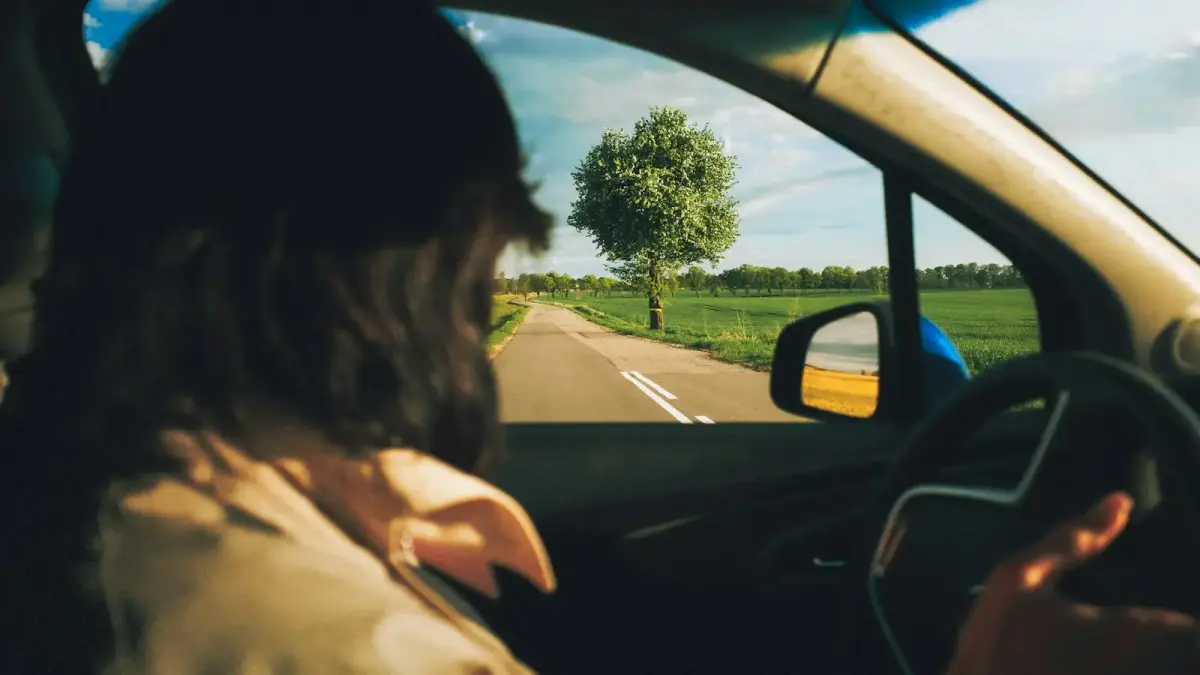
There is a particular kind of man who always drives in silence after a hard conversation - who turns the radio off, rolls the window down halfway, and takes the long way home - not because he is avoiding what he feels but because a boy who was never given permission to sit with sadness in the presence of another person learned that grief needs velocity, and the man at fifty-four who gets in his truck after a funeral and drives for two hours without a destination is not running from the loss but giving it the only room he was ever taught to offer - a moving vehicle, an open window, and the privacy of a road that asks no questions
The Truck in the Driveway That Never Stays Long
I watched my father do it for thirty years. The phone call would come - someone sick, someone gone, some conversation that left a mark - and within five minutes he would be reaching for his keys. Not rushing. Not panicking. Just moving toward the one place where his feelings had always been allowed to exist without apology.
The cab of a truck. An open highway. No witnesses.
He never announced it. Never said “I need to go for a drive.” He would just stand up from the kitchen table, put his coffee mug in the sink with a gentleness that didn’t match the size of his hands, and disappear into the garage. My mother would watch the taillights pull out of the driveway and she wouldn’t follow. She understood something about him that took me decades to learn for myself.
He wasn’t leaving us. He was going to the only room he knew how to cry in.
I am forty-seven years old and I do the same thing. After my divorce was finalized, I drove for three hours on a Tuesday afternoon. After my best friend’s diagnosis, I took a route through the hills that added forty minutes to a drive that should have been ten. After my son left for college and the house went quiet in a way I hadn’t expected, I sat in the driveway with the engine running for a long time before I finally backed out and just drove.
I am not unique in this. You know the man I’m describing. You may love him. You may be him.
The Boy Who Learned That Feelings Need an Exit Route
There is a geography to how boys learn emotion, and most of it is shaped by doors.
The door to his bedroom that he was sent behind when he started crying at nine. The door to the bathroom where he taught himself to get it together before anyone noticed. The door to the garage where his father disappeared when things got heavy. Every lesson pointed the same direction: whatever you’re feeling, feel it somewhere else. Feel it where no one has to watch.
A 2015 study published in Psychology of Men and Masculinities found that men who were discouraged from expressing vulnerable emotions in childhood developed what researchers called “motoric discharge” patterns - the tendency to process difficult feelings through physical movement rather than verbal expression. Running. Walking. Driving. The body learns to carry what the voice was never permitted to release.
This is not a deficit. This is an adaptation.
The boy doesn’t choose silence. Silence is chosen for him, over and over, until the wiring is permanent. And then one day he is a man in his fifties sitting in a truck outside a funeral home, and the engine is running, and the window is cracked, and the October air is coming through, and the tears are finally arriving because the road is the only therapist who never told him to use his words.
Why the Radio Goes Off
Pay attention to this detail, because it matters more than you think.
The man who drives to process grief doesn’t listen to music. He turns the radio off. He doesn’t want a soundtrack. He doesn’t want someone else’s words layered on top of what he is trying to feel.
The silence is not empty. The silence is the room.
Think about what that means. This is a person who has built an entire emotional architecture out of absence - the absence of other people, the absence of noise, the absence of expectation. He needs the sound of the road and the wind and the engine because those sounds don’t ask him to name what’s happening. They just let it happen.
Daniel Goleman wrote extensively about emotional processing styles, and one thing he identified is that some people need external stillness to access internal movement. The man in the truck has created the exact conditions his nervous system requires to feel safely. The forward motion regulates his body. The open window gives the sensation of breath and space. The privacy gives him permission.
He is not avoiding his feelings. He is building them a house in real time out of velocity and solitude, and it is the only blueprint he was ever given.
The Long Way Home
There is something sacred about the long way home, and every man who takes it knows this without being able to explain it.
The short route is ten minutes. The long route is forty. He takes the long route not because he’s dreading what’s waiting at home but because forty minutes is how long it takes for the feeling to move through him. He has learned this about himself the way you learn the weather in a place you’ve lived your whole life - not from study, but from a lifetime of paying quiet attention.
He knows that anger takes about twenty minutes. He knows that sadness takes longer. He knows that the particular ache of watching a parent age, of seeing someone he loves in a hospital bed, of hearing something break in a conversation that can’t be unbroken - that one takes the back roads, the ones that wind through the county where the streetlights stop and the sky opens up above the truck like it has room for whatever he’s carrying.
A 2019 study in Frontiers in Psychology examined what researchers called “mobile solitude” - the practice of using travel and transit as emotional regulation. They found that for individuals with restricted emotional expression patterns, movement through physical space provided a form of somatic processing that was neurologically similar to more traditional therapeutic practices. The body in motion processes what the body at rest was taught to suppress.
The long way home is not avoidance. It is a ritual. It is the closest thing to meditation that a man who was never taught to meditate has ever found.
What His Partner Sees and What Is Actually Happening
She watches him grab the keys and she thinks: he’s shutting me out. He’s going cold. He doesn’t want to deal with this. He doesn’t want to deal with me.
I understand why she thinks that. From the outside, the man who leaves after a hard conversation looks like a man who is choosing absence over presence. It looks like rejection. It looks like the door closing.
But here is what I want you to understand, because I have been that man and I have seen the look on her face and I have never known how to explain it until now.
He is not choosing to leave. He is choosing the only form of staying with himself that he knows how to do.
The conversation cracked something open. He felt it. He felt it in his chest and his jaw and the backs of his eyes. And every signal in his body said the same thing it has been saying since he was a boy of eight watching his father’s hands grip the steering wheel: you are not safe feeling this here. You are not safe being seen this soft. Go. Move. Find the road.
He doesn’t want to shut her out. He wants to come back whole. He wants to process what he’s feeling so that when he walks back through that door, he can be present again. The drive is not the opposite of intimacy. The drive is how he protects it.
The Grief That Needs Velocity
There is a physics to masculine grief, and it operates on different laws than what we are taught to expect.
We expect grief to be still. Sitting. Holding. Weeping into someone’s shoulder. And those are real and valid forms of mourning. But they are not the only forms, and they are not the ones that were available to every boy who grew up in a house where tenderness was treated as a foreign language.
Gabor Mate has written about how the body stores what the mind is told to forget. The man driving alone after a funeral is not intellectualizing his loss. He is letting his body do what it needs to do. The grip on the steering wheel is a form of holding. The speed is a form of release. The miles passing beneath him are a way of measuring something that otherwise has no shape - the distance between who he was when that person was alive and who he is now that they are gone.
I drove for two hours after my father died. I didn’t plan it. I just got in the truck and I drove until the crying stopped, and then I drove a little more until I could breathe evenly, and then I drove home. My wife was waiting on the porch. She didn’t ask where I had been. She just handed me a glass of water and sat next to me and said nothing.
That was the most loved I have ever felt. Because she understood that I hadn’t been running from grief. I had been running it through me like a river that needed somewhere to go.
The Permission He Never Received
Here is the truth that sits underneath all of it, quiet as a stone at the bottom of a creek.
He was never given permission to grieve in the presence of another person.
Not once. Not at eight, when his dog died and his father said “he had a good life, let’s not make a thing of it.” Not at fifteen, when his first heartbreak happened and his friends told him to get over it. Not at thirty, when his marriage was falling apart and every voice around him said “stay strong for the kids.” Not at fifty-four, sitting in a suit in a church pew, jaw clenched, eyes burning, holding perfectly still because the entire room seemed to be watching to see if he would break.
A 2022 study in the Journal of Research in Personality found that men who reported high levels of emotional suppression in childhood were significantly more likely to develop solitary processing rituals in adulthood. The researchers noted something that I think is both heartbreaking and beautiful: these rituals were not evidence of emotional absence. They were evidence of emotional ingenuity. The men had built their own rooms because no one had built rooms for them.
The truck. The highway. The open window. The silence.
These are not signs of a man who doesn’t feel. These are the architecture of a man who feels enormously and was told, a thousand times in a thousand ways, that he had to do it alone.
The Road That Asks No Questions
If you love this man - and many of you do - I want you to know something.
When he comes back, he is not the same person who left. Something moved through him out there on that road. Something he couldn’t have accessed across the kitchen table, no matter how safe you made the space, no matter how gently you asked. Not because you failed. But because the wiring goes deeper than any single conversation can reach.
He came back softer than he left, even if he doesn’t look it. He came back lighter, even if his face hasn’t changed. The drive did its work the way it always does - not by solving anything, but by giving the feeling room to exist without being managed or explained or fixed.
The road doesn’t ask him what’s wrong. The road doesn’t ask him to name it or rate it on a scale of one to ten. The road just lets him move through it at whatever speed the feeling requires, and when it’s done, the road brings him home.
That is not avoidance. That is one of the most honest forms of emotional processing I have ever witnessed.
And the man who does it - the man with the truck and the silence and the long way home - is not broken. He is a person who found a way to feel everything in a world that gave him permission to feel nothing.
That is not weakness. That is the quiet, private, road-worn shape of an enormous and tender strength.