Children who always drew maps of their neighborhood from memory - who sat at the kitchen table with crayons and mapped every house, every fence, every alley shortcut, who knew exactly how many steps from their front door to the bus stop and which sidewalk squares had cracks - often become adults who still carry mental maps of everywhere they have ever lived, because a child who drew her world from above was learning the only perspective from which it felt manageable
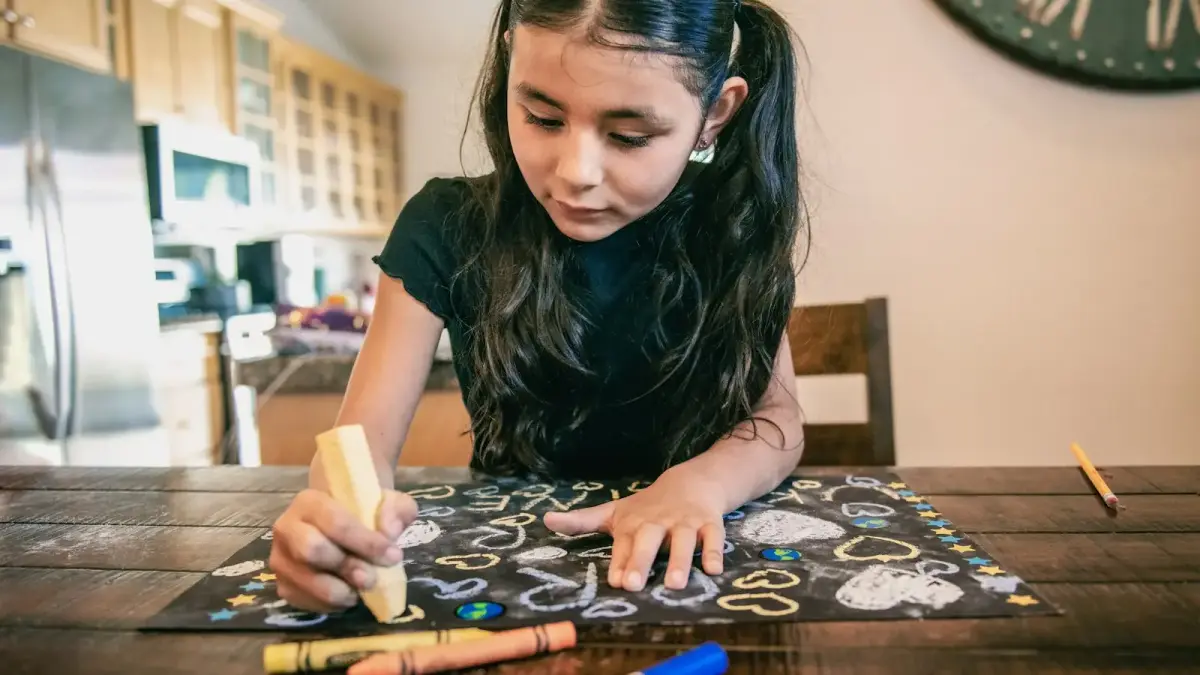
I was nine years old, lying on the carpet in my grandmother’s living room with a yellow legal pad, drawing a bird’s-eye view of our entire block. I labeled the Hendersons’ house with the chipped blue shutters. I drew the exact curve of Mrs. Kowalski’s driveway where it crumbled at the edge. I even marked the storm drain at the corner of Elm and Fourth where my brother once lost a tennis ball and we spent twenty minutes peering through the grate with a flashlight.
Nobody asked me to do this. There was no school assignment, no geography project due Monday.
I just needed to see my world from above. I needed the whole thing to fit on a single page - contained, bordered, knowable. And if you also spent childhood afternoons drawing maps nobody requested, sketching floor plans of houses you’d only visited once, or counting the steps between landmarks like it mattered - then you already know what I’m about to say.
That mapping impulse wasn’t a quirk. It was a strategy. And it probably never left you.
1. You can describe the layout of every house you’ve ever lived in with room-by-room precision
Ask most people to describe a house they lived in twenty years ago and they’ll give you broad strokes. A kitchen. A hallway. Maybe the color of the front door.
Ask you, and you’ll walk someone through every room like a realtor who just staged the place. The bathroom where the tile was cracked in the left corner. The closet in the second bedroom that had a weird step-up because it was built over the staircase. The way the kitchen light switch was behind the door, so you had to close it first to turn on the lights.
This isn’t a party trick. Psychologist Edward Tolman proposed the concept of “cognitive maps” back in the 1940s - internal spatial representations that animals and humans build to navigate their environments. For children who felt uncertain about their world, these maps weren’t casual. They were survival documents. You memorized the architecture of your life because knowing where everything was meant you could predict what would happen next.
2. You navigate by landmark and memory, not GPS - and feel vaguely distrustful of the blue dot
You know the way. You’ve always known the way. You navigate by the brick church on the corner, by the gas station that used to be a hardware store, by the hill where the road bends just before the overpass.
GPS feels like letting someone else hold the map, and something in you resists that. Not because you think technology is bad, but because your sense of direction is tied to something deeper than convenience. It’s tied to competence. To the feeling that you can orient yourself in the world without asking for help.
A 2020 study published in Nature Communications found that people who rely on spatial memory strategies for navigation show greater hippocampal gray matter volume compared to those who depend on GPS. Your brain literally built itself around the act of knowing where you are. That internal compass wasn’t a preference - it was architecture.
3. You always know which direction is north, even indoors
People find this strange about you. You’ll be inside a windowless conference room, or a basement restaurant, or a shopping mall with no exterior views, and you’ll still know which wall faces south. You track it without thinking. It runs in the background like software you never installed on purpose.
This is what happens when a child spends years calibrating herself against the physical world. You learned where the sun came through the kitchen window in the morning. You knew which side of the house got hot in the afternoon. Direction became something you carried in your body, not something you checked on a screen.
And when someone asks how you know, you can’t really explain it. It’s like asking how you know which hand is your left. You just do.
4. You can drive to a house you visited once, years ago, without directions
Someone mentions a dinner party from 2014. You haven’t been to that neighborhood since. But you can picture the route - the left turn past the elementary school, the street with the median full of crape myrtles, the driveway that sloped downhill so steeply you worried about your car.
This recall startles people. It sometimes startles you.
Research in environmental psychology calls this “place encoding” - the way certain minds automatically register and store the spatial details of every environment they enter. Roger Downs and David Stea, in their foundational work on cognitive mapping, described this as a process of encoding, storing, and decoding spatial information that becomes so automatic for some individuals it operates below conscious awareness. You don’t choose to remember these routes. Your brain catalogs them the way other people’s brains catalog song lyrics or phone numbers.
5. You notice immediately when something in your environment has changed - a new fence, a missing tree, a rearranged room
You walk into your friend’s living room and within thirty seconds you know the bookshelf has been moved. You drive down a street you haven’t visited in months and you clock that the oak tree on the corner is gone. Someone rearranges the break room at work and you feel it before you see it - something is different.
This hyperawareness of spatial change comes from the same place as the mapping. You built a detailed model of every environment you inhabited, and any deviation from that model registers as a signal. Not necessarily a dangerous signal. But a signal that the world has shifted without your input.
For a child who used spatial certainty as an anchor, noticing change isn’t casual observation. It’s monitoring. And the adult version of that child still runs the same background scan, even in perfectly safe environments.
6. You draw maps or floor plans to explain things to people, even when words would work fine
Someone asks where the restaurant is, and instead of saying “two blocks north, then a right,” you reach for a napkin and start sketching. Someone asks about your childhood home, and you don’t tell them about it - you draw it. Boxes and lines and little labels that turn a story into a diagram.
You think spatially. You always have.
This is how you process the world. Not in narratives first, but in layouts. The story of your childhood isn’t a sequence of events for you - it’s a floor plan. A map. A view from above where all the rooms and streets and shortcuts exist simultaneously rather than unfolding one memory at a time.
7. You feel disoriented and anxious in unfamiliar places in a way that goes beyond normal unfamiliarity
Here’s the part that doesn’t get talked about. The same spatial intelligence that lets you navigate your known world with such precision can make unfamiliar territory feel genuinely threatening.
A new city. A parking garage with no landmarks. A building where all the hallways look the same. These situations produce an anxiety in you that seems disproportionate. You’re not afraid something bad will happen. You just can’t orient. And for someone whose nervous system uses spatial certainty as a baseline for safety, losing your internal compass feels like losing solid ground.
A 2017 study published in the journal Cognition found that individuals with strong spatial encoding tendencies experienced measurably higher stress responses when placed in environments that disrupted their navigational strategies. Your discomfort in unfamiliar spaces isn’t irrational. It’s the natural consequence of a nervous system that equates knowing where you are with knowing that you’re okay.
8. You have an unusually detailed memory for physical spaces - but may struggle to remember conversations or dates
You can reconstruct the layout of your third-grade classroom from memory. You can describe the tile pattern in a hotel bathroom you used once in 2009. But ask what someone said to you last Tuesday and you draw a blank.
This isn’t a memory problem. It’s a memory priority. Your brain allocated its deepest encoding resources to spatial information because that’s what felt most essential when you were young. Places were stable. People were less predictable. Rooms didn’t change their minds. Hallways didn’t have moods.
So your memory became a museum of places rather than a library of conversations. And you might have spent years thinking something was wrong with you for remembering the exact dimensions of a laundry room but forgetting your anniversary. Nothing is wrong with you. Your memory is just organized around a different axis than most people’s.
9. You still dream about the geography of places you lived decades ago
The house you left when you were seven. The apartment your family stayed in for only a year. The street with the big hill and the bent stop sign. These places visit you at night with a spatial accuracy that borders on architectural.
You don’t just dream about things that happened in these places. You dream about the places themselves. The dimensions. The light. The way the back door stuck and you had to lift it slightly while you pulled. The creak on the fourth stair.
These aren’t nostalgia dreams. They’re your brain returning to the original maps - the first ones you ever drew, the ones that taught you the world could be known and contained and survived. Place attachment theory, studied extensively by environmental psychologists like Leila Scannell and Robert Gifford, suggests that the places we bond with most deeply become part of our identity architecture. For you, those bonds were forged in childhood, and they never dissolved. They just went underground, surfacing at night when your conscious mind stops managing the filing system.
If you read this and recognized yourself - the map-drawer, the direction-knower, the person who remembers rooms better than conversations and carries a detailed atlas of every home they’ve ever inhabited - I want you to know something.
That child at the kitchen table with the crayons wasn’t wasting time. She was doing something profoundly intelligent. She was taking a world that felt too large and too uncertain and rendering it at a scale she could hold in her hands.
And the adult you became - the one who still knows which direction is north, who can find any place she’s been before, who notices the second a painting gets moved - that adult is still carrying the gift that child gave herself.
You mapped the world because you needed it to make sense. And it worked. It still works. The maps never stopped being useful. And neither did you.