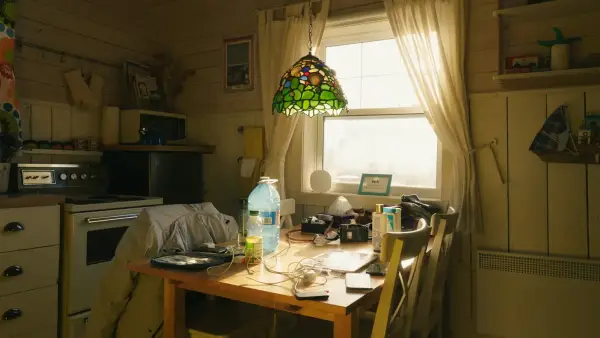
Children who grew up hearing 'we'll see' instead of a clear yes or no often become the adults who cannot fully relax into any plan, any promise, or any piece of good news until it has already happened, because their nervous system learned before the age of ten that hope was the specific thing most likely to be quietly retracted without explanation

My father had a phrase he used like a gate.
Not a locked gate. Worse. A gate that might be locked, or might swing open, and you wouldn’t know which until you’d already walked all the way up to it and put your hand on the latch. “We’ll see,” he’d say, without looking up from the newspaper. And the conversation was over - not because it had ended, but because it had entered a place where I couldn’t follow it.
I was seven years old the first time I realized that “we’ll see” was not a category of yes. It was a place to put my hope where it couldn’t bother anyone. A shelf too high for me to reach, where my wanting would sit until it was quietly forgotten by everyone except me.
I didn’t stop hoping. That would come later. What I did instead was something more subtle and more lasting - I learned to hope at a whisper. To want things sideways. To hold every future good thing at arm’s length, the way you’d hold something that might be taken from you, because in my house, it usually was.
Decades of studying developmental psychology have shown me that I was not unusual. Children who grew up hearing “we’ll see” instead of clear answers often develop a very specific relationship with the future - one marked not by pessimism exactly, but by an inability to rest inside any promise until the promise has already become a fact.
Here are eight patterns that tend to follow these children straight into adulthood.
1. They cannot enjoy the anticipation phase of anything good
Most people feel a lift when something good is on the horizon. A trip booked for next month. A dinner reservation on Friday. A text from someone they like saying “I’ll call you tonight.”
But for the child who grew up with “we’ll see,” the anticipation phase is not where joy lives. It’s where danger lives. That gap between “this might happen” and “this is happening” was the exact space where disappointment was born in their childhood, and their nervous system never unlearned the association.
A 2020 study published in Psychological Science examined what researchers called “anticipatory anxiety in ambiguity-exposed populations” and found that adults who reported high levels of childhood unpredictability showed measurably elevated cortisol during waiting periods - even when the outcome they were waiting for was positive. Their bodies were not responding to the content of the news. They were responding to the structure of not-knowing.
So you’ll see this adult book the concert tickets but feel nothing until they’re sitting in the seat. They’ll get the job offer but not believe it until the first paycheck deposits. They won’t celebrate the engagement until after the wedding, and even then, something in them keeps one eye on the door.
They’re not ungrateful. They’re completing a loop their childhood started - one where the only safe moment is the moment after the thing has already happened and can no longer be taken away.
2. They read “should” and “maybe” and “probably” as soft versions of no
Language became a minefield early for these children.
“We should do that sometime.” “Maybe next weekend.” “That sounds like it could work.” To most ears, these are casual, friendly, loosely positive. To the ear of someone who grew up decoding “we’ll see,” these phrases carry a specific weight. They are the sound of nothing happening dressed in the clothes of something happening.
The problem isn’t cynicism. The problem is accuracy. Because in their original household, every soft word was a soft no. “Maybe” meant “I don’t want to say no right now, but I’m not going to say yes later either.” And the child learned, with devastating precision, to hear the real answer inside the polite one.
In adult relationships, this becomes the friend who doesn’t respond to vague invitations. The partner who needs you to say “I will be there at six” instead of “I’ll try to swing by.” The person who hears “let’s get together soon” and files it under fiction, because their childhood taught them that the more pleasant a non-answer sounds, the less it means.
3. They have an extraordinarily difficult time trusting good news
Here is something I’ve noticed in my research that doesn’t get discussed enough - the “we’ll see” child doesn’t just struggle with uncertainty. They struggle specifically with positive uncertainty.
Bad news, they can handle. Bad news is stable. When someone says “no,” the ground holds. It’s the “maybe yes” that sends their system into overdrive, because “maybe yes” was the exact frequency at which their childhood disappointments broadcast.
A 2018 study published in the Journal of Research in Personality found that individuals with high ambiguity intolerance - often rooted in early caregiving environments where outcomes were inconsistent - showed paradoxically higher physiological stress responses to uncertain positive stimuli than to certain negative stimuli. In plain terms, they were calmer receiving bad news than they were hovering in the possibility of good news.
Think about what that means for a life. It means the promotion possibility is more stressful than the rejection letter. The “I think I love you” is harder to sit with than the breakup. The body has learned that good things in transit are the most dangerous category of experience, because those were the ones that got cancelled without warning in the kitchen on a Tuesday afternoon while a parent folded laundry and didn’t look up.
4. They make backup plans for their backup plans
You know this person. You might be this person.
They don’t just have a plan B. They have a plan C, D, and a general emotional exit strategy that they’ve rehearsed so thoroughly it could run without their conscious participation. They’re not anxious in the clinical sense. They’re prepared in the way that only someone who was repeatedly unprepared - by someone else’s choices - learns to be.
The backup plan isn’t about the event. It’s about the feeling. They are pre-building the emotional scaffolding they’ll need when the thing falls through, because their childhood offered no scaffolding at all. When “we’ll see” turned to “not today,” there was no comfort. No explanation. No acknowledgment that something had been lost. Just silence where anticipation used to be.
So the adult version of this child walks through the world holding two realities at once - the one where the good thing happens, and the one where it doesn’t. And they invest more emotional energy in the second one, because that’s the one they have experience surviving.
5. They feel guilty for wanting specific things
This one runs deeper than most people realize.
The “we’ll see” child didn’t just learn that outcomes were unreliable. They learned something worse - that their wanting was an inconvenience. That the act of asking for something specific, of naming a desire out loud, was the thing that created the problem. Not the parent’s unwillingness. Not the broken promise. The child’s audacity in hoping.
Gabor Mate has written extensively about how children in emotionally inconsistent environments learn to suppress their authentic needs in order to maintain attachment - a process he describes as trading authenticity for connection. The child doesn’t decide to stop wanting. The child’s system makes the calculation automatically: wanting things out loud leads to disappointment, and disappointment threatens the relationship, so wanting must be the variable to eliminate.
In adulthood, this looks like the person who says “I’m fine with anything” when asked what they want for their birthday. Who says “you don’t have to” before anyone has offered. Who feels a flush of something close to shame when they catch themselves wanting a specific outcome - a window seat, a particular restaurant, a call at a certain time - because specificity was the thing that made disappointment personal instead of abstract.
6. They are the calmest person in a crisis and the most unsettled in peace
This is the pattern that confuses the people who love them.
When everything is falling apart - the flight is cancelled, the plan has collapsed, the news is bad - they are steady. Grounded, even. They know this terrain. They grew up in this terrain. Disappointment is their mother tongue, and navigating it requires no translation.
But give them a stretch of stability. A month where nothing goes wrong. A relationship where the other person just keeps showing up, doing what they said they’d do, being where they said they’d be. And watch the anxiety start to hum. Because this is the part their childhood never taught them. The calm before the storm was never just calm in their house. It was the storm loading.
A 2021 study published in Frontiers in Psychology explored what researchers termed “stability anxiety” in adults with inconsistent early attachment experiences. Participants who reported unpredictable caregiving environments showed increased amygdala activation not during stress, but during sustained periods of safety. Their brains were scanning for the threat that always came after the quiet. The nervous system had learned that peace was the preamble to something being retracted, and it refused to put down its guard simply because nothing bad was currently happening.
7. They commit to things at the last possible moment
They don’t RSVP early. They buy the plane ticket the week of. They say “I’ll let you know” and hear themselves echoing the exact phrase that haunted their childhood, and they still can’t stop.
This isn’t flakiness. This is a nervous system that learned the cost of committing early. To commit early was to care visibly. To care visibly was to be vulnerable. And to be vulnerable in a “we’ll see” household was to hand someone the exact measurement of how much they could hurt you when they changed their mind.
So the adult version delays. Not because they don’t want to go. Often, they desperately want to go. But wanting and committing are two different acts in their internal economy, and the second one carries a tax the first one doesn’t. Committing means admitting you care. And admitting you care, in the house they grew up in, was the first step in a sequence that ended with you sitting on your bed at seven o’clock on a Saturday evening, still in the outfit you’d picked out for the thing that wasn’t going to happen.
Susan Cain has written about how many quiet, inward-turning tendencies that get labeled as personality traits are actually adaptations to early environments that demanded emotional self-management before the child had the tools for it. The late committer isn’t indecisive. They’re protecting something they learned was fragile - the part of them that still dares to look forward to things.
8. They struggle to say a clean, unconditional yes
Perhaps this is the most quietly devastating consequence of all.
Ask them if they want to go. They’ll say “I could probably make that work.” Ask them if they’re happy. They’ll say “things are good right now.” Ask them if they love you. They’ll say “you know I do” - warmly, genuinely, but with that tiny qualifier hovering somewhere in the sentence structure, some refusal to make a statement that doesn’t leave room for the ground to shift.
They don’t say “yes” the way people who grew up with clean answers say yes. They say yes like someone signing a contract they expect to be amended. There is always a conditional clause, even if it’s silent. Even if it lives only in the body, in the way their shoulders stay a fraction of an inch from fully relaxing, as if full relaxation would be the thing that finally invites the retraction.
Because that’s what “we’ll see” taught them. Not that the answer was no. That would have been survivable. What “we’ll see” taught them was that the answer existed in a state between yes and no - and that they were not important enough to be told which one it was.
If you recognized yourself in any of this, I want to say something clearly.
The way you hold the future at arm’s length is not a personality flaw. It is not pessimism, and it is not ingratitude. It is the shape your nervous system took when it was small and soft and learning how the world worked, and the world it was learning from could not give it a straight answer.
You adapted. You learned to scan for the retraction before it arrived. You learned to hedge your hope, to qualify your joy, to build exits into everything so the fall would never be as far as it was when you were seven and still willing to tape a countdown to your wall.
That adaptation kept you safe once. But you are no longer standing in front of someone who holds the gate.
You can say yes now - not “maybe,” not “we’ll see,” not “I could probably make that work.” Just yes. Clear and full and without a contingency plan folded up in your back pocket.
The good thing heading your way is allowed to just be good. You are allowed to stand in the space between the promise and the delivery and feel something other than dread. It might feel unfamiliar. It might feel like the most reckless thing you’ve ever done.
But the thing about being an adult who was once a child waiting for the answer - you already know how to wait. You’ve been doing it your whole life. The only new part is letting yourself believe that this time, the answer might be yes, and that believing it won’t be the thing that breaks you.