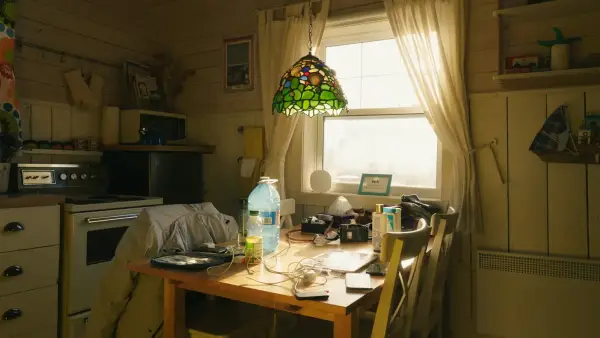
Children who learned to do the dinner dishes the moment an argument started in the kitchen often become adults who cannot sit still when someone in the room is upset, because productivity was the first language they ever spoke for diffusing a fight and no one ever taught them that presence was sometimes the more useful thing to offer

My partner was crying at the kitchen table last spring, and I was already halfway to the sink with two mugs before I realized what I was doing.
He hadn’t asked me to get up. He had, in fact, been mid-sentence. But some older reflex in me had clocked the thickness in his throat and decided the kindest thing I could offer was a clean counter and the sound of running water. I washed those mugs while he tried to tell me he was scared about his mother’s surgery, and when I turned around, his face had closed.
“Why do you always leave when I’m upset?” he said.
I hadn’t left. I had been three feet from him the whole time. But I understood what he meant, because I had felt it too, the way my body had drifted away from the conversation the moment it got heavy. I had physically stayed in the room. The rest of me had gone to find a task.
That is the thing I want to talk about.
The kitchen that taught us
For a lot of us, it started in a kitchen. Not always ours, but often. Kitchens are where families argue because they are where families are tired, and hungry, and close together, and already handling knives.
If you are the kind of adult who cannot watch someone cry without finding something to do with your hands, there is a good chance there was a small version of you who once stood at a sink, up on tiptoe, running warm water over a plate while two adults said things to each other you were not supposed to be hearing. Maybe you stacked the plates very carefully. Maybe you made yourself quiet in a particular way, the way a deer becomes quiet. You were not doing the dishes because you wanted clean dishes. You were doing them because something in the room needed to change, and you were the only one small enough to try.
And sometimes it worked.
Sometimes one of them would look over and soften. Sometimes the fight would pause because the presence of a helpful child is its own kind of interruption. Sometimes you just became invisible enough not to get pulled in, which at seven years old can feel like winning.
That was the first language you ever learned for diffusing conflict. Not words. Not repair. Tasks.
What “parentification” actually means
In developmental psychology, there is a concept called parentification, which sounds like jargon until you realize how many of us are walking around with it. The term was developed by the family therapist Salvador Minuchin in the 1960s and expanded by researchers like Gregory Jurkovic, who described two main forms: instrumental parentification, where a child takes on physical labor and household responsibilities beyond their years, and emotional parentification, where a child manages the emotional temperature of the adults around them.
Most of us who grew up this way were doing both at once.
A 2020 meta-analysis published in the Journal of Child and Family Studies found that children who took on heavy caregiving roles in their families of origin were significantly more likely as adults to show what researchers called “compulsive caregiving patterns” in close relationships. Translated out of academic language, this means we grew up to be the people who cannot let a hard moment pass without trying to fix it, tidy it, or feed it.
The children were not wrong to do this. They were, in fact, doing something extraordinarily intelligent. They read the room, identified a risk, and deployed the only intervention available to a person their size. They chose usefulness.
The problem is that no one ever came back to tell them they could stop.
The grown body that still won’t sit
If you recognize yourself in this, you probably know the physical sensation I am describing. It is not a thought. It is a current.
Someone you love says something that lands heavy, and your legs feel it first. There is a sudden urgency in your calves, an instruction to stand. Your eyes start scanning for a glass that needs refilling, a cushion that needs straightening, a plate that needs carrying. Your mouth may already be saying, “Let me just grab you some water.”
What you are experiencing, neurologically, is an affect regulation strategy. The psychiatrist Dan Siegel has written extensively about how the body stores emotional patterns from childhood, and how what feels like an adult preference is often a much older nervous system doing what it learned to do when it was four feet tall. In Siegel’s framework, your body is not betraying you when it stands up during a hard conversation. It is protecting you, using the exact protocol it developed in a kitchen thirty years ago.
The problem is that the protocol is out of date.
The person in front of you is not your tired mother. The argument is not about to escalate into something you cannot handle. You are not seven. You are allowed to stay.
But the body does not know that yet, because no one ever taught it the new thing.
What this costs the people who love you
Here is the part that I think is the hardest to sit with, and I am saying it gently because I have had to sit with it myself.
The people closest to you sometimes do not feel close to you. Not because you do not love them. You love them ferociously. You love them by making soup when they are sick and remembering their sister’s birthday and noticing when the light bulb in the hallway burns out. You love them through a thousand small acts of competence.
But sometimes they wanted something else. Sometimes they wanted you to just be there, eyes on them, hands still, while they said the scary thing. And you, without meaning to, offered them a clean counter instead.
A partner who is grieving does not need their water glass refilled. They need a witness.
A teenage daughter who is sobbing about her friend group does not need you to start researching therapists on your phone while she talks. She needs your face.
An aging parent who is frightened about a diagnosis does not need the laundry folded. They need you in the chair across from them, not flinching.
Presence is the thing the child version of you never got to see modeled, which is why it feels so much like nothing. In your family of origin, being still while someone was upset was the posture of the person who did not care, or the person who was about to explode, or the person who was checked out. You did not see presence done well. You saw absence, or volatility, or usefulness. And you picked the one that kept you safest.
Now the adults who love you are asking you for a thing you have never seen anyone do. No wonder you keep reaching for the dishes.
The research on stillness as a skill
The trauma researcher Bessel van der Kolk has written about how survivors of chronic childhood stress often struggle with what he calls “interoceptive awareness,” the ability to stay connected to one’s own body during emotional intensity. When everything inside you is surging, the fastest way to discharge that surge is to move. To do. To act. Stillness, for a nervous system trained on vigilance, can feel almost unbearable, because stillness is when you actually have to feel what is happening.
A 2019 study in the journal Attachment and Human Development examined adults who had been identified as “parentified” in childhood and found that many of them scored high on measures of empathy and low on measures of “self-focused emotional awareness.” In plain English, these adults were extraordinarily attuned to what other people were feeling and almost entirely cut off from what they themselves were feeling in the same moment.
This is what the dishes were always about, underneath.
Running water drowns out the inside of you. A task gives your hands something to do so your chest does not have to notice it is tight. When you stood up and walked to the sink during your partner’s hard sentence, you were not abandoning him. You were abandoning yourself first, and he was just the collateral.
Gabor Mate has talked about how many of our most entrenched adult behaviors are, at root, the brilliant survival strategies of a younger self who had no better options. The child who learned to clean during conflict was not being avoidant. That child was managing a system far too big for them with the only tools they had. That child deserves enormous tenderness, not a diagnosis.
Relearning presence, slowly
I am not going to tell you to stop doing the dishes. I tried that, and it did not work, because the urge is not the problem. The urge is a nervous system doing its job. Telling it to sit down is like telling a smoke alarm to be quiet while something is actually burning. It will not listen, because it was built not to.
What has helped me, and the clients I have thought about while writing this, is something much smaller.
When the urge comes, I try to notice it. Just that. I name it to myself. “Oh, there is the sink feeling.” I do not always resist it. Sometimes I let myself get up and pour the water, because the body needs a ramp, not a wall. But I come back. I sit back down. I put my hand on my partner’s knee. I say, “Keep going. I am here.”
The first fifty times I did this, it felt like nothing. It felt like I was offering him a blank stare instead of my competence. It felt like I was failing him.
He told me, months in, that it was the first time in our relationship he had felt truly met.
Presence, it turns out, is not doing nothing. It is a far more advanced skill than productivity, and it is the one the child version of you was never given a chance to learn. You were busy keeping everyone alive.
The adult version of you is allowed to put down the plate. Not because the plate does not matter. It does. Someone in your kitchen loved you, and you loved them back the only way a child knows how.
But you are not a child anymore, and the person in the room with you is not asking for clean dishes. They are asking for you. And the astonishing thing, the thing I want you to hear me say clearly, is that you are enough. Just you, in the chair, with your hands still, looking at them.
You always were.