Children who watched their mother sit in the parked car for a few extra minutes before coming inside - who saw her tilt the rearview mirror, press her fingers under her eyes, take one last breath before opening the door with a smile that was already in place - often become adults who can detect the seam in every smile they encounter, the exact point where the real feeling ends and the performance begins, because they learned before they had language for it that the truest version of a person was the one the room was never meant to see
I was seven the first time I noticed it.
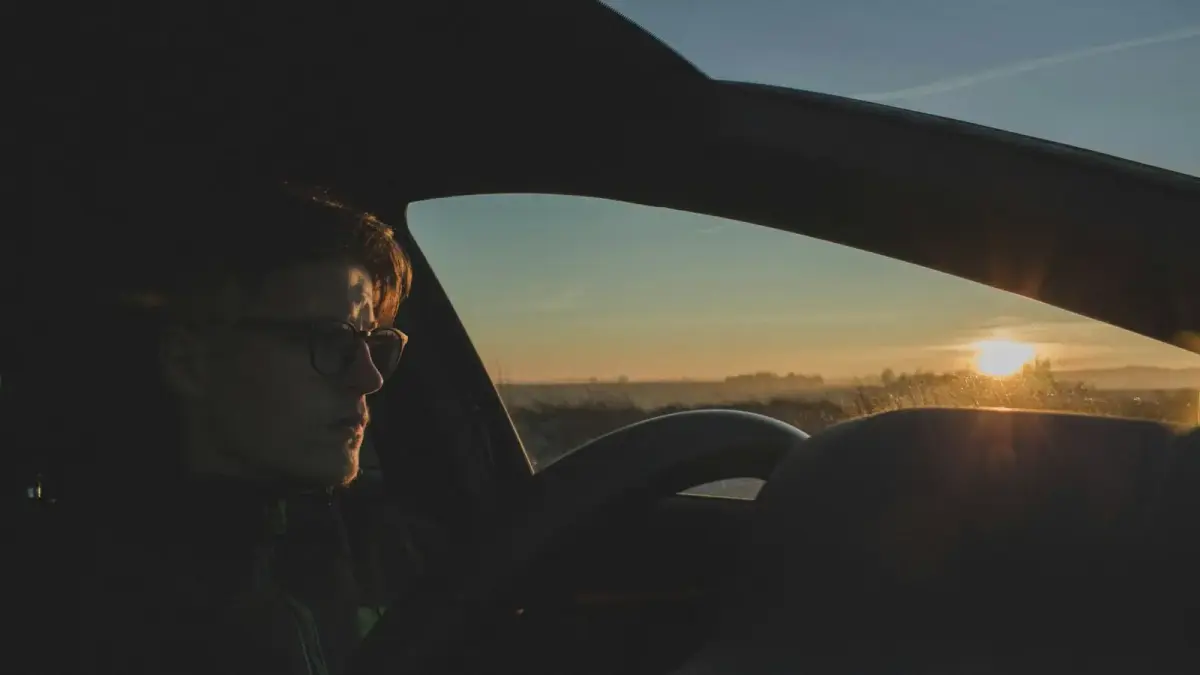
My mother had been gone for an hour - just errands, she said - and I was sitting on the front steps when she pulled into the driveway. The engine went quiet. But she didn’t get out. She sat there for what felt like a long time, though it was probably only two or three minutes. I watched her tilt the rearview mirror toward her face. I saw her press the pads of her fingers just below her eyes, the way you do when you’re trying to push something back in.
Then she smiled. Not at me. Not at anything. She smiled at the mirror, like she was rehearsing.
By the time she opened the car door, the smile was warm and easy and fully in place. She asked me if I wanted to help with the groceries. I said yes. I didn’t mention what I’d seen. I didn’t have words for it yet. But something had shifted in me - a small, permanent recalibration.
I had learned, without anyone teaching me, that the person who walks through the door is not always the person who was sitting in the car.
The lesson no one meant to teach
Most of the things that shape us deepest aren’t taught on purpose. No parent sits a child down and says, “Let me show you how to read the invisible.” But children who witnessed those quiet car moments - the pause before the performance, the face that existed before the face that was meant for the room - received an education in human emotion that most people never get.
It wasn’t abuse. It wasn’t neglect. In most cases, it was love. It was a mother or father trying to protect the household from whatever had happened out there in the world. It was a parent deciding, in the space of a few breaths, that their pain was not the family’s burden to carry.
But the child saw it anyway.
And what the child learned was this: there is a version of the people you love that they will never willingly show you. The real version lives in the car, in the bathroom with the faucet running, in the hallway just before they round the corner into the kitchen.
A 2019 study published in Developmental Psychology found that children as young as four can detect emotional incongruence in adults - the mismatch between what a face is doing and what the voice or body is saying. But children who are regularly exposed to these mismatches don’t just detect them. They become specialists. They build internal models of emotional performance that are more sophisticated than most adults ever develop.
They become the people who can feel the weather change in a room before anyone else notices the clouds.
What it looks like in adulthood
If you grew up watching someone compose themselves, you already know what I’m about to describe. You’ve been doing it your whole life without a name for it.
You walk into a party and within thirty seconds, you know who’s actually happy to be there and who arrived mid-argument and is now pretending everything is fine. You can tell by the timing of their laughter - a half-beat too late - or by the way their hand rests on their partner’s back with just slightly too much deliberateness, like they’re performing a closeness they don’t currently feel.
You notice when your friend says “I’m fine” but her exhale comes a fraction of a second before the words, as if the breath needed to make room for the lie.
You catch the micro-expressions that flicker across someone’s face in the moment before they realize you’re watching. The real feeling - the flash of grief, irritation, exhaustion - that gets smoothed over so quickly most people would never register it happened.
Dr. Paul Ekman’s research on micro-expressions showed that the ability to detect these fleeting emotional signals varies enormously across the population. Some people are what he called “natural lie detectors” - individuals who can read involuntary facial movements with unusual accuracy. What his research didn’t fully explore is where that ability comes from. But if you grew up watching someone rehearse their smile in a rearview mirror, you probably don’t need a study to tell you.
You learned to read the rough draft of a face because you saw one every day before the final version was presented to the room.
The exhaustion of seeing too much
Here is the part that nobody talks about.
This ability - this finely tuned perception - is not a superpower. Or if it is, it’s the kind that comes with a cost that doesn’t show up on the label.
When you can detect the seam in every smile, you start to wonder if any smile is real. When you can feel the tension beneath someone’s cheerful greeting, you begin to distrust cheerfulness itself. Not consciously. Not dramatically. But there is a low hum of vigilance that never fully goes away.
You become the person who is always scanning. At dinner, you’re half-listening to the conversation and half-reading the room - who’s uncomfortable, who’s performing, who needs to leave but won’t say so. At work, you pick up on the undercurrents in every meeting: the resentment disguised as agreement, the fear dressed up as enthusiasm.
A 2021 study in Frontiers in Psychology found that individuals with heightened emotional perception often experience what researchers call “empathic overload” - a state in which the constant processing of others’ emotional states leads to chronic fatigue, difficulty setting boundaries, and a persistent feeling of being responsible for the emotional temperature of every room they enter.
This is what it means to have been trained, from childhood, to monitor the gap between what people show and what people feel.
You don’t just notice. You absorb. And over time, the weight of carrying everyone else’s hidden truth becomes its own quiet form of exhaustion.
The trust problem nobody names
There’s another consequence that runs even deeper.
When you grow up watching someone you love perform “okay,” you develop a complicated relationship with trust. Not the obvious kind - you’re not suspicious of people’s intentions. You’re suspicious of their surfaces.
Someone tells you they love you and you believe them. But you also scan for what they’re not saying. You hear the words and simultaneously listen to the silence around them, checking for the parts that were edited out.
A friend says she’s doing great and you nod and smile and part of you - the part that sat on those front steps - is already cataloguing the evidence. The slight tightness around her eyes. The way she changed the subject a beat too fast. The laugh that didn’t quite reach her whole face.
You’re not paranoid. You’re not cynical. You’re thorough. You were taught to be thorough by someone who never meant to teach you anything except that the groceries were in the car and dinner would be ready soon.
The cruelest irony is this: the very people who are best at reading others are often the worst at letting themselves be read. Because if you learned early that real feelings are something you handle alone in the car before you walk inside, then you probably learned to do the same thing yourself.
You compose your face. You rehearse your answers. You walk into rooms with your smile already in place.
And somewhere, someone who loves you is watching, and learning.
What the research says about emotional inheritance
Psychologist Susan Cain has written extensively about the quiet forms of emotional intelligence that often go unrecognized - the kinds of perception that don’t show up as charisma or social dominance but as a deep, almost unsettling awareness of what’s happening beneath the surface of human interaction.
What she describes maps closely onto what developmental psychologists call “earned emotional literacy.” This isn’t the kind you get from reading books about body language or taking courses in emotional intelligence. It’s the kind you earn by watching, day after day, the distance between who someone is and who they present themselves to be.
A 2017 study published in the Journal of Personality and Social Psychology examined adults who reported growing up with a parent who regularly masked emotional distress. The researchers found that these adults scored significantly higher on measures of emotional perception and empathic accuracy. They were better at reading strangers. Better at detecting deception. Better at sensing emotional shifts in group settings.
They were also more likely to report feeling emotionally depleted, having difficulty accepting reassurance at face value, and struggling with what the researchers described as “relational hypervigilance” - the inability to stop monitoring.
The gift and the wound live in the same place. That’s what makes this so hard to talk about.
The reframe you deserve
If you recognize yourself in any of this, I want to be careful with what I say next. Because the last thing you need is someone telling you that your pain was actually a gift. You’ve heard that before. It felt hollow then and it would feel hollow now.
So let me say something different.
What you have is not cynicism. It’s not distrust. It’s not a disorder or a dysfunction or something that needs to be fixed.
What you have is a form of emotional literacy that was learned at a cost most people cannot imagine. You paid for it with a childhood spent watching instead of playing, reading rooms instead of relaxing in them, carrying knowledge that no child should have to carry alone.
And the thing you learned - that people are more complicated than what they show, that love sometimes looks like a woman pressing her fingers under her eyes in a parked car so her children don’t have to see her cry - that thing is true. It was always true. You didn’t invent it. You just saw it earlier than most.
The work now isn’t to unsee it. You can’t. The work is to let that perception be information rather than obligation. To notice without absorbing. To see the seam in someone’s smile and choose, sometimes, to let them have their performance without rushing in to fix what’s underneath.
You learned to read the room before you learned to read a book. That’s not something to be ashamed of.
It’s something to be gentle with.
What the woman in the car would want you to know
I think about my mother in that driveway sometimes. I’m older now than she was then. I understand things I couldn’t understand at seven.
She wasn’t hiding from me. She was trying to arrive as the version of herself she thought I needed. She was doing what millions of parents do - absorbing the impact so it didn’t reach the people she loved most.
She didn’t know I was watching. She didn’t know that her quiet moment of private composure was becoming the template for how I would read every human being I’d ever meet.
If she could see me now - the way I notice things, the way I carry things, the way I sometimes sit in my own car for a few extra minutes before walking inside - I think she would feel a complicated mix of pride and sorrow.
And I think she would say: you were never supposed to see that, sweetheart. But I’m not sorry you did. Because you learned something real. You learned that people are doing their best, and their best sometimes includes a performance, and the performance is not a lie. It’s a form of love that doesn’t know how else to protect the people it would die for.
You saw the truest version of someone before the room was ready for it.
That’s not a burden. That’s a kind of knowing that most people spend their whole lives pretending doesn’t exist.
And you’ve had it since you were seven years old, sitting on the front steps, watching the car.