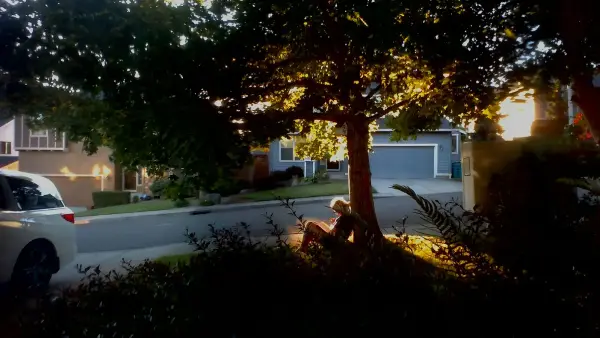
There is a kind of conversation that only happens between two old friends sitting on a porch in the last hour of daylight, where the sentences get shorter and the pauses get longer and neither person feels the need to fill the silence, and the thing they are doing together has no name because the generation that perfected it never needed one
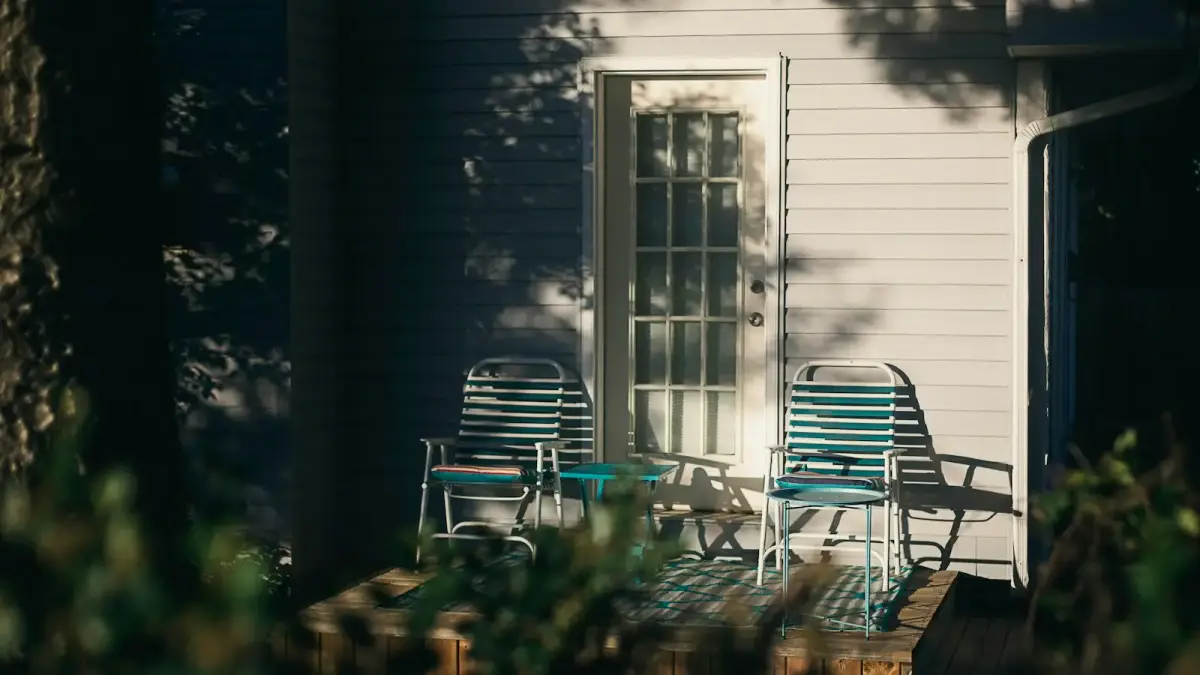
Last Thursday I sat on my friend Dale’s porch for close to two hours. We had maybe nine exchanges the entire time. One of them was about whether the neighbor’s dog had gotten bigger or just fluffier. Another was about a truck neither of us recognized parked down the block. The rest were fragments - half-sentences that trailed off not because we lost the thought but because the thought didn’t need finishing.
The sun dropped behind the tree line and turned everything that copper color it only gets in April. Dale said something about the light. I nodded. He didn’t elaborate. I didn’t ask him to.
When I got in my car to drive home, I felt more settled than I had in weeks. Not because anything had been resolved or discussed or processed. Nothing had been worked through. Nothing had been named. I had simply been sitting next to someone who has known me for thirty-four years, watching the same sky go dark, and that was enough. That was more than enough.
The anatomy of a porch conversation
There is a specific kind of social interaction that doesn’t follow any of the rules we’ve been taught about connection. It has no agenda. There is no catching up, no exchanging of news, no emotional labor being performed in either direction. Nobody is listening actively. Nobody is holding space. Nobody is being vulnerable on purpose.
A porch conversation between old friends operates on an entirely different frequency.
The sentences are observations, not disclosures. “Wind’s picking up.” “Yeah.” “Saw a hawk earlier.” The content is almost irrelevant. What matters is the rhythm - the fact that two people can sit in the same physical space and let minutes pass without either one reaching for a topic. Without either one performing interest or engagement or warmth.
This is not small talk. Small talk is what you do with people you don’t know well enough to be quiet around. This is the opposite. This is what happens when you know someone so thoroughly that language becomes optional. The silence between you isn’t empty. It’s full of forty years of context - every argument you survived, every loss you sat through together, every stupid joke that still makes one of you snort unexpectedly at a funeral.
I have had hundreds of these evenings. With Dale. With my friend Ray, who died three years ago. With my brother, on his back deck in Missouri, watching his grandkids run circles in the yard while we said almost nothing for an hour. The quality of those silences was different every time. But the structure was always the same: two people, facing the same direction, letting the world do the talking.
You cannot shortcut this
Here is what younger people sometimes don’t understand about this kind of companionship. You cannot manufacture it. You cannot accelerate it. There is no vulnerability exercise or trust-building workshop that produces the kind of silence Dale and I share on that porch.
It takes decades.
It takes showing up at the hospital when someone’s wife is in surgery and sitting in the waiting room without saying anything useful. It takes driving forty minutes to help someone move a couch and then staying for a beer you didn’t particularly want. It takes being wrong in an argument and coming back the next week anyway. It takes a hundred ordinary Saturdays where nothing memorable happens, stacked on top of each other until the sheer weight of them becomes the friendship itself.
A 2020 study published in the Journal of Social and Personal Relationships found that it takes roughly 200 hours of shared time to develop a close friendship - but the researchers noted that the quality of that time matters far less than its consistency. It is not the deep conversations that build trust. It is the accumulated hours of low-stakes proximity. The being there. The keeping on being there.
Dale and I don’t talk about our feelings. We never have. I couldn’t tell you his attachment style or his love language. But I can tell you that when my mother died, he showed up at my house with a bag of groceries, put them in the fridge without asking, sat on my porch for an hour, and left. He didn’t say he was sorry. He didn’t ask how I was doing. He already knew how I was doing. His presence was the sentence, and it said everything.
That kind of knowing doesn’t come from a single act of courage. It comes from a thousand acts of consistency.
What science now calls what they were already doing
Researchers have a term for what happens when two people sit together in calm, sustained proximity. They call it co-regulation - the process by which one nervous system helps stabilize another through physical presence, shared rhythm, and nonverbal attunement. A 2018 study in Psychological Science demonstrated that simply being near a trusted person can lower cortisol levels, reduce heart rate variability, and shift the nervous system from a state of vigilance to a state of rest.
Dale and I are co-regulating on that porch. Our breathing slows to match. Our shoulders drop at roughly the same time. The long pauses between sentences aren’t awkward because our bodies have already agreed on a tempo, and our words are just following along.
This is also what developmental psychologists describe as secure attachment between adults - the ability to exist in someone’s presence without monitoring, managing, or performing. Dr. Sue Johnson, who pioneered Emotionally Focused Therapy, has written extensively about how the deepest bonds are characterized not by dramatic expressions of love but by what she calls “quiet availability.” The sense that someone is simply there, reliably, without conditions.
The porch conversation is quiet availability made physical. Two chairs, angled slightly toward each other but mostly facing out. Two people who have earned the right to say nothing together.
What strikes me is that none of this required a vocabulary. Dale has never heard the term co-regulation. He would probably laugh if I explained it. But he has been practicing it with me since we were in our thirties - sitting on various porches, in various states of silence, through various versions of our lives. He didn’t need a framework. He just needed a chair and an evening and the willingness to keep showing up.
The generation that never named it
There is a generation of men and women - my father’s generation, and to some degree my own - who practiced a form of companionship so natural and instinctive that it never occurred to them to analyze it. They sat with people. They were present with people. They let silence exist between themselves and the people they loved, and they did not interpret that silence as a failure of communication.
They called it “sitting with someone.” Or they didn’t call it anything. They just did it.
Now we have words for all of it. Mindfulness. Holding space. Emotional attunement. Co-regulation. Nervous system safety. These are useful words. I am not dismissing them. But there is something almost comic about watching a generation of people pay $200 an hour to learn skills that their grandparents performed every evening on the front porch without a single therapeutic framework to guide them.
My father and his best friend, Lou, used to sit on our porch every Sunday after dinner. My mother would bring out coffee. They would drink it. They would watch the street. Occasionally one of them would comment on something - a car, a cloud, a kid on a bike. That was it. That was their practice.
They were not meditating. They were not being intentional about their friendship. They were not investing in their emotional health. They were just two men who had known each other since Korea, sitting in the same place they always sat, letting the day end the way it was supposed to end - slowly, together, without anyone trying to make it mean something.
It already meant something. It meant everything. And the fact that they never said so is not a limitation of their emotional vocabulary. It is proof of how deeply they understood what they had.
The light changes and you let it
I want to tell you about a specific moment because I think it captures something I can’t say directly.
Last fall, Dale and I were on his porch and the sky did that thing it does in October where the whole horizon turns the color of a bruise - purple and orange and something close to gold. We both looked at it. Neither of us said anything for maybe five minutes.
Then Dale said, “Well.”
And I said, “Yeah.”
And that was the entire conversation about the most beautiful sky either of us had seen in months.
A 2019 study in the Journal of Personality and Social Psychology found that experiences of awe - encounters with beauty or vastness that exceed our normal frames of reference - are processed more deeply when shared with a close other, even in the absence of verbal exchange. The researchers suggested that shared awe strengthens social bonds not through discussion but through synchronized emotional response. You don’t need to talk about what you’re seeing. You just need to see it together.
Dale and I saw it together. And the “well” and the “yeah” were not inadequate responses. They were the only honest responses. Some things are too real for full sentences.
This is what the porch teaches you if you sit on it long enough with someone you trust. Language is a tool, not a requirement. Connection is not conversation. The deepest form of being known is not being listened to - it is being sat with, in fading light, while both of you let the silence do whatever the silence is going to do.
The chair is still there
If you know this feeling - if you have someone you can be quiet with, someone whose presence alone makes the evening feel complete - then you already know everything I’ve been trying to say. You know it in your body. In the way your breathing changes when you sit down next to them. In the way the air between you settles into something warm and unthreatened.
You have been practicing something sacred without calling it that.
And if the person you’re thinking of is gone now - if the chair next to yours is empty, if the porch feels different than it used to - then I want you to know that the silence you shared was never nothing. It was the purest thing two people can offer each other. Time, presence, and the radical trust of letting someone see you do absolutely nothing.
Dale is probably on his porch right now. I might drive over later. I might not. That’s the thing about this kind of friendship. It doesn’t require planning or intention or even a reason. You just show up. You sit down. The light changes. You let it.
And if someone asks what you did all evening, you say, “Nothing, really.” And you mean it as the highest compliment either of you will ever pay.