He's 58 and just realized he stirs his coffee the exact same way his father did - slow circles with the spoon, then two taps on the rim, then setting it down handle facing right - because a boy who sat across from a man every morning for eighteen years absorbed a physical vocabulary that nobody taught and nobody noticed until the hands doing it were his own
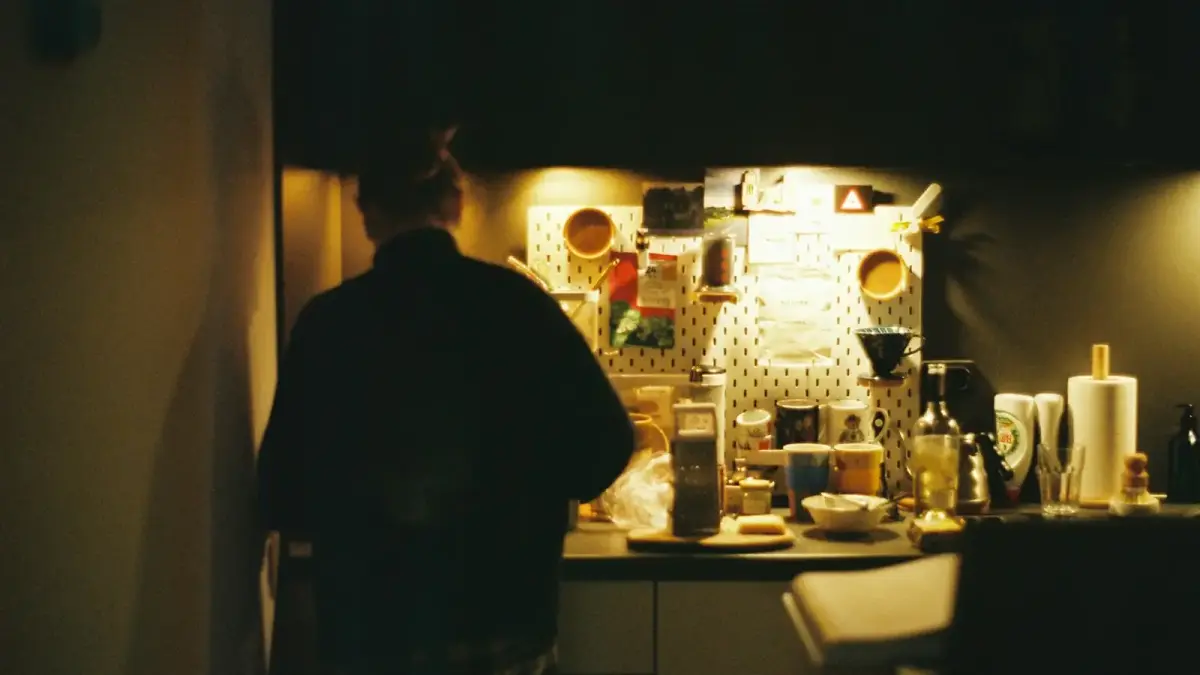
I was standing at the kitchen counter last October, half awake, stirring sugar into my coffee. My wife was behind me saying something about the neighbor’s fence. I wasn’t really listening. I was watching my own hand.
Three slow circles with the spoon. Then two taps on the rim - not hard, just enough to shake the last drop loose. Then I set the spoon down on the counter with the handle facing right.
I stopped breathing for a second. Because that was not my ritual. That was my father’s.
He’s been gone eleven years. And somehow his hands were still moving through mine, performing a ceremony I never agreed to memorize. Nobody taught me this. Nobody said, “Son, this is how a man stirs his coffee.” I just sat across from him at a yellow Formica table for about six thousand mornings and my body took notes that my brain never filed.
I’m 58 years old, and I am still becoming my father in ways I didn’t consent to and can’t seem to stop. And I’m starting to think that might be the most honest form of love I’ve ever received.
The Inheritance Nobody Mentions
We talk about what fathers leave behind. The house, the debts, the unresolved arguments, maybe a watch or a set of tools. We talk about emotional inheritance - the anxiety patterns, the avoidance, the things a man couldn’t say that his son now can’t say either.
But we almost never talk about the physical inheritance. The way a man holds a steering wheel. The specific angle of a head tilt when someone’s thinking. The rhythm of footsteps down a hallway at night.
I hold my coffee mug with both hands wrapped around it, thumbs on top, exactly the way my father did. I lean against the kitchen counter with my left hip, arms crossed, exactly the way he stood every evening while my mother cooked. I clear my throat before I speak in meetings - a small, unnecessary sound - because he did that before every sentence that mattered.
None of this was taught. All of it was transferred.
A boy who watches a man every day for nearly two decades doesn’t just observe him. He downloads him. Not the words - boys rarely remember what their fathers actually said. But the choreography. The way the man moved through a room, through a morning, through a silence.
Six Thousand Mornings of Silent Instruction
My father was not a talker. He was a decent man, a reliable man, but the emotional vocabulary in our house could have fit on an index card. Love was not discussed. It was demonstrated through consistency - through showing up at the same table, at the same hour, performing the same motions, every single morning.
I didn’t know I was learning anything. I thought I was just eating cereal.
But a 2011 study published in Psychological Science found that humans unconsciously mimic the motor behaviors of people they spend extended time with - a phenomenon researchers call “automatic imitation.” The effect is strongest in close relational bonds and happens entirely below conscious awareness. You don’t decide to absorb someone’s gestures. Your mirror neurons do the deciding for you.
My father’s hands stirred that coffee the same way every morning for thirty years. My body was sitting four feet away, recording every frame. And somewhere around age twelve or thirteen, without any announcement or ceremony, the recording started playing back through my own fingers.
I just didn’t notice for another forty-five years.
The Body Remembers What the Mind Never Catalogued
There’s a particular way I fold a newspaper - and yes, I still read the physical paper, because I am my father’s son in that way too. I fold it into thirds, then quarters, and hold it in my left hand at an angle. I’ve watched old home videos. He did it identically.
There’s a way I stand at a grill. Tongs in the right hand, left hand on my hip, weight shifted to one leg. I’ve seen photographs of him at maybe thirty-five, standing at a charcoal grill in the backyard, and the posture is so precisely mine that it made my chest hurt.
This is what I mean by physical vocabulary. It’s the collection of small, meaningless movements that make up a person’s way of being in a body. The scratch of the jaw while reading. The two-finger point when giving directions. The way a man sits down in a chair - does he lower himself carefully, or does he just drop?
My father dropped. And so do I.
Daniel Goleman has written about the concept of “emotional contagion” - the idea that emotions transfer between people through nonverbal channels, often without either person being aware. But I think there’s something even deeper happening between fathers and sons. It’s not just emotion that transfers. It’s the entire physical operating system.
A boy doesn’t just catch his father’s mood. He catches his father’s body.
What Gets Passed When Words Don’t
Here’s what I’ve been sitting with lately. My father never told me he loved me. Not once, in fifty-some years. That used to bother me more than I admitted. I spent a lot of my thirties vaguely angry about it and a lot of my forties trying to understand it.
But now I’m 58. And I stir my coffee exactly the way he did. And I’m starting to wonder if the love was always there - not in the words he couldn’t find, but in the proximity he maintained.
He sat with me every morning. Every single morning. Even when there was nothing to say - especially when there was nothing to say. He just showed up at that table in his undershirt with his coffee and his newspaper, and he was present in the most literal, physical sense of the word.
A 2019 study in Frontiers in Psychology examined what researchers call “embodied cognition” in family systems - the theory that relational knowledge is stored not just in memory but in the body itself. The researchers found that physical proximity over long periods created what they described as “motor resonance” - a bodily attunement between family members that persisted even after the relationship changed or ended.
Even after one of them died.
My father has been gone for over a decade, and my body is still attuned to his. Still performing his morning. Still holding the mug his way, standing his way, clearing his throat his way.
That’s not a habit. That’s a haunting. And I mean that in the most tender way possible.
The Sons Who Catch Themselves
I’ve talked to other men about this - carefully, because men my age don’t usually volunteer observations about their bodies unless it involves a doctor. But when I mention the coffee thing, something shifts in their faces.
One friend told me he discovered he whistles the same tuneless whistle his father did while locking up the house at night. He didn’t even know he whistled until his wife pointed it out. His father had been dead for twenty years.
Another friend - a man in his early sixties - said he caught himself folding his arms during his daughter’s school play in exactly the posture his father used to sit in church. Same crossed arms, same slight lean to the left, same expression of tolerant patience. He said he almost cried in the auditorium, not because of the play, but because for a half-second he felt his father sitting inside his own body.
This is what sons carry. Not memories, exactly. Memories fade and distort. What sons carry is motion. The physical record of a man who was there, doing ordinary things, being a body in a room with another smaller body that was quietly, invisibly, learning how to be a man by watching one.
The Love That Lives in the Hands
I think about my father’s hands a lot now. The thick fingers, the rough skin, the way he held a pen with too much pressure, the way he gripped the steering wheel at ten and two like they taught him in 1961 and he never saw reason to change.
My hands look different from his. Softer, thinner. But they move the same way. They perform the same small rituals he performed. And when I watch them stir my coffee in the morning - those three slow circles, the two taps, the spoon set down just so - I am watching a form of love that bypassed language entirely.
Gabor Mate has written about how the body stores what the conscious mind refuses to process. We usually apply that idea to trauma, to pain, to the things we suppress. But I think the body also stores tenderness. It stores the quiet, undramatic love of a man who didn’t know how to say it but showed up every morning and let his son sit close enough to learn his hands.
My father never told me how to be a man. He just was one, in the same room as me, for eighteen years. And my body took the rest from there.
If you’ve ever caught yourself performing some small, meaningless gesture and felt a jolt of recognition - if you’ve ever seen your parent’s hands moving at the end of your own arms - you already know what I’m trying to say.
Nobody taught you that. Nobody had to.
You were loved in a language that predates words. And your body has been speaking it back ever since.