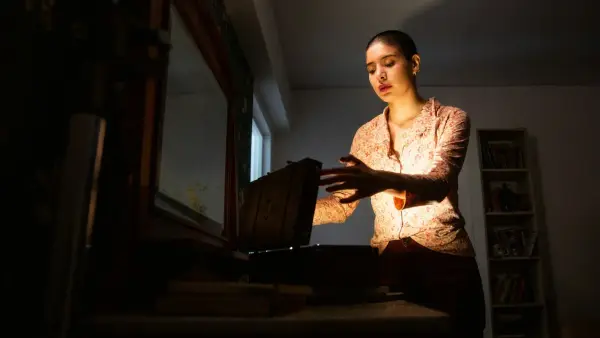
He is 49 and has just realized that the twenty years he spent answering every question with 'I'm fine' were not emotional stability and they were not strength, they were a slow and thorough forgetting of what it felt like to want something badly enough to say it out loud, and the steadiness everyone admired was actually the quiet sound of a man who had taught himself not to need

The moment that wasn’t even a moment
I was standing in the kitchen last Saturday when my wife asked me where I wanted to go for dinner. She does this once a week, sometimes twice. It’s a small, ordinary question. She said it the way she always does - half looking at her phone, half looking at me, waiting for an answer she already knows won’t come.
I said, “I don’t care, you choose.”
She nodded. She picked a place. We went. The food was fine. The evening was fine. Everything was fine.
But something happened this time that hadn’t happened before. As I was saying those words - I don’t care, you choose - I heard them. Not the way I usually hear them, as a polite deferral, an act of easygoing generosity. I heard them the way she must hear them. The way my kids must hear them. The way anyone who has ever asked me what I want must hear them.
I heard a man with no preference. No desire. No pull toward anything. A man who has made “I don’t care” his entire personality and called it being low-maintenance.
I’m 49 years old. I am not in crisis. I am not depressed. I have a good marriage, a career I built carefully, friends who respect me. And I cannot remember the last time I wanted something badly enough to say it out loud without being asked.
The architecture of “fine”
Here’s what I think happened, and I suspect it happened to a lot of men my age.
Somewhere in my late twenties, I made a decision. Not a conscious one - nobody sits down and drafts a plan for emotional disappearance. It was more like a series of tiny choices that compounded over time, the way interest works, except in reverse.
I chose to not make things complicated. I chose to be the steady one. When my wife was stressed, I was calm. When my kids were melting down, I was the anchor. When friends asked how I was doing, I said “I’m fine” and meant it - or thought I meant it.
Each time I said it, the words got a little more true. Not because my life was getting better, but because the part of me that might have answered honestly was getting quieter. The machinery of wanting, needing, feeling strongly about things - it doesn’t break all at once. It rusts. Slowly, over years, until one day you try to turn the handle and nothing moves.
A 2021 study published in the Journal of Personality and Social Psychology found that men who consistently suppress emotional expression don’t just hide their feelings from others - they gradually lose access to those feelings themselves. The researchers called it “emotional atrophy.” Like a muscle you stop using, the capacity to identify and articulate what you want literally weakens with disuse.
I read that and felt something I hadn’t felt in years. I felt seen.
The man everyone admires
The cruel part is that this kind of disappearance gets rewarded.
People respect the steady man. The one who doesn’t complain. The one who absorbs other people’s chaos without generating any of his own. At work, he’s the one they describe as “unflappable.” At home, he’s the one they describe as “easygoing.” In his friend group, he’s the one who never has drama.
And he nods at all of this because it sounds like a compliment. It sounds like he’s winning.
What nobody tells you is that “easygoing” and “empty” can feel exactly the same from the inside. The man who says “I don’t care, you pick” about restaurants is often the same man who says “I don’t care, you pick” about vacations, about weekends, about how to spend the next ten years of his life. The flexibility everyone admires is not flexibility at all. It’s the absence of something that used to be there.
Daniel Goleman wrote about emotional intelligence as a skill - something you develop and maintain. But he also acknowledged that emotional awareness requires practice. It requires regularly checking in with yourself, asking the uncomfortable question: what do I actually feel right now? Men who skip that question for twenty years aren’t emotionally intelligent. They’re emotionally retired.
I was emotionally retired and calling it maturity.
When did I stop wanting things?
I’ve been trying to trace it back, and that’s the part that scares me. I can’t find the line.
There was no single day when I stopped having preferences. No crisis that shut me down. No trauma I can point to and say, “That’s where it started.” It was more like falling asleep in the car as a kid - you don’t know when it happened, you just know you missed the scenery.
I used to care about music. Not casually - I used to drive an hour to see bands play in small venues. I used to argue with friends about albums. I used to hear a song and feel it rearrange something in my chest.
Now I listen to whatever playlist the algorithm gives me. I don’t dislike it. I don’t like it either. It’s just there, filling the silence while I drive to work.
I used to have opinions about food, about travel, about the kind of life I wanted to live. Somewhere along the way, I traded opinions for agreeableness. I traded desire for convenience. And the trade happened so gradually that I didn’t notice I’d given anything up.
A 2023 study in Frontiers in Psychology examined what researchers called “preference erosion” in long-term relationships. They found that partners who consistently deferred to the other person’s choices - not out of generosity, but out of habit - reported significantly lower life satisfaction and a diminished sense of personal identity over time. The kicker: most of them didn’t realize it was happening until the researchers pointed it out.
That’s the thing about slow disappearance. You don’t feel yourself leaving.
The difference between peace and numbness
I told my wife about this. Not all of it - I’m still learning how to talk about things I spent two decades not talking about. But I told her the part about the restaurant. About hearing my own words differently.
She got quiet for a long time. Then she said something that knocked the wind out of me.
She said, “I’ve been wondering where you went.”
Not in an angry way. Not as an accusation. She said it the way you’d say it about someone who used to live in the house but hasn’t been seen in a while. Like she’d been noticing my absence for years but didn’t have the language for it because I was still physically here, still showing up, still being steady and reliable and fine.
And that’s the distinction I’m trying to understand now. There’s a difference between a man who is at peace and a man who has simply stopped registering his own emotional signal. Peace is something you arrive at after doing the work - after feeling the difficult things and finding your way through them. What I had was not peace. It was a disconnection so complete that it passed for calm.
Gabor Mate has written extensively about how the body stores the emotions the mind refuses to process. He describes numbness not as the absence of feeling but as feeling’s opposite - an active suppression that takes enormous energy to maintain, even when the person doing it has no idea they’re doing it. The man who seems effortlessly calm is often spending everything he has on the project of not feeling.
I think I’ve been spending everything I have on that project since I was twenty-nine years old.
What “I’m fine” actually costs
There’s a particular kind of loneliness that comes with this, and it’s one that men almost never talk about.
It’s not the loneliness of being alone. It’s the loneliness of being surrounded by people who think they know you and being unable to tell them they don’t. Because you’re not hiding. You’re not lying. You genuinely don’t know what you’d say even if someone asked the right question.
When your wife asks what’s wrong and you say “nothing,” you’re not withholding. You actually can’t locate the answer. The feeling is there - you can sense its weight, the way you can feel the pressure change before a storm - but you can’t name it, can’t find its edges, can’t pull it into language. Twenty years of “I’m fine” didn’t just become a habit. It became a system. A way of processing the world that skips the part where you check in with yourself.
And the cost isn’t just personal. It’s relational. My wife didn’t just lose access to my feelings. She lost a partner who could meet her emotionally. My kids didn’t just get a calm dad. They got a dad who modeled, every single day, that men don’t want things, don’t feel things, don’t need things. I was teaching them by example that the proper way to be a man is to disappear inside your own life.
That’s not a legacy I want to leave.
The slow way back
I don’t have a redemption arc to offer here. I’m not going to tell you I started journaling and now I cry at sunsets. That’s not how twenty years of emotional rust works.
What I can tell you is that the noticing has started. And the noticing, I’m learning, is the whole thing.
Last Tuesday, someone asked me what kind of coffee I wanted. And instead of saying “whatever’s fine,” I paused. I actually thought about it. I wanted the dark roast. I wanted it black. And I said so.
It sounds ridiculous. A grown man, nearly fifty, treating a coffee order like a breakthrough. But that’s what happens when you’ve spent two decades flattening yourself into the shape of “no preference.” The smallest act of wanting feels foreign. It feels almost dangerous, like you’re asking for too much by asking for anything at all.
If you are a man reading this and something in your chest just tightened - if you recognize the pattern of saying “I don’t care” so often that it stopped being a choice and started being the truth - I want you to know something.
You are not broken. You are not weak for having done this. You adapted to something - expectations, responsibility, the unspoken rules about what men are supposed to need - and the adaptation worked so well that it swallowed the original person underneath.
But he’s still there. Rusted, maybe. Quiet, definitely. But still there. I know because I found him standing in a kitchen on a Saturday evening, hearing his own voice for the first time in twenty years and thinking: I used to want things.
That thought - small and uncertain and almost embarrassing in its simplicity - was the loudest thing I’d felt in two decades.
It was not fine. It was better than fine. It was a beginning.