He's 56 and has noticed that he cannot walk through a hardware store without touching things - running his hand along the grain of the lumber, testing the weight of a hammer, pressing his thumb into the bristles of a brush - and it is not nostalgia or boredom, it is that a boy who followed his father through those aisles at nine learned that the world was something you were supposed to know by the feel of it, and the hands at fifty-six are still doing the homework a man set for his son in aisle seven of a store that no longer exists
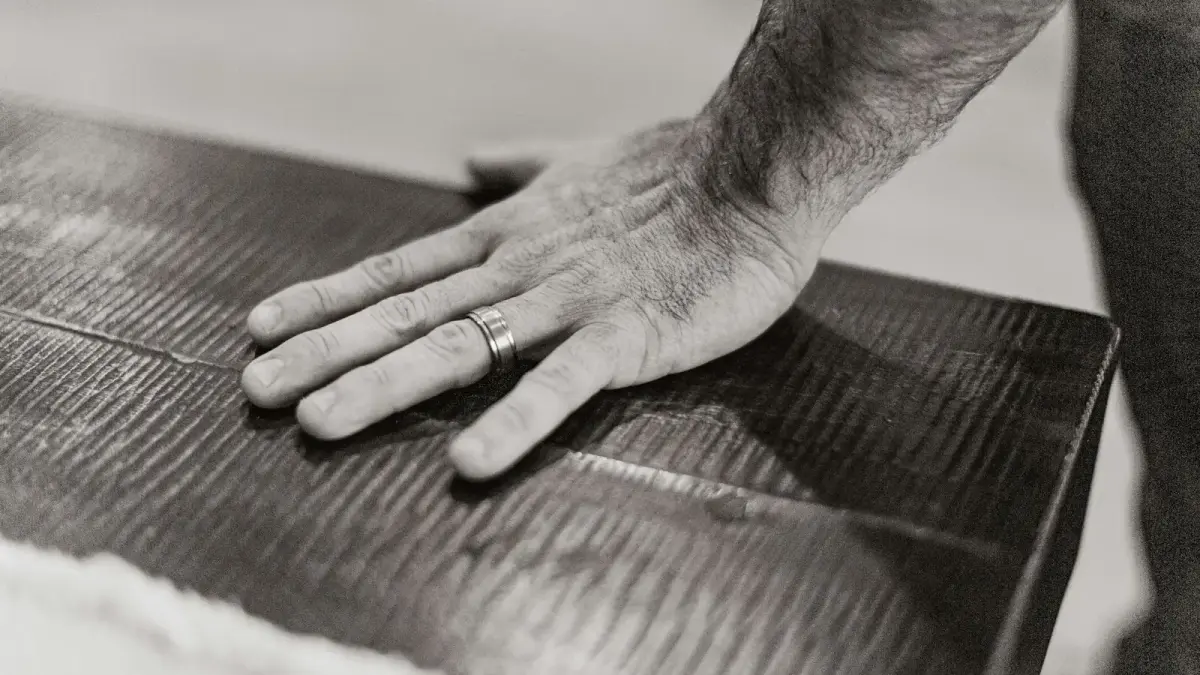
I was standing in the lumber aisle last Saturday, and my hand was already on the cedar before I knew what I was doing. My fingers moved along the grain the way you’d run them across a page of braille - slow, deliberate, reading something. I wasn’t shopping. I didn’t need cedar. I didn’t need anything, really.
But my hand was there, pressing into the wood, testing its give, feeling for the rough spots and the smooth ones. And for a half second I didn’t see my own hand. I saw my father’s. Thicker fingers, a scar across the left knuckle from a chisel that slipped in 1979, and the same exact motion. The same slow sweep along the board. The same quiet assessment that never needed words.
I pulled my hand back like I’d touched a stove. Not because it hurt. Because I understood, suddenly, what I’d been doing in hardware stores for the last thirty years.
The Curriculum Nobody Wrote Down
My father never sat me down and said, “Son, this is how you learn the world.” There was no speech. No lesson plan. He just walked into the store and started touching things, and I followed him the way a duckling follows whatever moves first.
I was nine. Maybe eight. Small enough that the shelves towered over me and the smell of cut wood and machine oil felt like entering a church - a place with rules I didn’t understand but knew I was supposed to respect.
He’d pick up a hammer and bounce it once in his palm. Not swinging it. Just weighing it. Feeling whether the balance sat right. He’d run his thumb across the teeth of a saw blade - not hard enough to cut, just hard enough to know. He’d press his fingernail into a piece of pine and study the crescent it left behind.
I watched all of this the way a child watches magic. I didn’t know what he was learning. I just knew he was learning something I couldn’t see.
So I started doing it too. Reaching up to touch what he touched. Pressing my small thumb into the same boards. Wrapping both hands around hammer handles that were too long for my grip. And he never corrected me. Never said “not like that” or “be careful.” He just glanced down, saw me doing it, and kept walking.
That glance was the entire diploma.
What the Hands Were Actually Learning
Here’s what I understand now that I couldn’t have understood then. My father wasn’t shopping. He was conducting an investigation with his fingertips. Every piece of wood, every tool, every surface was giving him information that his eyes alone couldn’t deliver.
The grain of a board tells you how it will split. The weight of a hammer tells you how your shoulder will feel at hour six. The stiffness of a brush tells you whether it will leave streaks. None of this is written on the price tag. None of it shows up in a product review. You have to touch it. You have to hold it. You have to let your hands do the asking.
Matthew Crawford wrote about this kind of intelligence - the knowledge that lives in skilled hands, not in abstraction. He called it manual competence, and he argued it was a form of thinking that our culture had quietly decided to stop respecting. The hands weren’t just tools. They were organs of perception. My father would have never used those words. But he lived them every Saturday morning.
And here’s what gets me. He wasn’t teaching. He was just being himself. The teaching happened because I was there, and I was watching, and children absorb what the adults around them do with their bodies the way sponges absorb water - not by choice, but by nature.
A 2019 study published in the Journal of Experimental Child Psychology confirmed what I already knew in my bones. Children acquire procedural knowledge - the how-to-do-things kind, the kind that lives in your muscles and your nerve endings - primarily through observation and imitation. Not through instruction. Through watching someone they trust do the thing, and then trying to do it themselves.
My father trusted his hands. So I learned to trust mine.
Fifty-Six and Still Enrolled
I am fifty-six years old. I have a desk job. I type for a living. My hands spend most of their day on a keyboard, doing work my father would not have recognized as work.
But walk me into a hardware store and something shifts. My posture changes. My pace slows. And my hands come alive in a way they don’t anywhere else. They reach for things. They test things. They wrap around tool handles and squeeze, feeling for the vibration of quality or the dead weight of cheap manufacturing.
I do this with things I will never buy. I pick up levels I don’t need. I press my thumb into caulk tubes. I run my palm along sheets of plywood and feel for the warp. I test the action of pliers, open and close, open and close, listening to the pivot point.
My wife has learned to wait. She’ll find me three aisles over from where she left me, standing in front of the sandpaper display, rubbing a sheet between my fingers with the focus of a sommelier assessing a vintage.
“Do you need sandpaper?” she’ll ask.
I never need sandpaper.
But my hands don’t know that. My hands are still doing what they were trained to do in a store on Route 9 that became a mattress outlet in 1998 and is now a vape shop. The store is gone. The man who walked those aisles is gone. But the assignment he gave my hands - know the world by touching it - never had an expiration date.
The Science of Hands That Remember
What I’m describing has a name. Researchers call it embodied cognition - the idea that thinking doesn’t just happen in your brain. It happens in your body. Your hands, your posture, your physical relationship with objects - these aren’t accessories to thought. They are thought.
A 2021 study in Frontiers in Psychology found that tactile interaction with objects activates memory networks that visual observation alone cannot reach. When you touch something, you aren’t just sensing it. You’re connecting it to every other thing you’ve ever touched that felt similar. The grain of that cedar in aisle four is linked, neurologically, to the cedar your father held up to the light in 1979 and said nothing about, because his face said everything.
This is procedural memory. It’s the same system that lets you ride a bicycle thirty years after the last time you did it. Once the body learns something through repetition and physical practice, it stores that knowledge differently than facts or dates. It goes deeper. It becomes part of how you move through space.
Daniel Goleman wrote about a kind of intelligence that doesn’t get measured on tests - the ability to read the physical world, to sense what your environment is telling you through channels that aren’t language. My father had that intelligence in abundance. He could feel when a board was going to warp before it showed any sign. He could tell a good weld from a bad one by running his finger over the seam.
He didn’t call it intelligence. He called it common sense. But it was something far more sophisticated than that.
A Language Without Words
Here’s what I’ve come to understand about the way men of my father’s generation communicated. They didn’t talk about feelings. They didn’t sit you down for heart-to-hearts. The vocabulary of emotional expression had been, for most of them, edited down to a handful of acceptable phrases - “I’m fine,” “not bad,” and “hand me that wrench.”
But they spoke with their hands constantly. The way my father handed me a tool was a sentence. The way he held a board steady while I practiced sawing was a paragraph. The way he stood behind me, close enough that I could feel his presence but far enough that I had to do the work myself - that was a whole chapter about trust and autonomy and the belief that I could figure it out.
A 2018 study published in the Journal of Family Psychology found that father-son bonding in working-class families often occurs through shared physical tasks rather than verbal communication. The researchers called it “side-by-side attachment” - the bond that forms not through face-to-face conversation but through standing next to each other, hands engaged in the same work, bodies synchronized around a common purpose.
My father and I were attached side-by-side in every hardware store, garage, and workshop of my childhood. We rarely spoke during those hours. We didn’t need to. The hands were speaking.
The Homework That Never Ends
I used to feel embarrassed about it. A grown man fondling lumber. A fifty-six-year-old pressing his thumb into things like a kid in a toy store. There’s something undignified about it if you look at it from the outside.
But I’ve stopped looking at it from the outside.
What I see now, when I catch my hand reaching for a board I don’t intend to buy, is a boy who is still listening to his father. Not with his ears. With his fingertips. The instruction was never verbal, so the memory isn’t verbal either. It lives in the way my thumb moves. In the way my palm opens. In the instinct to test, to weigh, to assess through contact.
My father has been gone for eleven years. I cannot call him. I cannot hear his voice, which I am starting to forget in ways that terrify me.
But I can walk into a hardware store and feel him immediately. He’s in the motion of my hands. In the slow sweep across the grain. In the way I bounce a hammer in my palm, once, twice, feeling for the balance point he showed me without showing me.
The store on Route 9 is gone. The man is gone. But the hands remember. The hands keep going back to class.
And maybe that’s the thing about the fathers who taught with their bodies instead of their words. They left a curriculum that can’t be lost. It’s written in your muscles. In your nerve endings. In the way you reach for things you don’t need, in stores you don’t remember entering, because the boy in you is still following a man down an aisle, learning the weight of the world one handful at a time.