He's 60 and just realized he still calculates the per-unit price of everything he puts in the grocery cart - even items he could buy ten of without thinking twice - because his mother turned every jar around to check the weight and divided price by ounces in her head before anything went in the basket, and a boy who watched a woman do arithmetic in a grocery aisle learned that money was something you counted before you spent it, and the counting never stopped even after the scarcity did
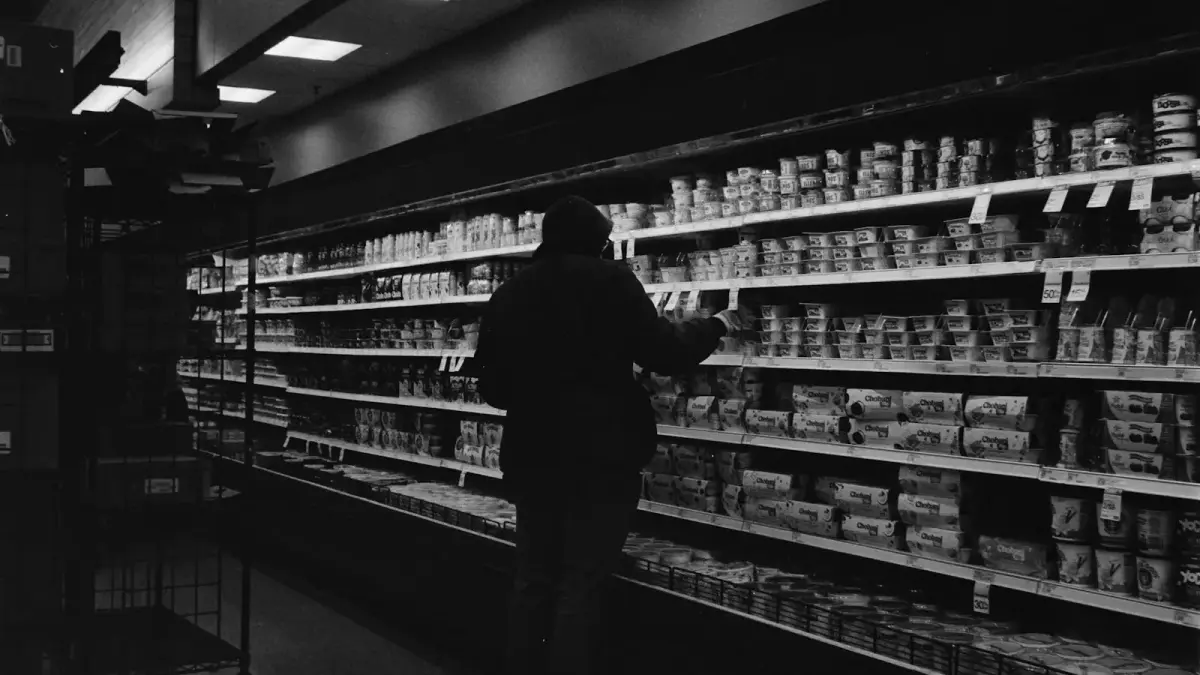
I turned sixty last March, and my wife threw me a dinner at the Italian place downtown - the one with cloth napkins and a wine list that doesn’t print prices next to the bottles. Sixty years old. Retired. Pension, savings, a house that’s been paid off since 2019. And three days later, I was standing in aisle seven of the grocery store, holding a jar of kalamata olives, and I had already done the math.
$6.49 for 12 ounces. Fifty-four cents an ounce.
I didn’t decide to do it. My brain just - did it. The way your lungs breathe or your eyes blink. I turned the jar around, found the weight, divided the price, and compared it to the store brand next to it. $4.29 for 10 ounces. Forty-three cents an ounce.
I put the store brand in the cart. Not because the dollar seventy mattered. It doesn’t. I could have bought every jar of olives on the shelf and my checking account wouldn’t have noticed. I put the store brand in the cart because something older than logic was making the decision for me. Something I learned in a grocery store forty-five years ago, standing next to a woman who did the same math on every single item she touched.
My mother.
She never used a calculator
My mother shopped the way a chess player scans a board - every move calculated three steps ahead, every item weighed against what it would mean for the rest of the week.
She’d pick up a can of tomatoes, turn it around in her hand, read the ounces, glance at the price, and I could see her lips move. Not words. Numbers. She was dividing. She was doing long division in her head while standing in a fluorescent-lit aisle with a toddler in the cart and a list written on the back of an envelope, and she was doing it faster than I could do it with a phone today.
She never explained what she was calculating. She didn’t have to. I stood next to her hip and watched, and by the time I was eight, I understood that the numbers on the shelf tag and the numbers on the label were in a relationship with each other, and that relationship determined whether the thing went in the basket or back on the shelf.
A 2018 study published in the Journal of Consumer Research found that children who regularly accompanied parents during grocery shopping developed what the researchers called “embedded economic cognition” - a set of financial calculation habits absorbed not through instruction but through proximity. The children didn’t remember learning the behavior. They remembered the person they learned it from.
I remember my mother’s hands. The way she held a jar at a slight angle so the light caught the small print. The way she’d set something back on the shelf with a gentleness that looked like she was apologizing to it for not being able to take it home.
The math was never about the math
Here’s what I didn’t understand until I was well into my fifties: my mother wasn’t being cheap. She wasn’t even being careful. She was performing a calculation that had nothing to do with the jar in her hand and everything to do with the distance between Thursday and payday.
Every item she put in that cart was a negotiation. A jar of peanut butter meant no jelly. Name brand cereal meant store brand bread. She was running a budget in real time, adjusting and readjusting with every aisle, and the per-unit price was her instrument for making the numbers land somewhere that meant the lights stayed on and the kids didn’t notice anything was tight.
And we didn’t notice. That was the point. That was the entire accomplishment of her arithmetic. My brother and I grew up thinking we were regular. Not rich, not poor, just - fine. We had food in the fridge and shoes that fit and a Christmas that felt like a Christmas. We had no idea that every one of those things was the result of a woman standing in a grocery store doing division in her head so fast it looked like she was just reading labels.
Sendhil Mullainathan’s work on the cognitive tax of scarcity describes this perfectly. Poverty doesn’t just limit what you can afford. It conscripts your mental bandwidth. Every decision becomes a calculation, every purchase a risk assessment, and the brain devotes so much processing power to the arithmetic of survival that there’s barely anything left for the rest of living. My mother gave that processing power willingly. She spent it so her children could spend their attention on being children.
A boy who watches learns what watching teaches
I didn’t set out to inherit my mother’s grocery store arithmetic. Nobody sits a child down and says, “Here’s how you calculate price per ounce.” But a boy who stands next to a woman while she does something with concentration and seriousness will learn the thing she’s doing. Not because she taught it. Because he watched.
Psychologist Albert Bandura called this observational learning - the process by which behaviors are transmitted not through explicit instruction but through modeling. His research showed that children absorb the emotional weight of an action, not just its mechanics. So I didn’t just learn to divide price by ounces. I learned that the act of dividing price by ounces was important. That it mattered. That it was the kind of thing a serious person did before putting something in a cart.
And I learned something else, something that went deeper than arithmetic. I learned that money was fragile. That it was something you held carefully, counted twice, and never assumed would be there next week just because it was there this week. My mother’s per-unit math was a theology as much as a habit. It said: abundance is not guaranteed. Plenty is not permanent. And the moment you stop counting is the moment you discover you should have been counting all along.
I’m sixty, and I have never put a jar of anything in a grocery cart without knowing its per-unit price. Not once in my adult life.
The moment I caught myself
It happened on an ordinary Tuesday. I was shopping for a dinner party - eight people, nice meal, nothing fancy but nothing cheap either. I was buying olives and good cheese and the crackers that come in the box with the little window. And I caught myself tilting a jar of roasted red peppers to read the ounces.
I stopped. I just stood there in the aisle with the jar in my hand and thought: What am I doing?
I could buy a hundred jars of roasted red peppers. I could buy the entire shelf of roasted red peppers and it would be an amusing anecdote, not a financial event. And yet here I was, sixty years old, turning the jar to check the weight, doing the division, comparing it to the one next to it. The same motion. The same slight tilt. The same squint at the small print.
My mother’s motion. My mother’s tilt. My mother’s squint.
And I understood, standing there, that the math had never been about the peppers. Or the olives. Or the peanut butter or the cereal or any of the ten thousand items I’d calculated in fifty years of grocery shopping. The math was about her. It was about a woman who made sure the numbers worked so her kids could live inside the results without knowing there were numbers at all.
A 2020 study published in Psychological Science found that economic behaviors inherited from caregivers during childhood were among the most resistant to change in adulthood - more persistent than inherited political views, dietary preferences, or even religious practices. The researchers theorized that this persistence was rooted in the emotional context of the learning. We don’t just learn the behavior. We learn the feeling that accompanied it. And the feeling - the seriousness, the care, the quiet vigilance - becomes the reason we can’t stop.
What the counting really costs
I don’t think the per-unit math has cost me anything concrete. I’ve never missed out on something important because I bought the store brand. My wife teases me about it sometimes - “Marcus, you make a pension, just get the good mustard” - and I laugh, and I get the good mustard, and then I do the math on it anyway. Silently. In my head. Where no one can see me being my mother’s son.
But there’s a cost that doesn’t show up in a bank statement. There’s the cost of never fully believing that you’re safe. Of never standing in a grocery store and feeling the simple, uncomplicated freedom of just putting things in the cart without arithmetic. Of looking at a jar of olives and seeing olives instead of a math problem.
I’ve talked to other men my age - men who grew up the way I grew up, in houses where the money was counted because counting it was the only way to make it last - and they all do some version of this. One friend told me he still checks the thermostat four times before bed, the same way his father did, because heat was the most expensive thing in the house and every degree was a decision. Another friend said he can’t throw away leftovers, even food he knows no one will eat, because in his mother’s kitchen, throwing away food was throwing away money, and throwing away money was something that happened to people who ended up in trouble.
We carry these calculations the way we carry our parents’ faces - not by choice but by proximity. We stood close enough to watch, and watching was enough.
The woman in the aisle
My mother is 84 now. She lives in a senior community in Delaware. She has enough. Her needs are covered, her fridge is full, and she doesn’t do her own grocery shopping anymore because her knees won’t let her stand that long.
I went to visit her last month, and I brought groceries. I was unpacking them in her small kitchen, and she picked up a jar of pasta sauce I’d bought and turned it around. Read the ounces. Glanced at the label where the price would have been, except I’d peeled the receipt off already.
“How much was this?” she asked.
“Mom, it doesn’t matter.”
“How much?”
“Four dollars.”
She looked at the jar. Twenty-four ounces. I could see her doing it. Sixteen and two-thirds cents per ounce. She didn’t say the number. She just nodded, set the jar down, and said, “That’s fine.”
And I thought: there it is. There’s the woman who taught me to count. Still counting. Still checking the weight. Still dividing in her head at eighty-four, not because she needs to, but because the counting was never about need. It was about love dressed up as arithmetic. It was about making sure the numbers added up so her children could live in a house where the math was invisible.
I’m sixty. I have a pension and a paid-off house and a retirement account that would have made my twenty-year-old self fall down. And I cannot - I genuinely cannot - put a jar of anything into a grocery cart without knowing what it costs per ounce.
Because a long time ago, a woman with tired hands and fast arithmetic made sure I never knew how close the numbers were. And the least I can do - the only thing I know how to do - is keep counting the way she taught me. Not because I have to.
Because she did.