He's 61 and he always turns back to check the booth before leaving a restaurant, pats every pocket twice, runs his hand along the seat - his father never left anything behind, because the man who grew up losing things learned that losing things meant losing ground
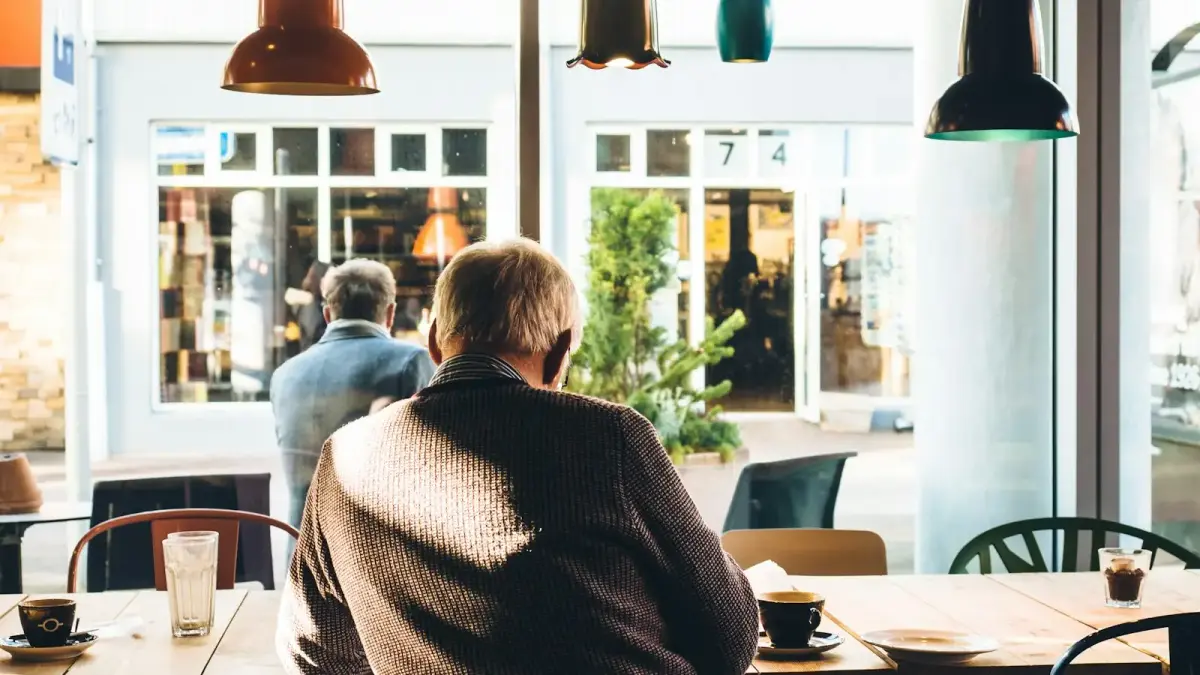
I watched my father leave a Denny’s booth in 1974 and what I remember is not the meal, not the conversation, not even what he was wearing. What I remember is the way he stood up and then turned back. He patted his front pockets. Then the back ones. He ran his hand across the vinyl seat. He leaned down and looked under the table. He checked the little shelf behind the napkin dispenser. Then he looked at me and nodded, and we walked out.
He did this every single time we left anywhere.
Every restaurant. Every waiting room. Every pew after Sunday service. Every bus seat, every park bench, every folding chair at every school event I ever had. The ritual was always the same - stand, turn, check, pat, scan, nod. It took about fifteen seconds. It was as automatic as breathing.
I am sixty-one years old and I did the exact same thing last Tuesday at a booth in a diner off Route 9. My wife was already at the door. I was running my hand along the seat cushion, checking the space between the backrest and the seat, patting my jacket. She turned around and watched me and said something she’s said maybe a hundred times in our marriage.
“What are you looking for?”
And for the first time, I actually heard the question. I wasn’t looking for anything. I was performing a prayer I learned before I had words for it.
The inventory my father couldn’t afford to skip
My father grew up in a house where things didn’t get replaced. A lost glove meant a cold hand for the rest of winter. A pen left behind at the doctor’s office was a pen gone. A hat forgotten on a bus was not a minor inconvenience - it was a small emergency.
He told me once, when I was maybe ten, that his mother sent him back six blocks in the rain to find a scarf he’d left at a friend’s house. Not because she was cruel. Because that was the only scarf.
When you grow up like that, you develop what I’ve come to think of as spatial vigilance. It’s the habit of treating every departure as a potential loss event. You scan the space because the space has taken things from you before, and what it takes, you do not get back.
A 2019 study published in the Journal of Personality and Social Psychology found that economic scarcity in childhood creates cognitive patterns that persist long after the scarcity itself has ended. The researchers called it a “scarcity mindset” - but that clinical phrase doesn’t capture what it actually looks like in a body. It looks like my father’s hands moving across a bus seat. It looks like a man who checks his pockets not once but twice, because once is hope and twice is certainty.
My father wasn’t anxious. He wasn’t paranoid. He was thorough in the way that only people who have genuinely lost things they needed can be thorough. There is a difference between caution and vigilance, and the difference is whether you’ve ever gone without.
The son who inherited the motion but not the reason
Here is what’s strange. I did not grow up poor. My father made sure of that. He worked steady union jobs, kept a clean house, put food on the table that was more than adequate. By every reasonable measure, I grew up comfortable.
But I inherited the ritual.
I check behind me before I leave any room that isn’t my own. I pat my pockets in a specific order - front left, front right, back left, back right, inside jacket. I look at the chair I was sitting in. I scan the floor around it. I do this at restaurants, at airports, at movie theaters, at the barber. I do it when I leave a friend’s house, even when I brought nothing with me.
My body performs an inventory of things I cannot lose, even though I could replace all of them by tomorrow.
This is what inheritance actually looks like. Not a trust fund or a family name. A gesture. A turning-back. A hand sweeping across a surface to make sure nothing was left behind, because somewhere in my nervous system lives a boy who watched his father count and recount what they had and understood - without anyone ever saying it out loud - that the distance between enough and not enough was exactly one lost item wide.
The other rituals that come from the same place
Once I recognized the checking for what it was, I started seeing its cousins everywhere in my life.
I keep receipts. Not all of them, but more than anyone needs to. Folded in my wallet, stuffed in the console of my truck, piled in a drawer in the kitchen. My wife asks why I keep a receipt for a $4 coffee and I don’t have a good answer. The answer is that a receipt is proof. Proof that the transaction happened, that the money went where it was supposed to go, that nothing was taken from me by accident.
I save boxes. The box my drill came in. The box my watch came in. Shoe boxes, appliance boxes, the box for a set of headphones I bought three years ago. I keep them in the garage, flattened and stacked. Because if something breaks, you need the box to return it. Because a thing without its box is a thing you’re stuck with. Because my father kept every box too.
I have never thrown away a tool that still works. I have screwdrivers from the 1990s. I have a level that wobbles slightly but still functions. I have a flashlight that requires a specific battery they don’t sell at the hardware store anymore, and I keep it anyway because it works.
These are not the behaviors of a hoarder. They are the behaviors of a man whose body remembers a world where replacement was not an option. Psychologist Sendhil Mullainathan, who co-authored research on scarcity and cognition, has described how resource scarcity creates a kind of mental bandwidth tax - the mind stays partially occupied with tracking and protecting what it has, even when the actual threat has passed. The bandwidth tax doesn’t expire when the bank account grows. It just changes what it monitors.
I monitor everything. I always have. I just didn’t know I was doing it.
What my wife actually asked me
When she said “what are you looking for?” that Tuesday at the diner, I stood there for a moment with my hand still on the booth seat. The vinyl was warm from where I’d been sitting. There was nothing on it. There was nothing under the table. My phone was in my pocket. My wallet was in my jacket. My keys were clipped to my belt loop where they always are.
I wasn’t looking for anything.
I was looking for the feeling of having accounted for everything. The feeling of being certain that nothing slipped away while I wasn’t watching. The feeling my father must have chased every single day of his life - the assurance that what he had was still his, that the world hadn’t quietly subtracted something when he turned his back.
She wasn’t asking the question to be difficult. She was asking because she grew up in a house where things got replaced. Where a lost glove meant a trip to the store, not a cold hand for three months. She has never checked behind her before leaving a booth in her life. It has genuinely never occurred to her.
And I love her for that. I love that she lives in a world where things can be left behind and recovered. But I also know that I will never fully live in that world, because my body was educated by a different one.
The boys who watched their fathers count
I brought this up to a friend of mine - same age, similar background, father worked in a warehouse his whole life. I told him about the booth, about the checking, about what my wife said.
He got very quiet. Then he said, “I do the same thing with light switches.”
He walks through his house before bed and checks every light switch, every lock, every appliance. Not because he thinks the house will burn down. Because his father did it. Because his father grew up in a house where the electric bill was the difference between keeping the lights on and sitting in the dark, and a light left on in an empty room was money leaking out of the walls.
A 2021 study in Frontiers in Psychology examined how poverty-related stress responses are transmitted across generations, finding that children of economically stressed parents often develop hypervigilant monitoring behaviors even when raised in stable financial environments. The researchers noted that these behaviors are not pathological - they are adaptive strategies that simply outlive the conditions that created them.
My friend’s father is gone now. But every night, his son walks the same route through the house, touching the same switches, checking the same locks. The father’s necessity became the son’s ritual. The ritual became the son’s way of saying goodnight to a man who isn’t there anymore.
I think a lot of men my age carry something like this. A gesture we perform without thinking. A behavior that looks neurotic from the outside but feels, on the inside, like the most natural thing in the world. Because it is natural. It was taught to us by hands, not words. By watching, not instruction.
The prayer you didn’t know you were saying
I called it a prayer earlier and I meant it.
When I check the booth, I am not anxious. I am not afraid. I am doing something that connects me to my father in a way that nothing else does. Not his stories, not his advice, not even his voice in my memory. His hands. The way they moved across surfaces. The way they patted and checked and accounted.
I carry his hands in mine.
And maybe that’s the thing about growing up watching someone survive. You don’t just learn what they did. You learn the shape of their attention. You learn what they watched for, what they protected, what they were afraid to lose. And your body takes that shape and keeps it, long after the fear is gone, long after the necessity has faded, long after the man himself has left the room for the last time.
I’m sixty-one. I have a good life. I have more than enough. But I will always check behind me. I will always pat my pockets twice. I will always turn back and scan the space I’m leaving.
Not because I’m afraid of losing something.
Because my father taught me that everything you have is worth one last look. And the looking is how you honor the fact that you have it at all.