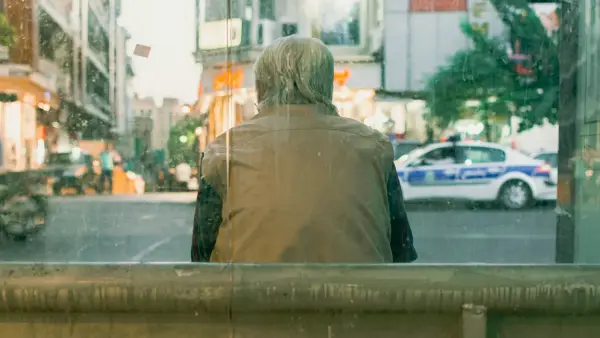
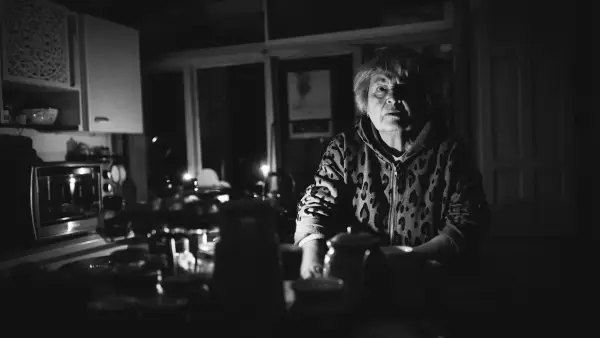
He's 62 and just realized that his house smells exactly like his grandfather's did - coffee that sat too long on the burner, wood polish on tables nobody eats at anymore, and something warm and faintly sweet that a boy of seven could never name but a man of sixty-two now recognizes as the scent of a life that has stopped rushing - and the thing nobody tells you about getting older is that you don't feel yourself becoming the person children visit on Sundays, you just look up one morning and realize the recliner is yours and the smell is coming from you

The morning it hit me
I was standing in the kitchen last Sunday, waiting for the coffee to finish, when something caught me off guard.
Not a sound. Not a thought. A smell.
It drifted up from somewhere - the coffee that had been warming for too long, the lemon polish I’d used on the dining room table the day before, and something else underneath both of those. Something warm and faintly sweet. Something I’d been breathing in for years without realizing it had a name.
I knew that smell. I knew it the way you know a voice that used to sing you to sleep - not in your mind but in your body, in the place below memory where the earliest impressions live.
It was my grandfather’s house. That exact smell. The one that greeted you at the front door when you were seven years old and your parents dropped you off on a Sunday afternoon. The one that meant hard candy in a glass dish and a recliner that seemed impossibly large and a man who moved slowly and spoke quietly and never seemed to be in a hurry to get anywhere at all.
I stood in my own kitchen and breathed it in, and the realization landed on me like something heavy and soft at the same time.
That smell isn’t a memory anymore. That smell is coming from me.
When your house starts to smell like time
Nobody warns you about this. Nobody pulls you aside at fifty-five and says, “Listen, one morning you’re going to notice that your house has a particular scent, and it’s going to be the same scent you associated with old people when you were a child, and you’re going to have to sit with that.”
But that’s exactly what happens.
A home accumulates scent the way it accumulates everything else - slowly, through repetition, through the quiet rhythms of a life that has settled into its patterns. The coffee you brew at the same time every morning. The soap you’ve used for twenty years. The particular warmth of rooms where the same person has been exhaling, cooking, reading, sleeping, for decades.
A 2014 study from the Monell Chemical Senses Center found that people can reliably identify the scent of elderly individuals’ living spaces, and that this scent profile is shaped not by age itself but by the metabolic byproducts of routine - the accumulated chemical signature of a life lived in repetition. Your house doesn’t smell like old age. It smells like consistency. It smells like you stopped changing the variables.
And here’s the part that gets me. That smell - the one I associated with my grandfather, the one I now recognize in my own hallway - it never smelled bad to me. Not then, not now. It smelled like safety. It smelled like a place where nothing unexpected was going to happen. It smelled like a house that had decided what it was.
I just didn’t expect to be the one making it.
The Proust effect and why smell is the cruelest sense
There’s a reason it was the smell that got me and not the recliner, not the candy dish, not the quiet.
Smell doesn’t go through the usual channels. It doesn’t get processed and filtered the way sight and sound do. Rachel Herz, a neuroscientist at Brown University who has spent her career studying olfactory perception, describes it this way - smell has a direct neural pathway to the hippocampus and amygdala, the brain’s centers for memory and emotion. Every other sense takes the long way around. Smell walks straight in through the back door.
That’s why a whiff of something - your mother’s perfume in a department store, cut grass on a summer evening, the particular mustiness of a basement you haven’t visited in forty years - can undo you in a way that a photograph never quite manages. A photo shows you what something looked like. A smell puts you back inside the moment. You’re not remembering it. You’re standing in it again.
A 2004 study published in the journal Neuropsychologia confirmed this. Researchers found that odor-triggered memories were significantly more emotional and more vivid than memories triggered by words or images, and they were more likely to be linked to early childhood. The memories weren’t more accurate - they were more felt.
So when I stood in my kitchen and recognized that smell, I wasn’t thinking about my grandfather. I was with him. Seven years old, standing in his doorway, looking up at a man who seemed ancient and permanent and unreachable.
And then I was back in my own kitchen, sixty-two, realizing that somewhere in the world, a child is forming a memory of my smell. A memory that will come back to them decades from now, unbidden and overwhelming, and they’ll stand in their own kitchen and think: when did this happen to me?
You don’t age in your own mind
Here’s the thing about getting older that I wish someone had told me early enough for it to matter.
You don’t feel it.
I don’t mean you don’t feel your knees or your back. I mean you don’t feel the transition. You don’t feel yourself becoming the older generation. There’s no ceremony, no threshold you cross, no morning when you wake up and think, “I am now the elder in this family.”
It just happens around you. Other people see it before you do. Your children start bringing their children to your house on Sundays. Your grandkids look at your living room the way you used to look at your grandfather’s - like it’s a museum of a life they can’t imagine living. They touch the arm of your chair and it feels impossibly large to them. You know this because you remember feeling the same thing.
But inside, you’re still the person who was rushing. You’re still the person who thought you had somewhere important to be. The only difference is that the rushing stopped at some point and you didn’t notice, the way you don’t notice the moment a car goes from decelerating to fully stopped. You just look down and the speedometer reads zero and you think, huh. I guess I’m here.
Psychologist Laura Carstensen’s socioemotional selectivity theory describes something similar from the research side. As people sense that their time horizon is narrowing - not consciously, not morbidly, just somewhere in the body’s deep awareness - they shift toward emotional meaning and away from novelty. They stop collecting new experiences and start savoring familiar ones. The coffee on the burner. The polish on the table. The same chair, the same window, the same light at the same time of day.
It doesn’t feel like decline. It feels like arrival.
But to a seven-year-old standing in your doorway, it looks like the thing old people do.
The recliner problem
I bought a recliner three years ago. I told myself it was because of my back, which was true. But also, I just wanted it. I wanted a chair I could sink into that didn’t require me to be doing something else - working, eating, socializing. A chair whose only purpose was to hold a person who was sitting still.
I didn’t think about my grandfather when I bought it. I didn’t think about anything at all. I just saw the chair in the store and my body said yes.
It sits in the living room now, next to the window, angled slightly toward the television that I leave on for noise more than entertainment. There’s a lamp beside it. A small table with a book I’m halfway through and a glass of water I refilled this morning.
If you photographed it and showed it to me when I was thirty, I would have said that’s an old man’s setup. I would have felt a flicker of pity. Not cruel pity - the soft kind, the kind that comes from not understanding yet that stillness is something you earn, not something that’s imposed on you.
Because that’s the part nobody tells you either. The recliner doesn’t feel like surrender. It feels like the first chair you’ve ever sat in that isn’t asking you to be somewhere else in twenty minutes.
Sensory inheritance
I think about this word sometimes - inheritance. We use it for money, property, genetics. The things that pass between generations through official channels.
But there’s another kind. The kind that passes through the senses. The way your mother’s hands looked when she was washing dishes and now your hands look the same way and you notice it under the faucet one Tuesday afternoon. The way your father cleared his throat before speaking and now you do it and your daughter has pointed it out twice.
The smell of your grandfather’s house, settling into your walls.
Nobody leaves you these things in a will. Nobody even knows they’re passing them along. They accumulate in you through proximity and repetition and love, and one day they surface, and you realize you’ve been carrying them for decades without knowing it.
I think that’s what got me, standing in the kitchen. Not the aging. Not the recognition that I’d become the older generation. It was the closeness of it. The realization that my grandfather hadn’t gone anywhere. He was here, in the smell of my house, in the weight of my chair, in the slowness of my Sunday morning. I inherited his rhythms the way I inherited the shape of his jaw. Not through any conscious choice, but through the body’s quiet insistence on repeating what it learned to associate with safety.
What the children see
My grandchildren come over on Sundays. They’re eight and five. They take off their shoes at the door without being asked because that’s what they’ve learned to do here. They know where the candy dish is. They know which couch cushion has the best bounce. They know that if they’re quiet enough, they can hear the clock in the hallway.
They will not remember most of this. Not specifically. Not the way I remember my grandfather’s house, in scenes I can describe.
But they’ll remember the smell.
Decades from now, standing in a kitchen they didn’t expect to be standing in, at an age they didn’t expect to be, they’ll catch a whiff of something - coffee left warming too long, wood polish, something sweet and impossible to name - and they’ll be back here. In this house. On this Sunday. Looking up at a man who seemed slow and permanent and endlessly patient.
They won’t know that he didn’t feel slow. They won’t know that inside, he still felt like the thirty-year-old who couldn’t sit still. They won’t know that he stood in the kitchen one morning and realized the smell was coming from him, and felt something he couldn’t quite name either - not sadness, not fear, but something like the gentlest kind of vertigo, the feeling of looking down and discovering you’ve been standing on a bridge the whole time, and the water below is moving, and you are perfectly still.
They’ll just remember the smell. And one day, they’ll make it themselves.
And I think that might be enough. I think that might be the whole inheritance - not the house, not the furniture, not anything you can point to and say “this was his.” Just the smell of a life that finally stopped rushing. Passed along without anyone meaning to. Received without anyone knowing how to refuse it.
The sweetest thing you’ll ever leave behind is something no one can describe but everyone will recognize.