He is 62 and has noticed that every time he hugs his adult son, his right hand rises to deliver two firm pats on the back - not because the hug is finished but because a boy who watched his father extend a hand instead of open arms learned before first grade that male tenderness requires percussion, and the two pats at sixty-two are not a signal to let go but the last negotiation between the man who wants to hold on and the boy who was taught that holding on is something only women were allowed to do
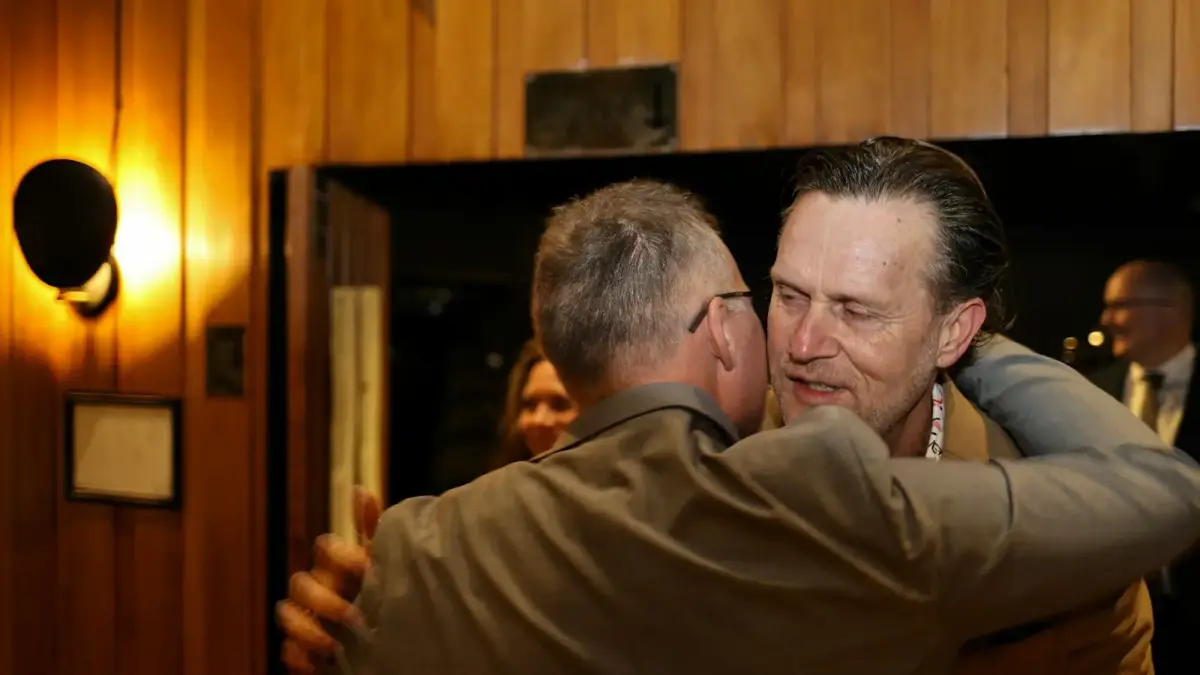
I noticed it at my son’s front door last Thanksgiving.
We’d eaten too much. His wife was packing leftovers I’d pretend to refuse but absolutely wanted. My grandson was asleep on the couch with one sock on. And when my son walked me to the door and leaned in for a goodbye hug, I felt it happen - the same thing that happens every time. My right hand rose like it was spring-loaded. Two firm pats. Thump, thump. And then I let go.
I didn’t decide to do it. I’ve never once decided to do it. But my hand knows the choreography by heart, the way a pianist’s fingers know a scale they learned at seven. Two pats. Not one - that would feel incomplete. Not three - that would be indulgent. Two. The exact number that says “I love you” in a dialect that can only be spoken through bone and shoulder blade.
I stood in his driveway afterward, keys in hand, and a thought surfaced that had probably been forming for decades: those pats aren’t finishing the hug. They’re the toll my body charges for letting the hug happen at all.
The handshake that learned to bend
My father never hugged me. I say that without bitterness now, which took years. He shook my hand. At graduations. At my wedding. When my son was born, he shook my hand in the hospital corridor while my boy was still wrinkled and howling two rooms away.
It wasn’t cruelty. It was his entire vocabulary for physical affection between men. His father had probably offered less. Somewhere back in the family line, there might have been a man who clapped another man on the shoulder and that was the most radical act of tenderness their generation could imagine.
I am one generation forward from the handshake. I made it to the hug. But I brought the percussion with me.
Those two pats are my father’s handshake, evolved. Closer to an embrace but still needing the impact, the firmness, the plausible deniability of a gesture that could also mean “good game” or “take care of yourself out there.” A hug that sounds like knocking on a door you’re not sure you’re allowed to enter.
The percussion toll
Watch men hug each other sometime. Really watch. You’ll see it everywhere once you know what you’re looking for.
The lean-in is usually one-armed. The contact lasts one to two seconds. And somewhere in that window, a hand rises and delivers the pats. Sometimes it’s the back. Sometimes it’s a shoulder blade. The firmness varies, but the rhythm almost never does. Pat-pat. A metronome of permission.
Kory Floyd, a communication researcher at the University of Arizona, has studied physical affection for decades. His affection exchange theory proposes that humans have a biological need to both express and receive affection - but that the way we express it is profoundly shaped by what we learned was safe. For many men, Floyd’s research suggests, affectionate touch exists in a narrow corridor between what the body craves and what the social code allows. The back-pat is the body’s compromise. It converts the softness of a hold into something that carries just enough force to pass as masculine.
I think about that word - compromise. It means both people give something up. The man who wants to hold on gives up duration. The boy inside who was taught that lingering is weakness gives up his veto. And what’s left is two seconds of warmth, bookended by percussion.
What boys lose before they can name it
Niobe Way, a developmental psychologist at New York University, spent fifteen years interviewing boys about their friendships. What she documented in her research was devastating in its consistency.
At thirteen, boys would describe their best friends with a depth that would startle most adults. They’d say things like “he’s the one person I can tell everything to” and “I’d go crazy without him.” The intimacy was breathtaking and completely unselfconscious.
By sixteen, those same boys had rewritten the script entirely. The closeness was still wanted - you could hear it underneath their words - but the language had shifted. “I don’t really need anyone like that.” “I’ve got my boys, but it’s not like we talk about deep stuff.” The loss happened in broad daylight and nobody called it what it was.
A 2020 study published in the Journal of Personality and Social Psychology confirmed that men in Western cultures experience significantly more “touch isolation” than women - fewer instances of non-sexual physical contact per day, fewer sustained embraces, fewer moments of being held without a transactional purpose. The study found that this deprivation wasn’t driven by a lack of desire for contact. Men reported wanting more physical closeness at nearly the same rates as women. They just didn’t feel permitted to seek it.
That gap between wanting and permitting is where the back-pat lives. It’s the gesture of a man who is reaching for connection and ringing the bell at the same time, announcing that the reaching is almost over, don’t worry, we’ll both be free soon.
The geometry of an allowed embrace
Think about the shape of a male hug versus the shape of what most people would recognize as an actual embrace.
A full embrace is chest to chest. Both arms wrapped. Weight leaned in. Duration determined by feeling rather than protocol. There’s no exit strategy built into the architecture of the gesture.
A standard male hug between friends or family members looks different. One arm in, one arm out - creating a triangle of space between the two bodies. The contact points are shoulders and one side of the chest. There’s almost always a lean rather than a press, which keeps the hips at a safe distance and turns the embrace into something more like two people briefly sharing the same doorframe.
And then the pats. Always the pats.
I’ve started paying attention to my own geometry. When I hug my son, my left arm goes around his back and pulls him in - that’s the part of me that wants to hold him the way I wasn’t held. But my right hand stays flat and firm. It’s the sentry. It monitors the duration and, when some invisible timer runs out, it delivers the signal. Two thumps. Time’s up. You made it through.
The thing I didn’t understand until recently is that the timer isn’t measuring how long the hug should last. It’s measuring how long I can tolerate the vulnerability before the boy I used to be starts pulling the alarm.
One generation of evolution
I’ve been thinking about this in terms of generations. My father offered a hand. I offer an embrace interrupted by percussion. My son - and this is the part that gets me - my son holds on.
When we hug, I’m the one who delivers the pats. He doesn’t. His arms just stay. Sometimes I feel his hand press into my back, not with the flat firmness of a pat but with the open softness of a palm that’s in no hurry. He doesn’t have the timer. Or if he does, it’s set longer than mine.
He learned that from his mother, I think. And maybe from the parts of me that tried, even when the trying looked like two pats and a release.
A 2018 study published in Psychological Science examined how patterns of physical affection transmit across generations. Researchers found that while touch patterns are remarkably persistent - sons often replicate the physical vocabulary of their fathers with startling precision - each generation tends to expand the repertoire slightly. Not through dramatic revolution but through small acts of deviation. A father who was never embraced might offer a one-armed hug. A son who received the one-armed hug might offer both arms. The evolution is glacial and achingly tender.
My two pats are that evolution. They’re my father’s handshake learning to curve. They’re the closest thing to “I love you, stay” that a boy trained in departure could manage. And some days that feels like failure - why can’t I just hold on? But most days now, it feels like the truth, which is that I am one generation closer to the full embrace, and the pats are not the end of something but the sound of something unfinished becoming more.
What the body is actually saying
Here is what I think my right hand is saying when it delivers those two pats on my son’s back.
It’s saying: I love you. It’s saying: I was not taught this. It’s saying: I’m doing it anyway, which is the part that costs me something. It’s saying: I’m sorry the hug comes with conditions I can’t seem to remove. And it’s saying: the fact that I’m here, chest to chest with you, in the doorway of your home, holding on for even two seconds before the percussion starts - that is the bravest thing the boy in me has ever done.
I don’t think the pats will ever disappear. They’re in my wiring now, sixty-two years deep. But I’ve started noticing something. Last Christmas, the timer ran a little longer before my hand rose. Not by much. Maybe half a second. But half a second, when you’ve spent a lifetime rationing tenderness, is a revolution.
My son won’t read this. He doesn’t need to. He already holds on without the pats, and that’s the only review of my fatherhood that matters - that somewhere between my father’s handshake and my percussion, a boy grew up who doesn’t need permission to stay in the embrace.
The two pats aren’t a failure. They’re a bridge. And the man delivering them is not letting go. He’s just crossing as fast as his training will allow.