He's 63 and keeps his father's old toolbox in the garage and hasn't opened it in two years and cannot explain to his wife why he won't give it away - not because the tools are valuable but because a boy who never heard his father say I love you learned to read devotion in the weight of a wrench placed carefully back in its slot and the toolbox is the closest thing to an embrace that man ever left behind
I have a box in my garage that I haven’t opened since the winter of 2024.
It’s a steel toolbox - the old kind, with the hinged lid and the fold-out trays that stick a little when you pull them. The red paint is mostly gone. What’s left has turned the color of dried blood. There’s a dent in the right side where my father dropped it off the tailgate of his truck in 1987, and I remember the sound it made hitting the driveway because he swore under his breath and I’d never heard him swear before.
My wife, Karen, has asked me twice now if I want to donate it. She’s not being unkind. She’s reorganizing the garage, and the toolbox takes up real space. She sees an object. I see something I can’t translate into a sentence that would make her understand.
I’m 63 years old. I have my own tools - better ones, honestly. Cordless drills and digital levels and things my father would have studied with quiet suspicion before setting them down and reaching for the hand tool that did the same job slower. And yet that toolbox stays where it is, against the back wall, under a tarp I don’t remember putting there, holding space in a way that has nothing to do with storage.
The language he never had
My father was born in 1934. He grew up in a house where men worked and women worried and children were fine as long as they were fed. Nobody talked about feelings because nobody had been taught that feelings were a thing you could talk about.
He wasn’t cold. I want to be clear about that. He wasn’t one of those distant, frightening fathers you read about in memoirs. He was present. He was steady. He came to my baseball games and sat in the bleachers with his arms crossed and nodded once when I made a good play.
But he never said it.
Not once in sixty years did my father tell me he loved me. Not when I graduated. Not when I got married. Not when I held my own son for the first time and looked over at him in the hospital hallway, and he looked back at me with something in his eyes that I didn’t have the courage to name until decades later.
A 2019 study published in the Journal of Family Communication found that men over 60 were significantly less likely to use direct verbal affection with their children than any other demographic group - not because they felt less love, but because they had internalized a model of caregiving that expressed itself through action, provision, and physical presence. The researchers called it “instrumental affection.” I call it the only language my father ever spoke fluently.
How a boy learns to read what was never written
When you grow up without the words, you become a translator.
You learn to read love in the things that surround it. The way he checked the oil in your car without being asked. The way he stood in the driveway and watched until your taillights disappeared around the corner. The way he built your mother a shelf she didn’t ask for and sanded it three times because the first two weren’t smooth enough.
I learned to read my father’s devotion in his hands.
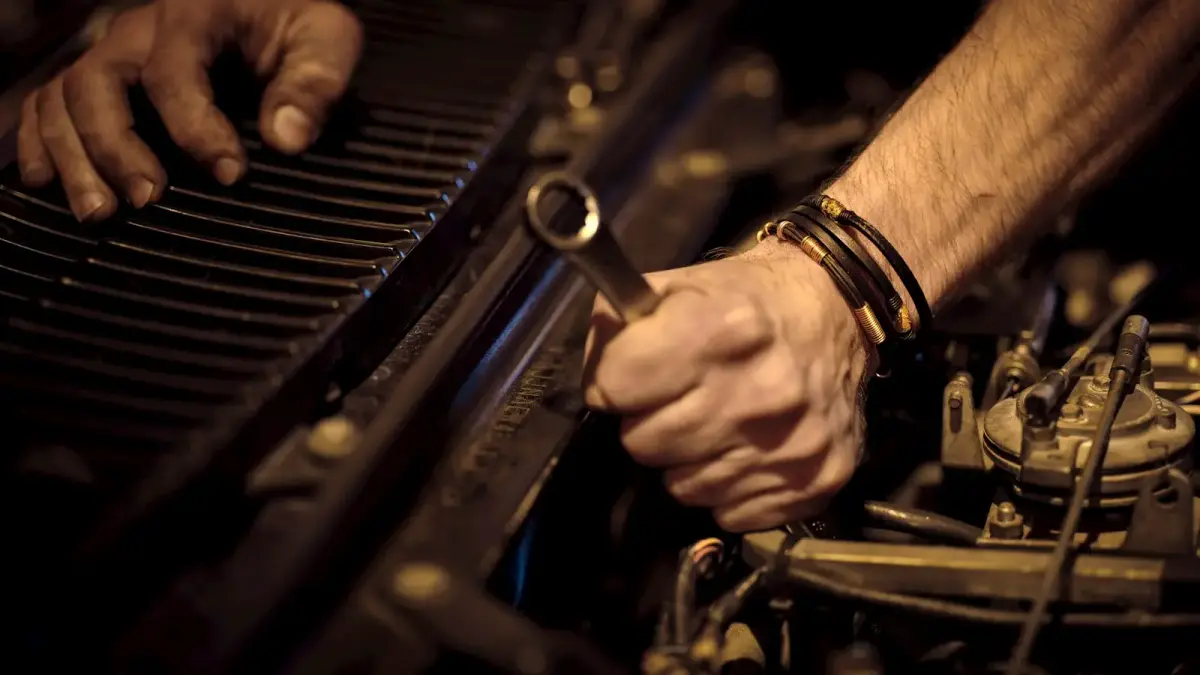
Those hands were enormous to me as a child - rough, cracked across the knuckles, always slightly stained with something. Grease, wood stain, the copper residue from sweating pipes. He could fix anything. A leaking faucet, a broken fence rail, the chain on my bicycle. And when he was done, he would clean each tool individually and place it back in the toolbox in its exact position, the way a musician returns an instrument to its case.
That was the tenderness. That was the love letter. Not the project itself - the care he took putting things away afterward.
I didn’t understand that as a boy. I thought he just liked things tidy. But I understand it now, from this side of sixty, where everything he did looks different when I stop expecting it to look like a Hallmark card.
Objects carry what people couldn’t say
There’s a psychological concept called “continuing bonds,” and it reshaped how grief researchers think about our relationship with the dead. For decades, the prevailing wisdom was that healthy grief meant letting go - detaching from the deceased, moving on, closing the chapter. But a landmark 1996 study by Dennis Klass, Phyllis Silverman, and Steven Nickman, published in their book Continuing Bonds: New Understandings of Grief, found that most bereaved people don’t let go at all. They maintain an ongoing internal relationship with the person they lost. And objects become the physical anchor for that relationship.
My father’s toolbox isn’t a toolbox. It’s a reliquary.
Every scratch on the handle is a Saturday morning. Every worn socket is a conversation we had in the language of doing things side by side without speaking. The Phillips head screwdriver with the cracked handle that he wrapped in electrical tape instead of replacing - that’s him. That’s his entire philosophy of life compressed into a single object. You don’t throw something away because it’s damaged. You find a way to make it work.
I can’t explain this to Karen because the explanation lives in a place that doesn’t connect to my mouth easily. It lives in the part of me that is still eight years old, handing him tools from the box while he lay on his back under the kitchen sink, and the weight of the wrench leaving my palm and entering his was the closest thing to a handshake between a father and son that our family knew how to produce.
The men who grieve in garages
I’m not the only one. I know this because I’ve had this conversation in fragments - at backyard barbecues, at funerals, in the strange confessional space that opens up between men after their second beer.
One friend keeps his father’s fishing rod mounted above his workbench. He hasn’t fished in fifteen years. Another has a jar of wood screws - mixed sizes, most of them slightly rusty - that his father kept on a shelf in the basement. The jar moved with him through three houses across two states. His wife doesn’t ask about it anymore.
We don’t have support groups for this. We don’t journal about it or talk to therapists about the weight of a dead man’s crescent wrench. We just keep the things. We put them somewhere visible enough that we can see them from the corner of an eye but private enough that nobody asks us to explain.
A 2021 study in the journal Psychology of Men and Masculinities found that men process grief more commonly through activity and object attachment than through verbal expression or social support. The researchers noted that this isn’t avoidance - it’s a different pathway to the same emotional destination. The man who keeps his father’s watch isn’t refusing to grieve. He’s grieving every time he opens the drawer and sees it sitting there, keeping time that no longer belongs to anyone.
That’s what my garage is. It’s not a storage space. It’s a chapel with a concrete floor.
What I wish I could tell her
Karen is a wonderful woman. She has asked about the toolbox gently, with genuine curiosity, not impatience. She knows it matters to me. She just doesn’t know why it matters in a way that makes it untouchable, unmovable, permanently installed in our life like a load-bearing wall she can’t see.
If I could find the words, I would tell her this:
That toolbox is the only object in this house that my father’s hands shaped through years of contact. Not built - shaped. The way a river shapes a stone. Every worn edge, every smooth spot on the handle, every groove in the metal tray where a tool slid back and forth ten thousand times - that’s him. That’s the physical record of his life’s motion.
When I was twenty-five, I wanted him to say it. When I was forty, I was angry that he never did. When I was fifty-five, I began to understand that he said it constantly, in a frequency I’d been tuning past my entire life.
And now, at sixty-three, I don’t need him to say it anymore. I know what the toolbox is. I know what it weighs. And the weight isn’t steel.
The inheritance nobody writes a will for
My father left me the house, which I sold. He left me a 2004 Chevrolet pickup, which I drove for three years and then traded in. He left me a savings account that was smaller than expected and a life insurance policy that covered the funeral with a little left over.
None of that is what he left me.
What he left me is a way of standing in a doorway and watching my own son drive away. A habit of checking the tire pressure on my daughter-in-law’s car when she visits. A silence that I used to mistake for emptiness but now recognize as a room that’s full of something too large for the door.
Psychologist Dr. Terrence Real, who has spent decades working with men and emotional literacy, writes about how love in many families gets passed down not through declaration but through acts of maintenance - fixing, building, providing, protecting. The love is in the labor. It’s in the showing up. The problem is that the sons who receive this love often don’t recognize it as love until they’re old enough to give it the same way, and then the recognition arrives like a punch to the chest on a Tuesday afternoon in the garage.
That’s what happened to me. I was putting a wrench back in my own toolbox - the new one, the nice one - and I placed it down carefully, handle facing out, snug against the side of the tray. And I stopped. Because that was him. That exact motion. That care. That was my father’s hand moving through mine.
I stood in the garage for a long time after that.
The toolbox stays
Karen hasn’t asked again. I think she saw something in my face the second time, some flicker of a thing that told her to leave it alone. She’s perceptive like that. She reads me the way I learned to read my father - through what’s present in the silence rather than what’s spoken across it.
The toolbox will stay in the garage. It will stay against the back wall, under the tarp, taking up space that could hold something more useful. And every now and then, I’ll walk past it and let my hand rest on the lid for a moment. Not to open it. Just to touch something that he touched.
That’s enough. For a boy who never heard the words, that’s more than enough.
There are men reading this who know exactly what I’m talking about. You have your own version of the toolbox - a jacket, a pocketknife, a coffee mug with a chip in the rim, a pair of work gloves that still hold the shape of hands that aren’t here anymore. You don’t have to explain it to anyone. You don’t have to justify the space it takes up in your house or in your chest.
Some inheritances don’t fit in an envelope. Some of them only make sense when you hold them, and the holding itself is the conversation you were always trying to have.
Your father said it. He just said it in a language that takes a lifetime to learn how to hear.