He's 63 and just realized that the way he taps the roof of the car twice after closing the passenger door for someone he loves - that double pat against the metal before walking around to the driver's side, a gesture so automatic his hand moves before his mind catches up - is the exact motion his father made every time he closed the car door for his mother, and the man who thought he was signaling 'all clear' was performing the only benediction his father ever learned to give without speaking
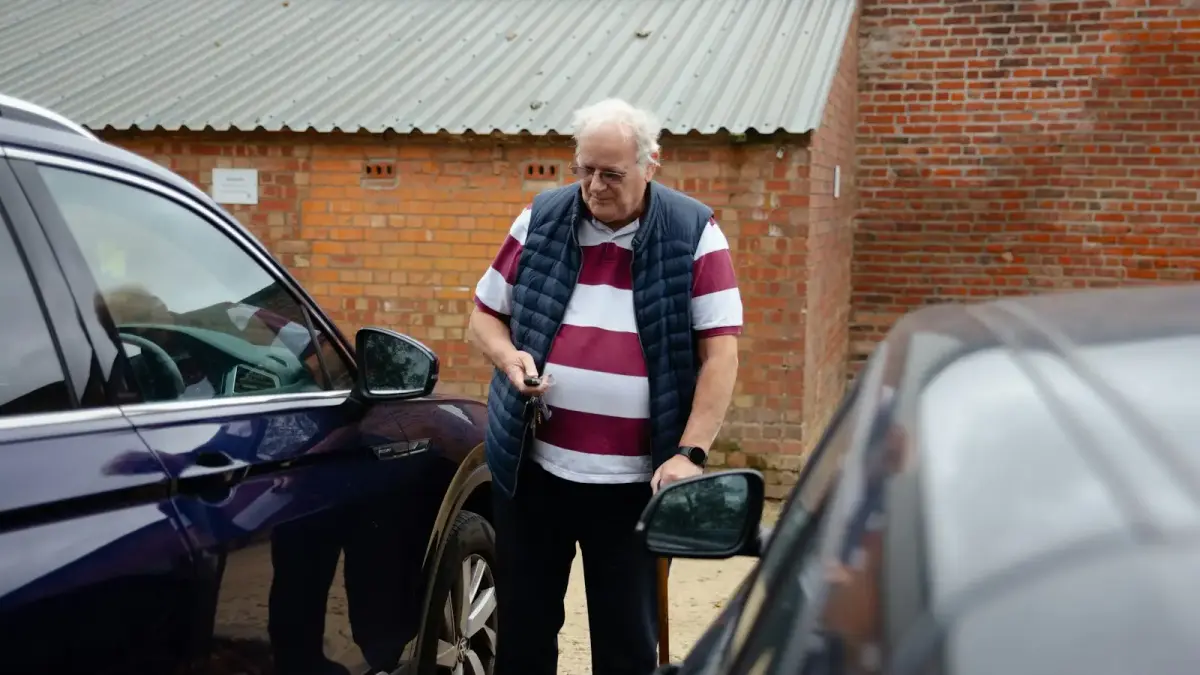
I watched my hand do it last Tuesday before I understood what I was seeing.
My wife had just settled into the passenger seat. I closed the door - firm but careful, the way you close a door for someone whose body you’ve memorized over forty years. And then my right hand rose on its own, landed flat against the roof, and tapped twice. Two quick pats against the warm metal. I walked around to the driver’s side without thinking.
But this time, something caught. Some snag in my attention. I stopped mid-step and stood in the parking lot of a grocery store at three in the afternoon, feeling the ghost of my father standing where I was standing, his palm against a different roof, a different decade, the same gesture traveling through time like it had never left his hand.
I’m 63 years old, and I have been performing a ritual I never chose.
The tap that isn’t a tap
If you asked me why I do it, I would have told you it means “all clear.” Door is shut, you’re safe, I’m coming around. A functional signal. Mechanical. Practical.
Except it isn’t any of those things.
Because I don’t do it when I close the trunk. I don’t do it when I shut the back door after loading groceries. I don’t do it when anyone else gets in the car - a colleague, a neighbor, the guy from the shop I’m giving a ride to.
I only do it when I close the door for someone I love.
My wife. My daughter. My mother, when she was still alive and I drove her to appointments on Wednesday mornings. The double-tap appeared for them and only them, as reliable as a heartbeat, as unconscious as breathing.
That selectivity should have told me something years ago. A mechanical signal doesn’t choose its audience.
Watching him do it first
My father was not a man who said much about what he felt. He was born in 1932, raised in a house where affection was expressed through labor and presence, not language. He loved my mother with a devotion that was visible to everyone who watched them together but nearly invisible in anything he ever said out loud.
He opened the car door for her every single time. Not as performance. Not as chivalry he’d read about somewhere. He did it the way you breathe - because not doing it would feel like suffocation.
And every time he closed that door, his hand came up and tapped the roof twice. Two pats. Then he walked around to his side, got in, and started the engine.
I must have watched him do it ten thousand times. From the back seat as a boy. From the driveway as a teenager. From across parking lots as an adult visiting on weekends. The gesture was so consistent it became invisible - part of the scenery of their marriage, like the way she always touched his shoulder when she passed behind his chair.
He never explained it. I never asked about it. It existed in that vast territory of things families do that nobody narrates.
The body remembers what the mind forgets
A 2019 study published in Psychological Science found that motor behaviors - physical gestures, habitual movements, postural patterns - transfer between generations with remarkable fidelity, often without any conscious teaching or imitation. The researchers called it “embodied intergenerational transmission,” and their data showed that children absorb the physical vocabularies of their parents the way they absorb grammar: not through instruction but through exposure.
You don’t learn to tap the roof of a car. You absorb it the way a dialect settles into your mouth. Your muscles watch. Your tendons take notes. And decades later, your hand rises without permission and performs a ceremony you never agreed to carry.
I think about this constantly now. How many of my gestures are mine? How many are echoes? When I rest my hand on the back of my wife’s neck while we stand in line somewhere, is that me or is that a movement my body borrowed from a man who couldn’t say “I love you” without his voice cracking, so he said it with his hands instead?
Daniel Goleman writes about how emotional learning lives in the body long after the mind has stopped paying attention. The amygdala stores what language can’t hold. And the body performs what the heart can’t articulate, especially in men who were raised to treat vulnerability like a structural weakness.
My father’s generation didn’t have a vocabulary for tenderness. They had gestures.
What the tap actually says
I’ve been trying to translate it. Two pats on the roof of a car - what does that mean in the language of men who were never taught the language of feeling?
Here is what I think it says.
It says: the door is closed, and you are enclosed, and I am the one who enclosed you, and now I will walk around to my side and take us where we’re going. It says: for these few seconds, while I circle the car, you are inside something I sealed shut with my own hands. It says: I checked. You’re safe.
It says: I cannot put my palm against your face in a parking lot because I am a man born in a decade that made that gesture feel impossible. But I can put my palm against this metal that sits between you and the world, and I can pat it twice like a heartbeat, and that will have to be enough.
A 2021 study in Frontiers in Psychology examined how men in older age cohorts express attachment through what the researchers called “protective micro-rituals” - small, repetitive physical actions that communicate care without requiring emotional disclosure. Opening doors, checking locks, adjusting thermostats, walking on the street side of the sidewalk. These gestures carry relational meaning that the men performing them rarely articulate and sometimes don’t consciously recognize.
The double-tap is one of those rituals. It is a benediction disguised as a habit.
The moment my daughter noticed
Last Thanksgiving, my daughter rode with me to pick up the pie from the bakery. I opened her door, she got in, I closed it, and my hand rose and tapped the roof twice.
From inside the car, muffled through the glass, I heard her laugh. When I got in, she was looking at me with an expression I couldn’t read.
“You know you do that, right?” she said.
“Do what?”
“The tap. The two taps on the roof. You do it every time.”
I told her it was just a habit. Just signaling that the door was shut properly.
She shook her head. “Grandpa used to do the exact same thing. The exact same way. Two taps, right hand, flat palm.”
I didn’t say anything for a while after that. I drove to the bakery with both hands on the wheel and a thickness in my throat that I couldn’t explain to her without becoming someone I don’t know how to be in front of my children.
She was right, of course. She’d been watching the way I once watched. Absorbing the gesture from the back seat. Filing it somewhere in a body that would carry it forward without instructions.
What gets passed down without a word
Research on intergenerational behavior patterns from the Journal of Personality and Social Psychology has shown that the physical habits of parents often persist in their children well into middle and late adulthood - long after the original context has disappeared. The way a father crosses his arms during difficult conversations. The way a mother touches her collarbone when she’s thinking. These are not genetic. They are not learned. They are something in between - absorbed gestures that live in the connective tissue of families, passed down like heirlooms nobody remembers packing.
My father has been dead for eleven years. His hands are gone. The particular weight of his palm, the roughness of his fingers, the way his wedding ring clicked faintly against the metal when he tapped - all of that is gone from the physical world.
Except it isn’t.
Because last Tuesday, in a grocery store parking lot, his hand came up and tapped the roof of a car. It just happened to be attached to my arm.
The blessing you didn’t know you were giving
I don’t think my father knew he was blessing my mother every time he closed that door. I don’t think he would have used that word. He would have said what I would have said - it’s just something I do, it doesn’t mean anything, stop reading into it.
But we would both be wrong.
Some gestures outlive the people who made them. Some gestures are more honest than any sentence. And some men spend sixty years performing an act of love so quiet that even they don’t hear it - a two-beat prayer against the roof of a car, a whispered “you are safe, I am here, we are going together.”
I still do it. Every time. I close the door for my wife, and my hand rises, and I tap twice, and I walk around to my side.
But now I know what I’m saying. And now I let myself feel the weight of a palm that hasn’t existed for over a decade, pressing gently against mine from the other side of the metal, tapping along with me. Two pats. Always two. The exact same rhythm, inherited like a heartbeat - the only love letter my father ever wrote, delivered one tap at a time, and still being sent.