He's 65 and just realized he has never once thrown away a cardboard box without first breaking it down flat and stacking it behind the water heater in case it could be useful for something - because his father saved every box, every jar, every length of wire, and a boy who watched a man build garage shelves from a neighbor's discarded moving boxes learned that throwing something away without first imagining what it could become was a luxury only people who could afford to buy things new were permitted
My father never once put a cardboard box in the trash whole.
I know this because I watched him for eighteen years, and in eighteen years I never once saw him toss a box without first running his thumbnail along the seam tape, popping the flaps open, pressing the whole thing flat against his thigh, and sliding it behind the water heater where a stack of forty identical flattened boxes lived like a filing system for things that hadn’t found their purpose yet. He did this with the focus of a man performing surgery. He did it the way other fathers washed their cars on Saturdays - like it was a small, necessary act of order in a life that didn’t always cooperate.
I am sixty-five years old. And last Tuesday, standing in my garage with an Amazon box in my hands, I realized I was doing the exact same thing. Thumbnail along the tape. Flaps open. Pressed flat. Slid behind the water heater. Forty boxes deep.
Nobody assigned me this task. Nobody asked me to maintain this collection. I have been building it for decades without ever consciously deciding to.
The Museum Behind the Water Heater
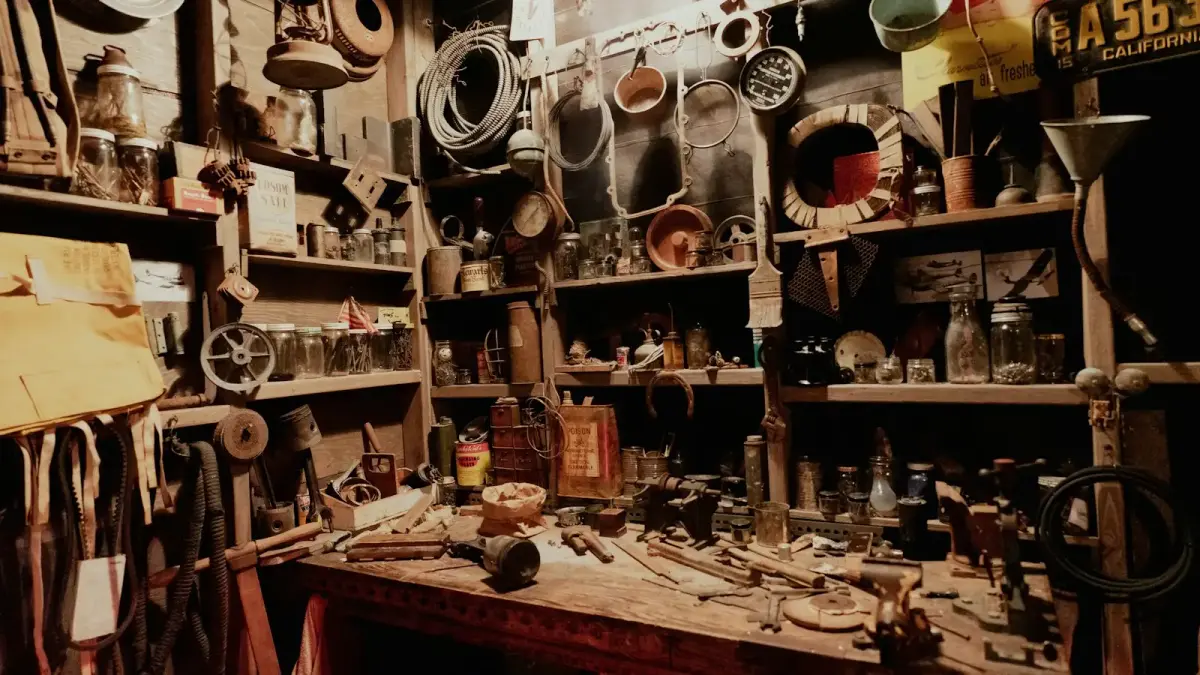
My father’s garage was not a garage in the way most people use that word. It was a library. A warehouse. A temple to the idea that nothing is finished being useful just because its first job is done.
Coffee cans sorted by nail size - finishing nails in the Folgers can, roofing nails in the Maxwell House. Bread bags folded into tight triangles and stored in a shoebox on the third shelf. Rubber bands saved from the morning newspaper, balled together into a sphere the size of a grapefruit. Lengths of wire coiled around themselves and hung from nails he’d driven into the exposed studs at exactly the same height, evenly spaced, like an art installation nobody had commissioned.
Every object in that garage had been rescued from someone else’s trash or saved from our own. The shelving unit itself was built from boxes - actual cardboard boxes, reinforced with scrap plywood he’d gotten from a neighbor’s fence project. The neighbor threw the scraps in a pile by the curb. My father was there with his truck before the pile sat for an hour.
I used to think this was embarrassing. I was twelve, and my friends’ fathers had real shelves from Sears. My father had cardboard engineering held together with wood glue and conviction.
I didn’t understand yet what I was looking at.
The Theology of Waste
In the house I grew up in, waste was not an environmental concern. Nobody in 1972 was talking about carbon footprints in working-class neighborhoods in eastern Ohio.
Waste was a moral category. It sat right next to laziness and ingratitude in the hierarchy of sins my parents carried but never named. You don’t throw away what someone else would have been grateful to have. You don’t discard what still has a use you haven’t imagined yet. You don’t act like things are replaceable, because acting like things are replaceable is something rich people do, and we are not rich people.
This was never spoken as a lecture. It was demonstrated. My father didn’t sit me down and explain the economics of scarcity. He just flattened boxes in the garage every evening after dinner and let me watch.
A 2019 study published in the Journal of Personality and Social Psychology found that people who grew up in resource-scarce environments develop what researchers call “conservation cognition” - a persistent tendency to evaluate objects for potential future use, regardless of their current financial stability. The researchers found that this pattern persists for decades after the original scarcity ends. The brain, once trained to see potential in discarded things, never fully unlearns the habit.
My father has been dead for eleven years. His brain taught my brain. And my brain still sees a cardboard box and thinks: not yet.
What the Saving Was Really About
Here is what took me fifty years to understand. The saving was never about the objects.
My father was not a hoarder. His garage was immaculate. Everything had a place. Everything was sorted, stacked, labeled in his careful block handwriting on strips of masking tape. This was not chaos dressed up as thrift. This was order. This was a man who could not control his paycheck or his foreman or his lower back or the transmission in the Chevy - but he could control this. He could make sure that nothing in his possession went to waste.
Psychologist Sendhil Mullainathan, whose research on scarcity has reshaped how we understand poverty, describes this kind of behavior as “tunneling” - a deep cognitive focus on managing limited resources that becomes so ingrained it functions like identity. It’s not a choice. It’s architecture. The mind literally builds itself around the constraint.
My father didn’t save boxes because he was afraid of running out of boxes. He saved boxes because saving things was the only proof he had that he was a careful man in a careless world. The saving was dignity. The saving was evidence that he paid attention, that he noticed, that he did not take the ordinary gifts of life and throw them away without consideration.
The box was never about the box. It was about a man who could not afford to believe that anything was disposable. Including himself.
The Flattening as Prayer
I want to tell you about the physical act itself, because it matters.
There is a specific way you break down a cardboard box if you learned it from a man like my father. You don’t stomp on it. You don’t tear it. You find the seam where the tape holds the bottom closed, and you run your thumbnail along it with the precision of someone opening a letter they’ve been waiting for. You pop each flap free. You press the whole thing flat, and you press it firmly, because a box that’s been flattened carelessly will spring back open and take up more space than it deserves.
Then you carry it to the stack. And you place it on top of the other flattened boxes, aligning the edges, because a neat stack is a respectful stack, and a respectful stack is one that honors the work of making it.
I do this every single time. Every Amazon delivery. Every shoe box. Every appliance carton I carry in from the car. I do it without thinking, and I do it with the seriousness of a man saying grace before dinner. The ritual has its own gravity. My hands know the motions the way a pianist’s hands know the keys.
Adam Grant writes about what he calls “identity echoes” - the small, automatic behaviors we inherit from the people who raised us, behaviors that persist long after we’ve forgotten where they came from. We think they’re preferences. We think they’re personality. They’re actually someone else’s survival strategy, living on in our muscle memory.
My father’s hands taught my hands. And my hands still pray in cardboard.
What My Children Will Never Understand
My son is thirty-seven. Last Thanksgiving, I watched him open a package, glance at the box, and carry it directly to the recycling bin. He didn’t break it down. He didn’t pause. He didn’t tilt his head and think about what that box could become if you just gave it a minute.
He threw it away the way you throw away a napkin.
I felt something in my chest that wasn’t anger. It was grief. Not for the box - I know it’s a box. It was grief for the world my father built, the world where every object carried the weight of its own potential, where a man’s worth was partly measured by his ability to see use where others saw trash. That world was becoming invisible, and my son was standing in its absence without knowing it had ever existed.
I don’t blame him. His life has been different. He grew up in a house where the heat was always on and the fridge was always full and new things arrived on the porch every other day in boxes that had crossed the country overnight. He never had to imagine a second life for a cardboard box because he never had to imagine a second life for anything. Everything was replaceable. Everything was available. Everything was new.
That is a kind of freedom I wanted for him. I worked for decades so he could have it.
But there is something in that freedom that also feels like forgetting. And I am not sure how to mourn something that no one else recognizes as lost.
The Inheritance You Carry in Your Hands
If you are reading this, and you are the kind of person who breaks down every box, who saves jars, who keeps a drawer full of twist ties and rubber bands and plastic bags folded into neat squares - I want you to know something.
You are not being ridiculous. You are not being a hoarder. You are not stuck in the past.
You are performing a faith. A working-class faith that says every object carries a second life if you have enough imagination and not enough money. A faith that says paying attention to small things is not small. A faith your father or your mother or your grandmother taught you with their hands, not their words.
Brene Brown talks about how shame attaches itself to the things we do automatically - the habits we can’t explain, the compulsions we hide from people who might not understand. But some of those habits aren’t shame. They’re love. They’re loyalty. They’re a man in a garage in 1974 showing his son that care looks like flattened cardboard and sorted nails and nothing wasted.
I am sixty-five. I have a retirement account and a paid-off mortgage and enough money to buy any box I need from any store at any time.
And I will never, for the rest of my life, throw away a cardboard box without first breaking it down flat, pressing it smooth, and sliding it behind the water heater. Because my father taught me that the world is full of things other people overlook. And the men who notice - the men who stop and flatten and save and imagine - those men are not foolish.
Those men are the ones who built everything the rest of us stand on.