There are men who have sat in the same booth at the same diner every Saturday morning for fifteen years and the waitress who refills their coffee without asking is not a stranger but the only person in their lives who knows exactly how they take it and has never once needed anything in return, and at fifty-eight the cracked vinyl seat by the window is not a habit but the only room in the world where being known does not come with a cost
He doesn’t remember the first Saturday. That’s the honest part. It wasn’t a decision. It was more like the way a river finds a groove in soft rock - not all at once, but slowly, through repetition, until one morning the channel is there and the water doesn’t know how to go any other way.
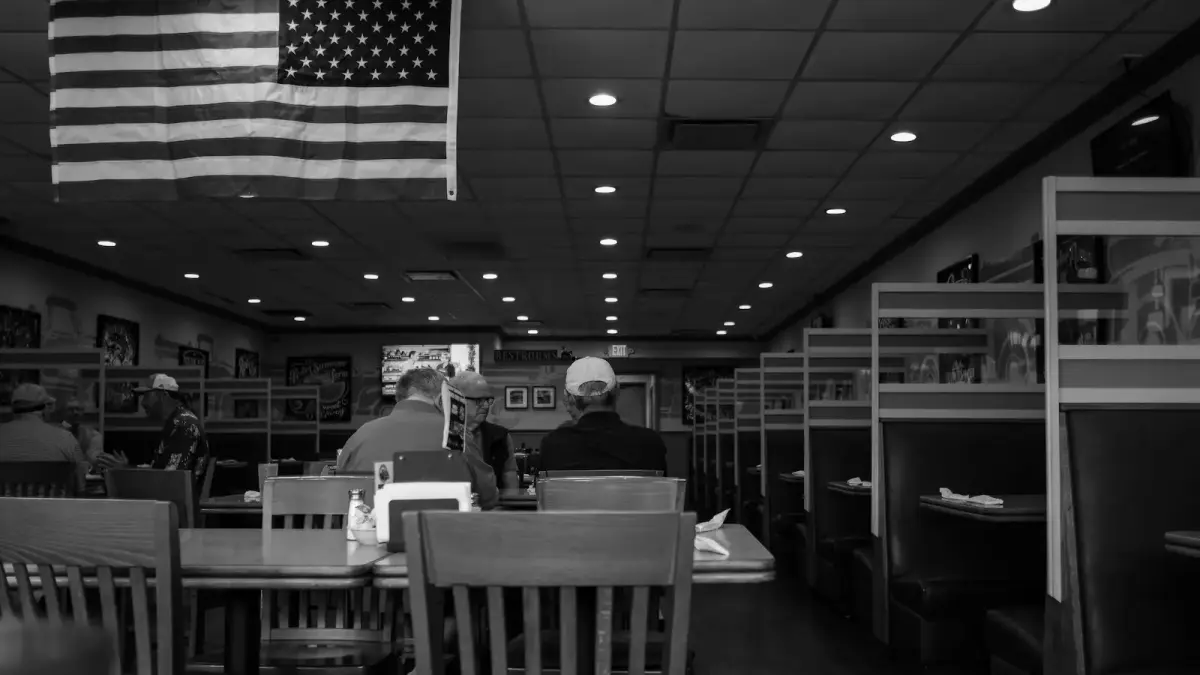
The booth is the third one from the door, by the window. The vinyl is cracked in two places on the left side where the sun hits it. The table has a wobble that he fixed years ago with a folded sugar packet, and nobody has ever removed it.
He arrives at seven-fifteen. Coffee is already poured by the time he sits down. Donna doesn’t ask anymore. She hasn’t asked in years. Two sugars, no cream, and a small glass of ice water on the side because his doctor told him something about hydration once and it stuck the way certain pieces of advice stick - not because they’re important, but because they came from someone who seemed to care whether he lived or died.
And that is the thing I want to talk about. Not the coffee. Not the booth. The specific, quiet architecture of a man’s life at fifty-eight, and the room where he finally gets to stop performing it.
The room that asks nothing
There is a concept in sociology that I think about constantly. Ray Oldenburg, in The Great Good Place, wrote about what he called “third places” - spaces that are neither home nor work, where people gather without obligation. The barbershop. The pub. The park bench where the same four men have played chess since 1987.
Oldenburg argued that these places are essential to civic life. But I think he undersold something. For certain men - quiet men, men who grew up in houses where they were assigned a role before they were old enough to refuse it - third places are not just nice. They are the only rooms where they are allowed to exist without function.
At home, he is a husband. A father. A provider. A man whose value is measured in problems solved and burdens carried without complaint. At work, he is a title. A set of tasks. A body in a chair that other people need things from.
At the diner, he is just the guy in the third booth. And that is the most complete version of himself he gets to be all week.
What the waitress actually carries
Donna knows things about him that his wife does not. Not secrets. Nothing dramatic. She knows that he reads the obituaries first, not because he’s morbid but because he once told her, on a quiet Tuesday morning when he came in off-schedule after a funeral, that he likes to see who made it to ninety. She knows he orders the eggs over-medium even though the menu says over-easy because she learned to tell the cook without him asking. She knows he doesn’t talk much before his second cup, and she doesn’t take it personally.
She knows these things because she watched. Not the way a therapist watches, or a wife watches, or a friend watches. She watched the way a person watches when they have no stake in what they see. No agenda. No disappointment waiting on the other side of the observation.
A 2018 study published in the Journal of Social and Personal Relationships found that people often reported feeling more authentically themselves around what the researchers called “weak ties” - acquaintances, baristas, the neighbor who waves but never comes inside. The reason was paradoxical. Because these people knew less, they expected less. And because they expected less, the person didn’t have to curate. Didn’t have to manage. Didn’t have to show up as the version of themselves that kept someone else comfortable.
Donna is the purest version of a weak tie. She is the woman who has watched him for fifteen years and has never once used what she knows against him.
The newspaper and the luxury of unwitnessed time
He reads the paper cover to cover. He is probably the last man in his zip code who still gets ink on his fingers on purpose. Sports first, then local, then the crossword, then the obituaries. He takes his time. He is not efficient about it. He is not productive about it. He does not skim.
And this is the part I want to sit with, because it matters more than it seems.
Nobody is waiting for him to finish. Nobody is sighing in the next room. Nobody is refreshing a screen, shifting their weight, giving off the subtle radiation of a person who needs you to be done so they can have their turn with your attention. He is alone in the most generous sense of the word - alone the way Susan Cain described it in Quiet, not as absence but as presence. The presence of the self, uninterrupted.
Cain wrote about solitude as a need for certain temperaments, not a deficit. She was mostly talking about introverts in open-plan offices and children in collaborative classrooms. But I think the truest application of her work sits in a cracked vinyl booth on a Saturday morning, turning pages slowly, because nobody taught him the word “introvert” and he wouldn’t use it if they had. He just knows that this hour is the hour when his breathing changes. When his shoulders drop a quarter-inch. When something in his chest loosens that he didn’t know was tight.
The other regulars and the grammar of the nod
There are other men. They don’t sit together. That’s important.
There’s a man in a feed cap two booths down who has been coming here almost as long. They nod. They have exchanged maybe three hundred nods over the course of fifteen years and perhaps forty total sentences. Both of them would attend the other’s funeral. Neither of them could tell you the other’s last name.
This is a kind of intimacy that our culture does not have a word for. It is not friendship, exactly. It is not brotherhood. It is something older and stranger - a recognition between two people who have chosen the same room for the same reason, and who understand, without ever discussing it, that the reason is sacred precisely because it goes unnamed.
A 2021 study in Psychological Science found that even minimal, repeated social contact - the kind that happens in barbershops, coffee counters, and neighborhood walks - contributed significantly to a person’s sense of belonging. Not because the interactions were deep. Because they were reliable. The researchers called it “relational density.” I call it something simpler. Showing up.
These men have been showing up for each other without ever calling it that. The nod is not small talk. The nod is a complete sentence. It says: I see you. I expect nothing. I’ll be here next week.
What the tip is actually paying for
He tips too much. He has always tipped too much. Donna has told him more than once, and he waves it off the way he waves off most forms of attention directed at him - quickly, with a slight shake of the head that means don’t make a thing of it.
But I think the tip is a thing, whether he wants it to be or not.
Gratitude is the only currency he knows how to spend freely. He grew up in a house where affection was transactional - not cruel, not cold, just structured. You earned warmth by being useful. You kept it by staying small. Somewhere along the line he learned that the safest way to say thank you was with money, because money doesn’t require eye contact. Money doesn’t make the room complicated. Money says what he means without making him find the words.
The extra three dollars on a six-dollar check is not generosity in the way most people would define it. It is the closest thing he has to a love language, expressed every Saturday to the one person in his week who has never charged him anything for knowing his name.
The seat by the window
The window faces the parking lot. There is nothing beautiful about the view. A Chrysler with a dented fender. The edge of a laundromat. A road that goes to the highway if you turn left or to the feed store if you turn right.
He doesn’t sit by the window for the view. He sits by the window because of the light. At seven-fifteen on a Saturday in any season, the light comes in at an angle that warms the left side of his face and makes the coffee steam visible, and he has never once thought about this consciously but his body knows it. His body chose this booth the way an animal chooses the warm rock. Not with reason. With something older.
Virginia Woolf wrote about a room of one’s own. She meant a physical space where a woman could close the door and think without interruption, without the weight of domestic expectation pressing in. She was talking about writing, but she was also talking about selfhood - the idea that you cannot fully become a person until you have a place where no one else’s needs are louder than your own.
This man has his version. He does not own it. He rents it one Saturday at a time, at the cost of a plate of eggs and a tip that is always too large. But for one hour every week, the booth by the window is his room. The only room where he is not a husband or a father or an employee or a problem-solver. The only room where he is simply a man who showed up, and that was enough.
He’ll be back
The bell above the door makes a sound when he leaves that Donna can identify without looking up. She knows his footstep. She knows the particular weight of his exit - not heavy, not rushed, just certain. The way a man walks when he has somewhere to be but is not in a hurry to get there.
He folds the newspaper under his arm. He leaves the exact change plus the extra bills fanned out beneath the water glass, because putting money directly into someone’s hand would require a moment he is not built for. He nods at the man in the feed cap. The man in the feed cap nods back.
The booth is empty for about forty-five seconds before Donna wipes it down. She doesn’t reset it all the way. She leaves the sugar packet under the table leg. She doesn’t even think about it anymore. It’s just part of the booth now, the way he is.
He’ll be back next Saturday. Same time. Same seat. Same coffee, same newspaper, same waitress who does not know - and he would never tell her - that she is the most important appointment on his calendar. Not because of what she gives him, but because of what she has never asked him to be.
And that cracked vinyl seat by the window, in a diner that will probably close in five years because nothing that matters ever gets to stay - that seat is not a habit. It was never a habit.
It is the only room in the world where being known does not come with a cost. And he will keep paying for his eggs every Saturday morning until the room is gone, or he is, because that is what a man does with the only place that ever loved him the way he needed to be loved.
Quietly. Without conditions. And without ever once asking him to explain why he keeps showing up.