There are men who walk into every family gathering, every barbecue, every birthday party and immediately look for something to do with their hands - who take over the grill or start collecting plates or offer to fix something in the garage - not because they love being helpful but because a boy who never quite felt he had earned his seat at the table discovered that usefulness was the only form of belonging no one could take away from him
The scan
He walks in and he does not sit down.
He does not grab a drink. He does not join the circle of cousins catching up by the cooler. He does not lower himself into one of those plastic chairs on the patio and stretch his legs out like a man who feels entitled to rest.
He scans.
His eyes move across the yard the way a lifeguard watches a pool - not casually, not socially, but with a specific kind of alertness. He is looking for the thing that needs doing. The grill that nobody has started yet. The garbage bag that is getting full. The folding table with one wobbly leg. The aunt who needs a ride to the pharmacy before it closes.
Within ninety seconds of arriving, his hands are full.
I know this man. I have been this man. I am still, on most days, this man. The one who shows up at a barbecue and feels a low hum of panic in his chest until he finds a task. The one who volunteers to pick up ice when no one asked for more ice. The one standing at the grill for three hours, flipping burgers he barely eats, because the grill is a station and a station is a role and a role means no one is going to turn to him and say the thing he has been afraid of hearing since he was nine years old.
Why are you here?
The negotiation nobody sees
People call this helpfulness. They say he is generous, dependable, the kind of guy you can always count on.
And he is. That part is real.
But underneath the helpfulness is something older and quieter, something that started long before he could name it. It is a negotiation. An ongoing, decades-long deal he struck with every room he has ever walked into: I will make myself useful, and in exchange, you will let me stay.
He does not experience social gatherings the way people who feel naturally welcome experience them. He does not walk through the door and assume he belongs. He walks through the door and begins earning his presence, the same way he earned it as a child - by doing, by fixing, by carrying, by making himself so functionally necessary that removing him would create a problem.
A 2019 study published in the Journal of Personality and Social Psychology found that men who scored high on what researchers called “contingent self-worth” - the belief that their value depends on external validation - were significantly more likely to engage in compulsive helping behaviors in social settings. Not because they felt generous. Because they felt conditional.
That word matters. Conditional.
He learned, somewhere very early, that his presence in a room was not a given. It was a lease. And the rent was usefulness.
The boy at the edge of the room
Most men who do this can trace it back to a specific texture of childhood. Not necessarily abuse. Not necessarily neglect in any way that would show up on a report.
Something subtler.
Maybe a father who only softened when his son helped with the car. Maybe a household where praise was transactional - you got warmth when you did something, and silence when you simply existed. Maybe a family dinner table where the kid who sat quietly was invisible, but the kid who got up to clear plates was suddenly seen.
He learned the equation young. Presence minus usefulness equals vulnerability. Presence plus usefulness equals safety.
And so he became the boy who carried things. The boy who offered to help before anyone asked. The boy who mowed lawns and held doors and stayed late to stack chairs after the school assembly, not because he was responsible but because responsibility was the only language the adults in his life reliably responded to.
Gabor Mate has written about this pattern - the way children who do not feel securely attached will develop adaptive strategies to maintain proximity to caregivers. For some children, the strategy is performance. For others, it is silence. For boys like this one, it is utility. You become the tool the household cannot function without, and in doing so, you make yourself unremovable.
It works. That is the cruel part. It works beautifully.
The grill is not a grill
If you have ever watched a man at a barbecue - really watched him - you have seen something that looks like relaxation but is actually architecture.
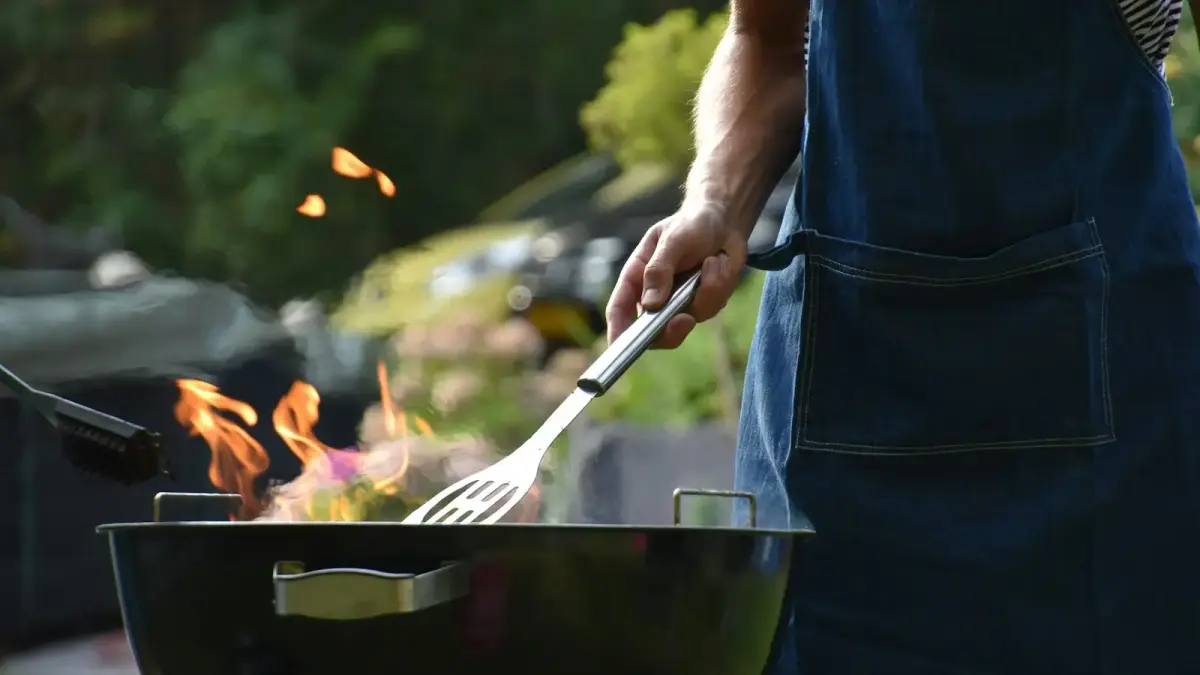
He is standing at the grill because the grill is a defined position. It has clear inputs and outputs. It gives him a reason to be in the yard without having to make conversation he has not rehearsed. It lets him face the food instead of the circle of faces. It provides a continuous stream of small tasks - flip this, check that, adjust the heat - that keep his hands busy and his mind occupied with something other than the dull, persistent question: do these people actually want me here, or do they just tolerate me?
The grill is a role. And a role is armor.
The same man will collect bottles from the table when the conversation turns personal. He will offer to drive someone to the airport at an inconvenient hour. He will fix the screen door during Thanksgiving while everyone else is watching football. He will build a deck no one asked for. He will assemble furniture for friends who just moved, arriving with his own tools, staying for seven hours, leaving before dinner is served.
Not because he does not want to stay for dinner.
Because dinner is the part where you sit down with nothing in your hands, and sitting down with nothing in your hands is the part where the old feeling comes back - that he is taking up space he did not earn.
The women who notice
The women in these men’s lives often describe the same confusion.
She watches him arrive at her parents’ house and immediately disappear into the kitchen to wash dishes that are already clean. She sees him at their daughter’s birthday party, running the bouncy castle instead of sitting with the other parents. She finds him in the garage during Christmas, reorganizing shelves no one cares about.
She says: “You can just sit with us. You don’t have to do anything.”
And he nods. He says “I know.” He means it. And then he gets up to check if the driveway needs shoveling.
It is not stubbornness. It is not that he does not hear her.
It is that “just sitting” requires a belief he does not have - the belief that his company, without a task attached to it, is enough. That people want him in the room because of who he is, not what he does.
A 2021 study in Frontiers in Psychology found that adults with insecure attachment styles were significantly more likely to use what researchers called “instrumental helping” - helping as a means of relationship maintenance rather than genuine altruism. The helping was real. The motivation was survival.
She is asking him to rest. He is hearing her ask him to be vulnerable. And vulnerability, for a man who spent his childhood earning the right to stay in rooms, feels like handing back the only currency that ever kept him safe.
What he is actually afraid of
If you asked him directly, he would probably say he just likes staying busy. That he gets restless. That he is not good at small talk. That sitting around feels lazy.
These are the stories he tells himself, and they are not lies exactly. They are translations.
What he means is: I am afraid that if I stop being useful, you will finally see that I am not interesting enough, not funny enough, not warm enough to justify my presence here. I am afraid that my company, stripped of function, is not something anyone would choose.
This is not low self-esteem in the way people usually mean it. He may be confident at work. He may be competent, successful, even admired. He may run a department or coach a team or build things with his hands that other men admire.
But there is a difference between professional confidence and the deep, cellular belief that you are welcome simply because you exist. Adam Grant has written about how some of the most generous people are driven not by abundance but by a fundamental anxiety about their own worth - that giving becomes a way of preemptively paying a debt they believe they owe the world for the space they occupy in it.
That is what is happening at the barbecue. He is not grilling burgers. He is paying rent.
The reframe he deserves
Here is what I want to say to this man, because I am this man, and I have spent years learning to say it to myself.
Your helpfulness is real. The care you put into other people’s comfort is genuine. The fact that you notice the wobbly table, the empty drink, the aunt who needs a ride - that is not a flaw. That is an extraordinary attentiveness that most people never develop.
But you did not develop it because you are generous. You developed it because you were afraid. And the boy who developed that skill deserves to know something he was never told clearly enough when it mattered.
You were always allowed to be in the room.
You were allowed to sit down. You were allowed to have empty hands. You were allowed to arrive at the party and do absolutely nothing and still be wanted there. Not tolerated. Wanted.
The lease was a lie. There was no rent. The room was never going to ask you to leave.
A 2023 study published in Psychological Science found that when individuals with contingent self-worth were given explicit reassurance of unconditional belonging, their compulsive helping behaviors decreased - not because they stopped caring, but because they finally had the internal permission to help from desire rather than from fear.
That is the shift. Not from helpful to selfish. From obligated to free.
Sitting down
I still go to the grill at barbecues. I still collect plates. I still notice the thing that needs fixing before anyone else does.
But sometimes now, I sit down first.
Not for long. Not comfortably. There is still a moment, every time, where my hands feel dangerously empty and the old negotiation starts whispering - get up, do something, earn this.
I let it whisper. I stay in the chair. I hold my drink and I look at the people around me and I practice believing something that the boy I was never got to learn.
That I am not here because I am useful. I am here because I was invited. And the invitation did not come with conditions.
If you recognize this man - if you are this man, or you love this man - know that his hands are not restless because he is industrious. They are restless because they were never allowed to be still. And every time he sits down with nothing to carry, nothing to fix, nothing to clean, he is doing the bravest thing he knows how to do.
He is letting himself be enough.