There are men who still remember the exact score of a game they watched with their father thirty years ago but cannot remember the last time their father told them he was proud, and the sports statistics they carry like scripture are not about the game at all but about the only version of closeness a boy was ever offered, and the man at fifty-three who can recite every detail of that afternoon is still trying to say I needed more from you in the only language his father ever spoke
I can tell you the exact score. Dodgers 6, Cardinals 2. Game five. October 1993.
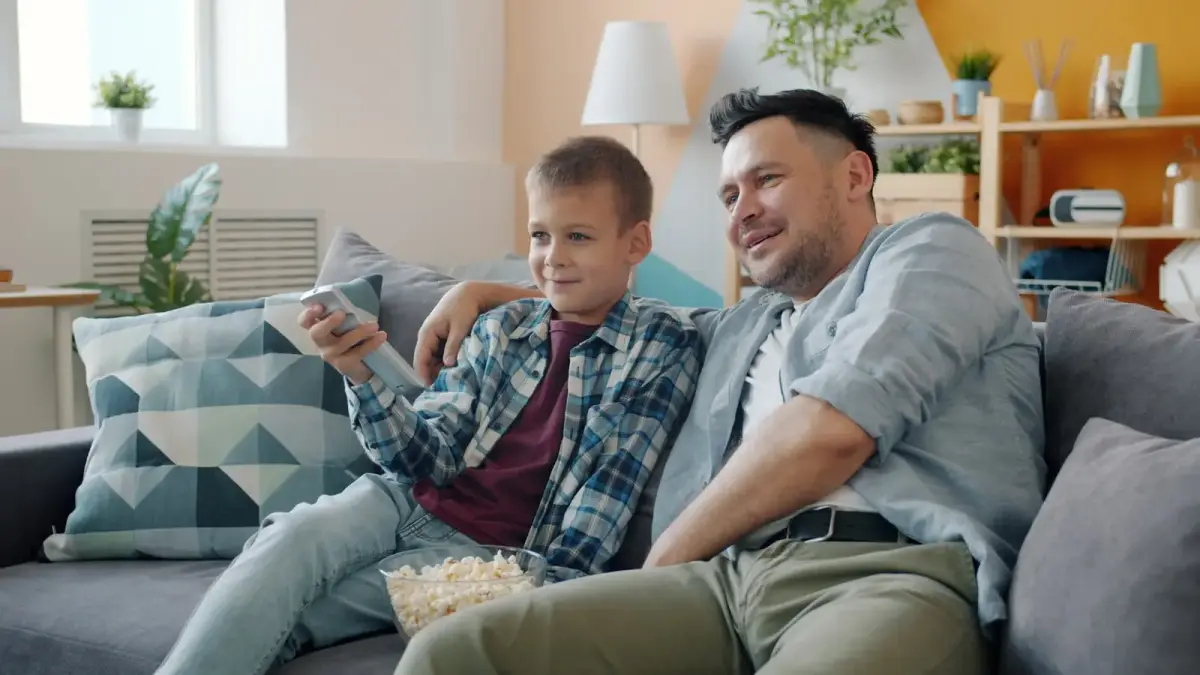
I was eleven years old, sitting on a couch that smelled like cigarette smoke and Old Spice, and my father had his hand on my shoulder for approximately eight seconds after the final out. I know this because I counted. Not then - I didn’t count then. I count now, in memory, because that touch was so rare that my body catalogued it the way you’d press a wildflower into a book.
I can tell you what inning Piazza hit the double. I can tell you the temperature outside. I can tell you that my father opened his second beer at the top of the third and his third at the bottom of the sixth and that he said “hell of a game” as he turned off the television, and that those four words felt, at the time, like the warmest thing anyone had ever said to me.
What I cannot tell you is the last time my father told me he was proud of me. I’ve searched that archive - the same brain that preserved pitch counts and batting averages with photographic fidelity - and the file is either empty or was never created.
I don’t think I’m unusual in this. I think there are millions of us.
The language no one taught us to translate
My father didn’t have a vocabulary for love. Not the way we think of vocabulary now - words, declarations, the stuff you’re supposed to say to your children so they grow up knowing they matter. His vocabulary was different. It was built from box scores and pennant races and the slow grammar of sitting beside someone for three hours without having to explain why you’re there.
He didn’t say “I want to spend time with you.” He said “game’s on at seven.”
He didn’t say “I’m glad you exist.” He said “grab me a beer and sit down.”
And I learned to hear love in those translations. I became fluent in a language that had no word for love but conveyed it through proximity, through shared attention, through the mutual worship of something happening on a screen that gave us permission to be in the same room without the terrifying expectation of actually talking.
A 2021 study published in the Journal of Family Psychology found that fathers who grew up in homes with limited emotional expression were significantly more likely to use shared activities - particularly sports viewing - as their primary bonding mechanism with their sons. The researchers called it “parallel intimacy” - closeness achieved not through face-to-face emotional exchange but through sitting side by side, focused on a third object.
That third object was everything. It was the reason we could exist together.
What the statistics are actually holding
I know men who can recite the starting lineup of the 1986 Mets the way other people recite prayers. They know batting averages to the third decimal point. They know ERAs and on-base percentages and the exact sequence of plays that led to a walk-off in a game that happened before some of their coworkers were born.
And if you asked them when their father last said “I love you,” they’d change the subject. Or laugh. Or say something like “that’s not really how my old man operated.”
The statistics are not trivia. They are artifacts. Each one is attached to an afternoon, a living room, a version of their father who was relaxed enough to be almost tender. The numbers are the closest thing they have to proof that it happened - that there were moments when their father was present, engaged, and glad they were there.
Psychologist Terrence Real, who has spent decades working with men and emotional expression, describes this phenomenon as “covert connection” - the way men often build their deepest bonds through shared experience rather than shared feeling. The connection is real. It happened. But it was encoded in a format that’s nearly impossible to decode once the moment passes.
So they hold the statistics instead. They carry the numbers the way someone else might carry a love letter.
The couch as sacred ground
Here is something no one talks about: for many boys, the couch on game day was the only place in the house where proximity to their father felt safe.
Not the dinner table, where silence was tense. Not the car, where conversation was obligatory and awkward. Not the backyard, where everything became a lesson or a correction. The couch, during a game, was neutral territory. The rules were simple. You sat. You watched. You reacted to the same things at the same time. And if your father’s knee touched yours, or if he put his arm on the back of the cushion behind you, or if he looked over after a big play and grinned, you absorbed those tiny gestures like water in a drought.
You didn’t analyze it then. You just felt warm.
A 2018 study in Psychological Science found that children are remarkably sensitive to what researchers called “ambient affection” - small, indirect signals of emotional availability from caregivers. A shared laugh. A hand on a shoulder. Eye contact during a moment of excitement. These micro-moments of connection, the study found, could carry as much developmental weight as explicit verbal affirmation - but only when they were the primary source of warmth a child received.
When they’re all you get, you remember every single one.
The inheritance of almost
My father’s father never watched a game with him at all. My father grew up on a farm where tenderness was not a concept that applied to boys, where physical affection ended at roughly age five, and where the closest thing to approval was the absence of criticism.
So when my father sat beside me on that couch and said “hell of a game” - in his mind, he was being generous. He was giving me something he never received. He was offering what felt, to him, like an enormous emotional gesture.
And this is the part that makes it impossible to be angry. Because he was right. Relative to what he got, he gave me more. He broke the pattern by a few degrees. He couldn’t give me the words, but he gave me the couch and the beer and the October light through the window and the sound of the crowd and his presence in the room.
He gave me the only version of closeness he’d ever been taught.
The problem is that a few degrees of improvement across a generation still leaves you cold. Warmer than frozen is still not warm. And the boy who received that incremental warmth grows into a man who is profoundly grateful for something that was, objectively, not enough. And the gratitude and the grief get so tangled together that he can’t pull them apart.
That’s the inheritance. Not abuse. Not neglect. Just - almost. A lifetime of almost.
When the game becomes the grief
I went to a playoff game two years ago. Sat in the stands by myself. My father had been dead for three years. The crowd was enormous and loud and alive, and when the home team scored in the eighth, everyone around me was standing and screaming, and I was crying.
Not because of the game. Because the game had always been the container, and now the container was still here but the thing it held was gone. The person I’d been trying to reach through all those scores and statistics and shared silences - he was gone, and I never did manage to say the thing I was always trying to say, which was not “great game” but “did you love me?”
And he never managed to say the thing he was always trying to say, which was not “hell of a game” but “I don’t know how to tell you that you’re the reason I turn the television on.”
Brene Brown has written about how grief and love are not opposites but the same thing viewed from different angles. I think about that often. The men who carry thirty-year-old statistics in their heads like precious cargo - they are not sports fans. They are grieving something they never fully had. They are holding the evidence of love that almost reached them.
The conversation that never happens
I talk to men about this sometimes. Carefully, because the territory is mined. You don’t walk up to a fifty-three-year-old man and say “tell me about your father’s emotional unavailability.” You say “did you watch the game last night?” And then you wait.
Eventually, if you wait long enough, they’ll tell you about a specific game. One game. And their voice will change when they describe it - it’ll get softer, younger, less defended. They won’t say “my father and I had a beautiful moment.” They’ll say “we watched the ‘87 series together and it was - I don’t know. It was good.”
That “it was good” is doing so much work. It’s carrying thirty years of longing and loss and love and the quiet devastation of realizing that the closest you ever felt to your father was during somebody else’s achievement on a field you never set foot on.
A 2022 study in the Journal of Research in Personality found that men who described their fathers as emotionally reserved were three times more likely to use specific, detailed memories of shared activities as evidence of their father’s love - even when those memories contained no verbal or physical expressions of affection. The researchers described this as “inferential attachment” - building a sense of being loved from context clues rather than direct evidence.
We are detectives of our fathers’ hearts. We build the case from circumstantial evidence.
What I want you to know
If you are the man who remembers the score - if you carry a box score in your chest where a conversation should be - I want you to know that what you’re holding is not trivial.
It’s not silly that you remember. It’s not strange that a baseball game from 1993 can make your throat close. It’s not weakness that you can recite statistics with perfect clarity but cannot find the words to describe what your father meant to you.
You were a boy who was offered a very specific container for love, and you filled it with everything you had. You memorized the details because the details were all you were given. And you carry them now not because you care about the game but because the game is where your father lived, briefly, as someone who was glad you were next to him.
The score was never the point.
You were the point.
And somewhere in that living room, in that blue October light, in that silence between innings - your father was trying to tell you. He just didn’t have the language. So he turned the volume up and handed you a soda and sat close enough that your shoulders almost touched.
Almost. Always almost.
But you felt it. You counted the seconds. And you’ve been carrying them ever since, like scripture, like proof, like the only love letter he ever wrote - scored in innings, measured in runs, and never once using the word that both of you meant.