There is a particular kind of heartbreak that arrives not when your parent can no longer remember your name but when you notice their handwriting has changed - the birthday card that trembles where it used to flow, the grocery list in letters twice the size they used to be - because handwriting was the last place where the person you grew up with still lived exactly as you remembered them, and watching it change is watching time rewrite the author
I found the birthday card in a kitchen drawer last March, tucked between takeout menus and a roll of tape. My mother had mailed it three weeks early because she worries now about things arriving on time. Inside, she had written what she always writes - “So proud of you, sweetheart. Love, Mom” - but the handwriting wasn’t hers.
Except it was.
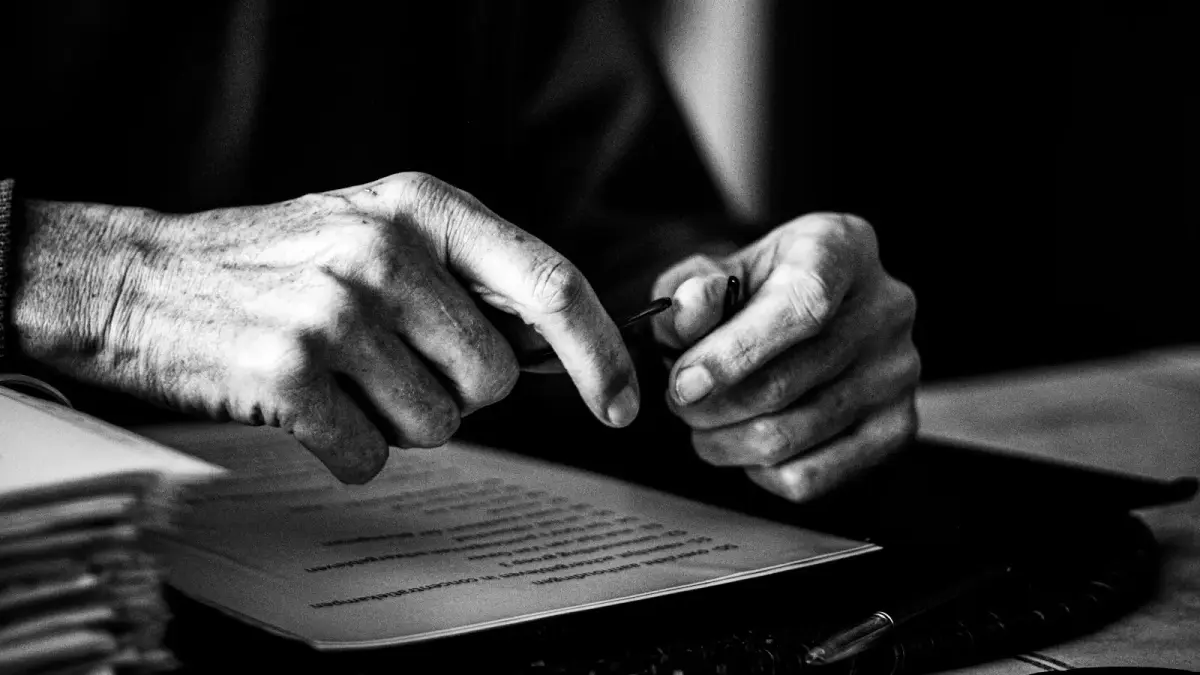
The letters were larger than I remembered. The cursive that used to sweep across Hallmark cardstock in confident, looping strokes now pressed harder into the paper, as if each word required a kind of negotiation with her own hand. The “L” in “Love” had a small tremor running through its upstroke, a vibration I could actually feel with my fingertip.
I stood in my kitchen holding this card and I understood something I had been refusing to understand for a very long time. My mother is getting older. I knew this already, of course - I have eyes, I see her moving more carefully, I hear the new caution in her voice when she takes the stairs. But knowing it in your mind and seeing it written in a shaking hand on a piece of cardstock that still smells faintly like her kitchen are two entirely different kinds of knowing.
The handwriting you memorized without trying
You probably don’t think of yourself as someone who studied your parent’s handwriting. But you did. You studied it the way children study everything about the people keeping them alive - unconsciously, completely, with the full absorptive power of a brain that hadn’t yet learned to filter what mattered from what didn’t.
You knew it from permission slips. From the notes tucked into your lunch bag that you pretended embarrassed you but secretly kept. From the signature on your report card, written so quickly and with such practiced ease that it barely lifted from the page. From the grocery lists left on the kitchen counter in a hand so familiar you could have identified it in a lineup of a thousand samples.
Their handwriting was a background fact of your childhood, like the color of your living room walls or the sound the back door made when it closed. You never consciously memorized it. You didn’t have to. It was simply part of the landscape of the person who raised you, as specific and unrepeatable as their voice or the way they laughed when they were genuinely surprised.
A 2018 study published in the journal Cognitive Processing found that handwriting is one of the most individually distinctive motor behaviors humans produce - more unique than gait, more consistent than speech patterns. Each person’s handwriting carries what researchers call a “motor signature,” a pattern as personal as a fingerprint but far more emotionally legible. You can feel the mood in someone’s handwriting. You can feel the hurry, the patience, the steadiness of the hand that held the pen.
Which is exactly why you notice when it changes.
What the pen reveals that the voice still hides
Here is something nobody warns you about. Your parent’s voice will adapt. They will learn to speak more slowly and you will learn to listen more patiently, and the adjustment will be so gradual that neither of you will notice it happening. Their face will change, but you see their face every day or every week or in photos, and the brain is remarkably good at updating its internal portrait of someone it loves.
But handwriting doesn’t adapt. Handwriting tells the truth.
When fine motor control begins to decline - and research in Neurobiology of Aging has documented that this begins, for most people, somewhere in the late sixties and accelerates in the seventies - the pen becomes a kind of seismograph. It registers tremors too subtle for the eye to catch across a dinner table. It records the microsecond delays in muscle response that a conversation would never reveal.
Your father’s signature on the Christmas check doesn’t look like his signature anymore. It looks like someone doing a careful impression of it. Your mother’s grocery list, once a quick scrawl dashed off in thirty seconds, is now written in letters twice their former size, each one deliberate and separate, as if she is writing for a teacher instead of for herself.
They haven’t mentioned any of this to you. They may not have fully noticed it themselves. The body changes so gradually from the inside that the person living in it is often the last to know. But you are holding the evidence in your hands, and it is dated, and you can compare it to the card from five years ago that you kept in a box, and the difference is a sentence you cannot unread.
The quiet inventory of change
Once you see it, you start looking for it everywhere. You become an accidental archivist of your parent’s physical decline, and the collection builds itself without your permission.
The sticky note on the fridge that says “call dentist” in letters that lean more heavily than they used to, as if the words needed the support of the paper beneath them. The birthday check written in an amount that you suspect was chosen partly because the numbers were easier to form. The address on the envelope that took three lines where it used to take two, because the letters have spread out, reaching for more room.
You find yourself keeping things you would have thrown away before. The card goes into the drawer instead of the recycling. The envelope with her handwriting on it gets tucked into a book. You are collecting evidence of a person who is still here, which is a strange thing to do, and yet you understand instinctively why you are doing it. You are preserving the version of them that the next version will overwrite.
Psychologist Pauline Boss spent decades studying what she called “ambiguous loss” - grief that occurs without a clear ending, without a death, without a moment you can point to and say “this is when it happened.” Watching a parent age is perhaps the most universal form of ambiguous loss there is. Nothing has been taken from you. Everything is simply being revised, slowly, in a handwriting you are learning to read all over again.
The permission slip and the Christmas card
I have a theory about why handwriting hits us harder than other signs of aging, and it has nothing to do with motor control or neurology. It has to do with documents.
Think about the artifacts of your childhood that carried your parent’s handwriting. Not the photographs - those show you their face, which you already know is changing. But the permission slip they signed so you could go on the field trip to the science museum. The inscription inside the book they gave you for your twelfth birthday. The note they left on the counter when they went to the store: “Back by 4. There’s fruit salad in the fridge.”
These were acts of authority and care rendered in ink. Their handwriting on a permission slip literally meant you were allowed to go. Their signature on a check meant the bills were paid. Their name on your lunch bag meant someone was thinking about you at six in the morning while you were still asleep.
When that handwriting changes, it rearranges something in the architecture of your sense of safety. Not because you still need permission slips signed. But because the hand that signed them represented a kind of permanence you have been unconsciously relying on your entire adult life. The confident, quick, unhesitating signature of a person in full command of their life - that was a promise you never knew you were being made, and it is being quietly retracted in the growing space between letters and the new uncertainty in once-familiar loops.
The grief that arrives before the loss
There is no Hallmark card for this. There is no moment of diagnosis, no phone call from a doctor, no event that gives you permission to sit down and feel what you are feeling. Your parent is fine. They are still here, still themselves, still calling you on Sundays and asking if you’ve eaten enough and telling you the same story about the neighbor’s dog that they told you last week.
And yet.
You are grieving. You are grieving a version of a person who is still alive, which means you cannot talk about it without feeling like you are being dramatic, or premature, or ungrateful. A 2022 study in Frontiers in Psychology examined what researchers called “pre-loss grief” in adult children of aging parents and found that it was both remarkably common and remarkably unspoken. Nearly everyone in the study reported experiencing it. Almost none of them had ever named it out loud.
This is the grief that lives in the birthday card you read twice before putting it in the drawer. In the moment you hold the Christmas check up to the light, not to see the amount but to look at the way the letters sit on the line. In the fraction of a second where your heart catches before your mind reassembles itself and you go back to the conversation you were having.
You are not being dramatic. You are paying attention. And paying attention to the people you love - really paying attention, down to the pressure of their pen on paper - is one of the most honest things a person can do.
The letters that live inside your own
Here is something I want you to know, because I think it matters more than anything else I could say about handwriting or aging or the strange mathematics of watching someone you love move through time.
Their handwriting lives in yours.
Pick up a pen right now and write your name. Look at the way you form your capital letters. Look at the slant - does it lean forward, eager and rushing, or does it stand straight? Look at the way you cross your t’s and dot your i’s. Now think about where you learned that. Think about who was sitting next to you at the kitchen table, guiding your hand, showing you how letters worked.
You carry their handwriting inside your own the way you carry their voice inside the way you talk, the way you carry their gestures in the way you stand in the kitchen with one hand on the counter. It is not a copy. It is an inheritance, translated and transformed, but rooted in a hand that once held yours and helped it move across the page.
My mother’s cursive is shakier now than it was a decade ago. The loops are wider, the pressure is uneven, the letters sometimes don’t connect where they used to. But when I sign my own name - quickly, without thinking, in the rushed automatic way we all sign things - I can see her in it. The way I make my capital “M.” The way my “e” curls up at the end like it’s reaching for the next letter before it’s finished being itself.
She taught me that. Not in a lesson, not on purpose, but in the way parents teach us most things - by being themselves, consistently, in our presence, until we absorbed them without knowing it.
The birthday card in my kitchen drawer trembles where it used to flow. But the hand that wrote it also wrote my name on my first lunchbox, and that hand taught my hand to write, and my hand is steady, and my hand carries hers.
That is not a small thing. That is, in fact, everything.