There is a particular kind of man who has never once walked into a hospital without first telling everyone he is fine - who broke his collarbone at forty-six and drove himself to the emergency room, who sat in the waiting area with a bone pressing against his skin and told the nurse it was probably nothing, who has never once used the word pain without immediately downgrading it to discomfort - because a boy who cried once from a stomach ache at the dinner table and heard his father say 'you're fine, eat your dinner' learned that a man's body does not get to complain, and he has spent forty years translating every injury into a lesser word because the boy who was told it wasn't that bad never found the adult permission to say that it was
He broke his collarbone on a Saturday afternoon. He was carrying a ladder out of the garage, misjudged the clearance of the doorframe, and felt the bone go with a sound he would later describe to his wife as “a little pop.” Not a crack. Not the wet snap that it actually was. A pop. Like a knuckle. Like something minor and forgettable.
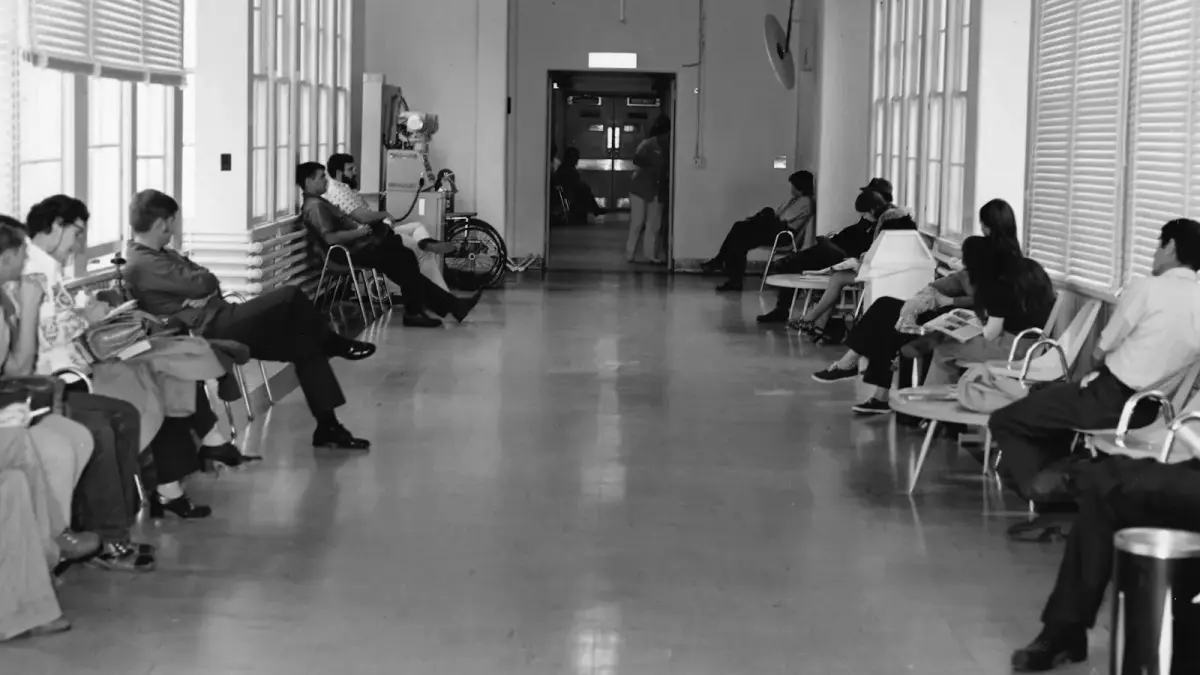
He drove himself to the emergency room. He parked the car, walked through the automatic doors with his left arm hanging at an angle that should have alarmed anyone who saw it, and told the woman at the intake desk that he was probably wasting her time. “I think I might have tweaked my shoulder,” he said. “It’s probably nothing.”
The X-ray showed a clean fracture of the clavicle. The doctor asked him, on a scale of one to ten, how much pain he was in. He said four. His wife, who had arrived by then and could see the color draining from his face, knew it was at least an eight.
He is fifty-seven years old. He has never once used the word pain without immediately translating it into something less. And if you know this man - if you are this man, or if you love one - what I am about to describe is not stubbornness. It is a vocabulary he learned before he had any say in the language.
The dinner table
There is almost always a dinner table in this story. Not because dinner tables are inherently significant, but because they were the courtroom of the childhood home - the one place where the entire family gathered, where bodies were visible, where weakness could be witnessed by everyone at once.
He was nine. Maybe ten. He had a stomach ache - a real one, the kind that makes a child pull his knees toward his chest and press his forehead against the table. And he said something. He said it hurt. He might have cried, or come close to crying, or made the face that comes right before crying, which for a boy at a dinner table amounts to the same thing.
His father looked at him across the table and said five words: “You’re fine. Eat your dinner.”
That was all. No cruelty in the voice. No raised hand. Just a correction, delivered with the same casual authority as “close the door” or “take your elbows off the table.” A statement of fact from a man who had been told the same thing by his own father, who had been told the same thing by his.
A 2016 study published in the journal Psychology of Men and Masculinities found that boys who received dismissive responses to physical pain expressions from male caregivers developed what the researchers called “pain minimization scripts” - automatic cognitive patterns that reframe pain as less severe before it reaches language. The study noted that these scripts were remarkably durable, persisting into late adulthood even when the individual was consciously aware of them.
The boy at the dinner table did not decide to stop feeling pain. He decided to stop saying it out loud. And over the next forty years, that decision calcified into something that looks like toughness but is actually a translator running in the background of every sentence his body tries to speak.
The vocabulary of less
Here is what the translation sounds like in practice.
“It’s just a twinge” means something is torn. “A little sore” means he can barely lift his arm. “I’m fine” means his back has been seizing for three days and he has been sleeping on the floor because the mattress makes it worse, but he will not say any of this because the sentence “my back hurts” contains a word his mouth has been trained to avoid.
The word is hurts. Not pain, not discomfort, not any of the clinical terms a doctor might use. The specific, vulnerable, childlike word hurts - the one that a nine-year-old would use at a dinner table before he learned better. That is the word that gets translated out of every sentence before it reaches the air.
He says “it’s nothing” the way another person might say “good morning” - reflexively, without thinking, as a social reflex rather than an assessment of reality. He says “I’ve had worse” as if the existence of previous pain invalidates current pain. He says “it’ll pass” the way his father said it, and his father’s father said it, as if male pain is weather - something that happens to the landscape but never to the man standing in it.
Brene Brown’s research on male vulnerability describes what she calls the “shame box” around men’s physical expression - a set of unwritten rules that dictate what a man is allowed to feel and, more critically, what he is allowed to say about what he feels. In her interviews, Brown found that men consistently identified physical pain as one of the most carefully policed territories. Not emotional pain - most men expected that to be off limits. But physical pain, the kind that should be purely biological and therefore safe to report, was still filtered through a screen of acceptability before being spoken.
The man who tells the emergency room nurse “it’s probably nothing” is not lying. He is speaking the only language he was ever given for this situation. And in that language, the maximum allowable severity for any injury, under any circumstances, is “not that bad.”
What the wife sees
She stopped asking years ago. Not because she stopped caring but because the answer never changed.
“Does that hurt?” “Nah, it’s fine.”
“Should you see a doctor?” “For what? It’s nothing.”
“You’re limping.” “I’m not limping, I’m just walking funny.”
She has learned to read him the way you read weather when the forecast isn’t available - by watching. The way he holds his coffee mug tells her which hand isn’t working properly. The way he lowers himself into a chair tells her whether it’s his back or his knee. The breath he takes before standing up - the one he doesn’t know she hears - tells her how much the thing he will never name is costing him today.
A 2021 study in Frontiers in Psychology on intimate partner health communication found that female partners of men who scored high on pain minimization scales developed what the researchers called “compensatory health monitoring” - an increase in observational attention to their partner’s physical behavior that functioned as a substitute for direct verbal health reporting. The study noted that this dynamic often produced resentment in the monitoring partner, not because they minded watching, but because they grieved the absence of being told.
She does not want him to be weak. She wants him to say “this hurts” the way she would say it - as information, not as confession. She wants the word to be available to him the way it is available to her. And the fact that it isn’t - that he will call a fracture a twinge and a torn muscle “a little stiffness” and a kidney stone “some discomfort” - is not a testament to his strength. It is a testament to the thoroughness of the lesson he learned at nine, sitting at a dinner table with a stomach ache he was not permitted to have.
The inheritance
His son is watching.
He doesn’t know his son is watching, because he doesn’t know he’s doing anything. He thinks he is simply being normal - handling pain the way pain is handled, getting on with it the way you get on with things. He does not see the performance because to him it is not a performance. It is just what men do.
But the boy sees it. The boy sees his father stand up from the couch with a grimace he immediately covers with a neutral expression. The boy sees his father come home from the doctor and say “all good” when the prescription bag in his hand says otherwise. The boy sees his father hold his wrist at a certain angle for six weeks and never once say the word sprain.
And the boy learns the same lesson that was learned at the dinner table a generation ago, not through five explicit words but through the accumulated observation of a man who never once let his body’s complaints reach the surface of a sentence.
Daniel Goleman, in his work on emotional intelligence and learned behavior, describes how children absorb emotional regulation strategies not primarily through instruction but through what he calls “emotional modeling” - the silent demonstration of which feelings are expressible and which must be managed privately. A father who never says “this hurts” is teaching his son, without a single word of direct instruction, that a man’s pain exists in a register below language.
The chain does not need to be dramatic to be unbroken. It does not need shouting or cruelty or even coldness. It only needs one man, sitting at one dinner table, telling one boy that he is fine. And then that boy grows up and tells his own son the same thing, and the word fine travels through generations like a family heirloom - polished, respected, and completely hollow.
The two words
I am not going to tell you to go to therapy, or to start journaling, or to practice vulnerability in a mirror. I am not going to give you five steps to unlearn something that has been running in your body longer than most of your organs have been doing their current jobs.
But I want to tell you something about two words.
The two words are: it hurts.
Not “it’s a little sore.” Not “I’ve had worse.” Not “it’s nothing.” Just the thing itself, in the words a child would use, before the child learned that those words needed translation.
It hurts. That’s all. Two words that contain no weakness, no failure, no betrayal of the man you were taught to be. Two words that simply describe what is happening in your body at this moment, without apology, without minimization, without the reflexive pivot to “but I’m fine.”
The man at fifty-seven who says “it hurts” without adding a qualifier is not falling apart. He is doing something his father never did, and his father’s father never did, and possibly no man in his family line has done within living memory. He is letting the sentence end where the pain actually lives, instead of where the translation places it.
And the first time you say it - if you are this man, if you have spent decades running every physical sensation through a filter that downgrades it before it reaches your mouth - the first time you let the words arrive without an escort, something will feel wrong. Your body will try to add “but it’s not that bad.” Your throat will want to clear. The nine-year-old at the dinner table will brace for the correction that is no longer coming.
Let him wait. Let the room hold the sentence without revision. Let “it hurts” be the whole truth, because it always was.
You were never fine. You were brave, and trained, and obedient to a rule that was handed down without discussion. But you were not fine. And the permission to say so did not need to come from your father’s table.
It was always yours.