There Is a Particular Kind of Man Who Stacks the Plates at the End of Every Restaurant Meal - Who Gathers the Silverware, Places the Napkins on Top, and Pushes the Whole Neat Tower to the Edge of the Table Before the Server Has Even Brought the Check
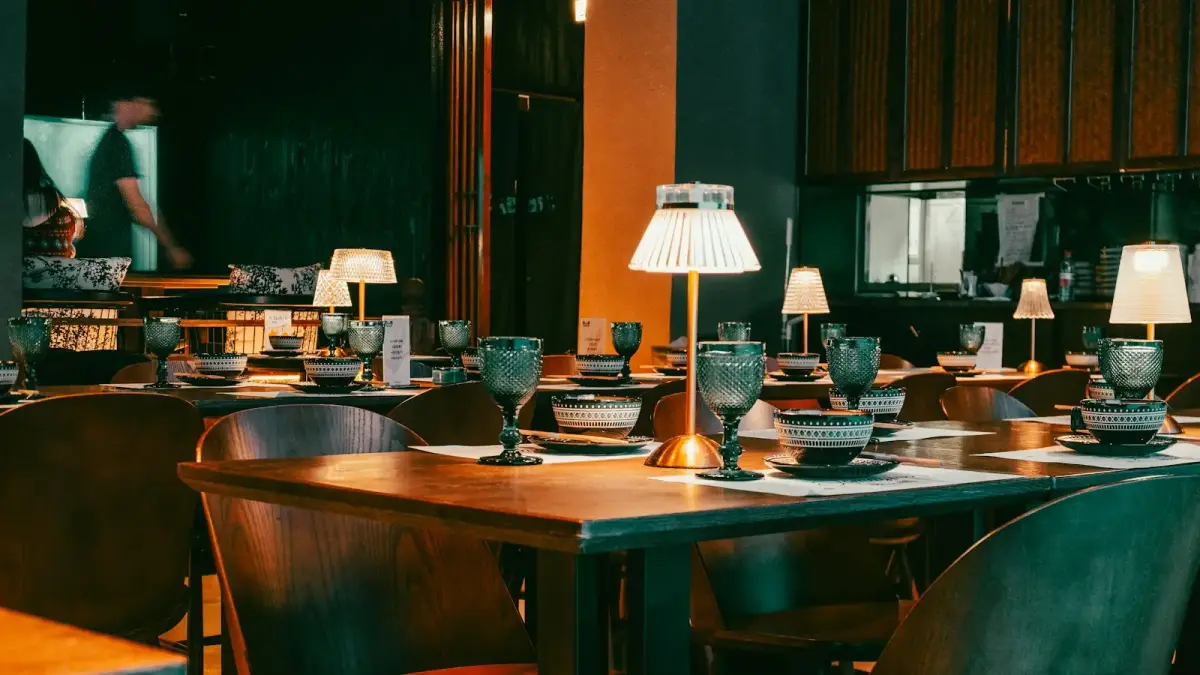
The Meal Is Over but Something in Him Isn’t Finished
I do it without thinking now. The plates get stacked. The forks go on top, blades turned inward. The crumpled napkins get placed on the highest plate so they don’t blow off when the busser carries the whole thing back. The cups get turned right-side up and pushed to the outer edge, handles facing out for an easy grab.
My wife noticed it on our third date. She watched me build this little architecture of consideration at the corner of a two-top in a Thai restaurant, and she tilted her head like she was trying to solve me.
“You don’t have to do that,” she said. “They have people.”
I know they have people. That’s the point.
I am the son of a woman who was one of those people. And the body remembers what the mouth stopped talking about a long time ago.
A Boy in a Vinyl Booth Watching His Mother Work
My mother waited tables at a family diner off Route 9 for eleven years. Not the kind of diner that gets written up in magazines for its charm. The kind with a coffee machine that screamed, fluorescent lights that buzzed at a frequency you could feel in your teeth, and a owner who called her “hon” in a way that had nothing to do with affection.
I’d sit in a back booth after school sometimes, doing homework on the sticky tabletop, and I’d watch her work. She moved through that room like water - refilling, clearing, apologizing for things that weren’t her fault.
What I noticed most, even as a kid, was what people left behind. Not just the mess. The way they left it. The shredded sugar packets sprinkled like confetti. The ketchup smeared in a half-circle on the plate as if someone had finger-painted and walked away. The chairs pushed out at angles that said “this is not my problem anymore.”
And then my mother would appear with her gray bus tub and her rag, and she’d erase every trace of them in ninety seconds. She’d reset the table like nothing had happened. Like nobody had been there at all.
That is what invisible labor looks like. Not just the work itself, but the fact that it’s designed to leave no evidence of the worker.
The Inheritance Nobody Talks About
A 2019 study published in the Journal of Personality and Social Psychology found that people who grew up in lower socioeconomic environments showed significantly higher levels of what researchers called “empathic accuracy” - the ability to read and respond to the emotional states and practical needs of others. The study suggested this wasn’t a personality trait. It was an adaptive skill, developed through years of navigating environments where reading the room was a matter of survival.
I think about that study when I catch myself stacking plates. Because it isn’t generosity. It isn’t even politeness, really. It’s something deeper and older. It’s a reflex that was written into my nervous system by years of watching a woman I loved perform work that nobody saw.
There are certain things you inherit from a working-class childhood that don’t show up in bank accounts or career trajectories. They show up in your hands. In what your body does automatically when a meal is finished and the evidence of your presence is scattered across a table that someone else will have to clean.
You learn to leave a room better than you found it. Not because someone told you to, but because you watched what happened when people didn’t.
The Distance Between the Two Sides of the Table
Here is something I’ve never quite been able to explain to people who didn’t grow up around service work. There is a distance between the person eating and the person clearing, and it is measured in something more permanent than feet.
It’s measured in visibility. The diner sits and is seen. The server moves and is invisible. The customer’s comfort is the point. The worker’s comfort is irrelevant. And when you’ve been on the invisible side, or when you’ve loved someone who was, you carry that awareness into every restaurant for the rest of your life.
I cannot sit in a booth and leave a mess. My body literally will not let me. It’s not a decision I make. It’s an override that happens somewhere below thought, in the part of me that still sees my mother’s hands - red and rough from hot water and chemical soap - gathering up what strangers couldn’t be bothered to organize.
A 2021 study in Frontiers in Psychology found that individuals with histories of manual or service labor showed distinct patterns of spatial awareness and anticipatory behavior in shared environments. They were more likely to clear pathways, organize shared materials, and prepare spaces for the next user. The researchers described it as “embodied consideration” - a form of empathy expressed not through words but through physical preparation.
That phrase stopped me cold the first time I read it. Embodied consideration. That’s exactly what it is. My mother’s whole career was an act of embodied consideration that no one ever named.
What Comfort Never Had to Teach
I don’t resent people who leave their plates scattered. I really don’t. If you grew up in a house where someone else always handled the aftermath - where the dishwasher ran itself and the counters got wiped by someone you didn’t think about - then you never had a reason to develop this particular instinct.
That’s not a moral failing. It’s a gap in experience.
But the gap is real, and it shows up in a thousand small moments. It shows up in who pushes their chair in when they leave a table. In who holds the door for the person carrying boxes. In who notices that the bathroom at a party is out of paper towels and quietly replaces the roll without saying anything.
These are not virtues. They’re calibrations. They come from having been, at some point in your life, the person who noticed because nobody else was going to.
My friend Dave does the same thing I do - stacks, organizes, pushes everything to the edge. His father was a janitor at a middle school for twenty-two years. Dave is an engineer now, makes good money, lives in a house with a water feature in the front yard. But when the meal is done, his hands go to work like they’re answering a bell that only he can hear.
We’ve never talked about it. We don’t need to. We just do it, side by side, at the same table, two men performing a small ceremony of remembrance that looks like nothing to everyone else.
The Working-Class Body Keeps the Score
There’s a version of this that people find charming. “Oh, he’s so considerate.” And I’ll take the compliment, sure. But it misses the deeper thing by a wide margin.
This isn’t consideration. It’s testimony. Every stacked plate is a sentence in a story I can’t stop telling, about a woman who stood on her feet for eight hours a day so I could sit in a booth and do long division. About a world that sorts people into those who make messes and those who clean them, and then pretends the sorting is natural.
A 2020 study published in the Journal of Research in Personality found that class-of-origin markers persist in behavior long after economic circumstances change. Adults who had moved from working-class childhoods into middle or upper-middle-class adulthoods still demonstrated what the researchers called “labor consciousness” - an ongoing, often unconscious awareness of the physical work being performed by others in shared spaces.
You can change your zip code. You can change your tax bracket. You can change the kind of restaurant you eat at. But you don’t change the part of you that knows someone has to carry that plate to the kitchen, scrape it into the bin, run it through the machine, and set it out again for the next person who won’t think about any of this.
The Quiet Reckoning at Every Table
My mother retired eight years ago. Her knees are bad. Her wrists ache when it rains. She has a hard time opening jars, and she won’t admit it, but I see her wince when she carries a bag of groceries from the car.
Those are the receipts. That’s what eleven years of clearing tables costs when the bill finally comes due, long after the diner has closed and the last customer has left without pushing in his chair.
When I sit down in a restaurant now, I’m sitting in two places at once. I’m at the table with my wife, enjoying a meal I can afford to pay for. And I’m in the back booth off Route 9, watching a woman I love move through a room full of people who will never know her name.
The plates get stacked. The forks get gathered. The napkins go on top.
It’s the smallest thing in the world. It changes nothing about the economics of service work or the invisibility of the people who do it. But it’s the only prayer I know how to say with my hands. And I will keep saying it at every table, for every server, for as long as I am the kind of man my mother’s work made me.