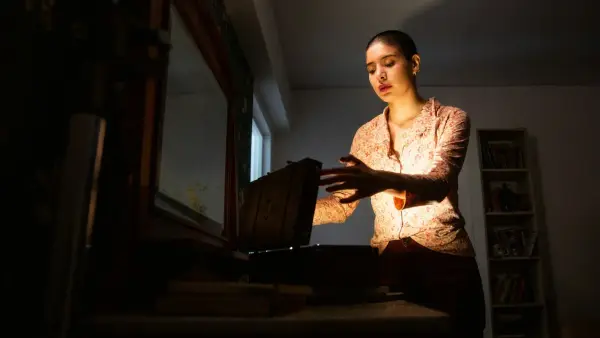
There are people who can tell you exactly what you were wearing the last time you cried in front of them - not because they were watching your clothes but because a nervous system that learned early to photograph every room where someone it loved was in pain stores the entire scene as evidence, and the blue sweater and the half-finished coffee are not details but the way a body remembers what it could not fix
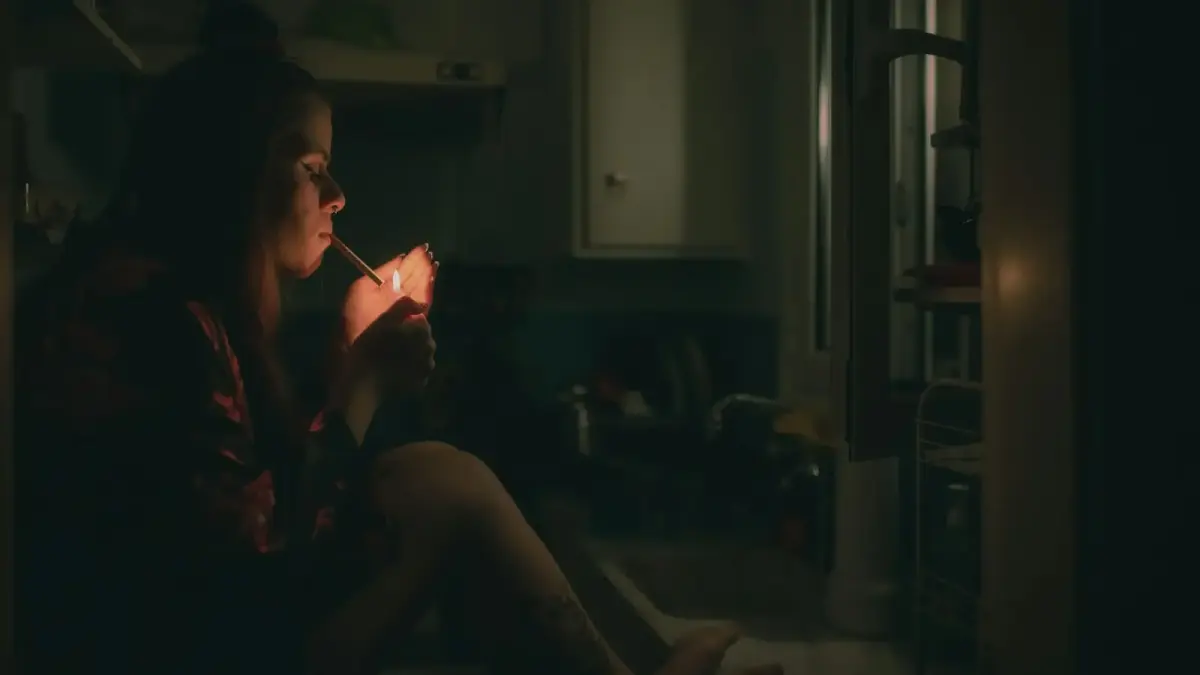
My sister called me on a Tuesday in March, eleven years ago now, to tell me our father’s diagnosis was worse than they’d thought. I was standing in my kitchen. The coffee I’d poured twenty minutes earlier was sitting on the counter, exactly two inches from the edge, in the green mug with the chipped handle. The late afternoon light was cutting a stripe across the floor at a forty-five degree angle. She was wearing their mother’s ring - I could hear her twisting it, the way she always did when she was trying to hold herself together.
I can tell you all of this. I can tell you the song that was playing from the speaker on the windowsill - something by Iron and Wine, the quiet one. I can tell you that the neighbor’s dog was barking in short, rhythmic bursts outside. I can tell you the dishcloth was hanging off the oven handle, slightly crooked.
I cannot tell you what I had for lunch yesterday.
If you recognize this - the way certain moments are preserved in impossible, almost photographic detail while entire ordinary weeks dissolve into nothing - then you already know what I’m about to describe. And you probably already know that it only works in one direction. The memories that stay sharpest, the ones that refuse to fade, are never the happy ones. They’re the ones where someone you loved was hurting.
The rooms your body refuses to forget
There’s a particular kind of remembering that doesn’t feel like memory at all. It feels more like being there again. Not the fuzzy, reconstructed version most people describe when they recall something from a decade ago, but the full sensory recording. The temperature of the room. The texture of the chair you were sitting in. The exact shade of gray the sky was through the window behind their head.
You didn’t choose to notice these things. You weren’t cataloging details on purpose, the way a detective studies a crime scene. Your nervous system did it for you, automatically, because somewhere deep in the wiring of your body, a room where someone you love is in pain registers as a scene that must be preserved in its entirety.
A 2017 study published in the journal Cognition and Emotion found that emotionally charged events are encoded with significantly greater sensory detail than neutral ones - a phenomenon researchers call “emotional enhancement of memory.” The brain’s amygdala, the region that processes emotional significance, essentially tells the hippocampus to record everything. Not just the words. Not just the feeling. The wallpaper. The shoes. The half-eaten sandwich on the plate.
But here’s what the study doesn’t quite capture. For some of us, this isn’t occasional. It’s the default setting. Every room where someone we love has been afraid or sad or broken open gets stored like a crime scene photograph. And we carry hundreds of them.
A nervous system that learned to scan
This kind of memory doesn’t come from nowhere. It almost always traces back to a childhood where reading the room wasn’t a social skill - it was survival.
Maybe you grew up in a house where the mood could shift without warning. Where you learned, very early, that the difference between a calm evening and a terrible one lived in tiny details most people would never notice. The way a door closed. The pitch of a voice from the other room. Whether the glass on the counter was the first one or the third.
Your nervous system learned to photograph everything because the details mattered. They were data. They were early warning systems. A child who learns that the angle of a parent’s shoulders predicts what kind of night it will be becomes an adult whose body automatically records the entire sensory landscape of any moment that carries emotional weight.
Dr. Bessel van der Kolk, whose research on trauma and the body changed how we understand these patterns, describes this as the body keeping score in high definition. The nervous system doesn’t distinguish between a crisis that requires your intervention and a crisis you’re simply witnessing. It records them all with the same obsessive fidelity, because a body that learned early to be the emotional first responder never fully trusts that the emergency is over.
You’re not choosing to remember the blue sweater. Your body is filing it as evidence, because evidence is what kept you safe once.
The selective sharpness
Here’s the part that can make you feel like something is wrong with you. The memories are extraordinarily selective.
You can remember that your best friend was wearing a white t-shirt with a small coffee stain near the collar the night she told you about her divorce. You remember the stain was roughly the shape of a comma. You remember the ice in her glass had melted completely and the condensation had left a ring on the wooden table that she kept tracing with her index finger while she talked.
That was seven years ago.
But you stood in the grocery store parking lot last Thursday trying to remember whether you’d already bought milk, and you genuinely could not reconstruct the previous forty-eight hours of your life in any meaningful detail.
This is not a memory problem. This is a memory priority system. Your brain has decided, based on decades of emotional training, that ordinary moments don’t warrant the full recording. Only the ones that matter. And “the ones that matter,” to a nervous system like yours, means the ones where someone needed you.
Research published in Psychological Science in 2019 showed that individuals with high emotional empathy demonstrated stronger episodic memory specifically for events involving others’ distress - while showing average or even below-average recall for routine autobiographical events. The brain, it turns out, is allocating its resources according to what it believes is most important. And your brain believes the most important thing in any room is whether someone in it is okay.
What it costs to carry this archive
Nobody talks about the weight of it. The sheer volume of rooms you’re carrying.
You remember the hospital waiting room - the particular green of the chairs, the magazine someone had left open to a page about vacation homes, the sound the vending machine made every ninety seconds. You remember the park bench where your son told you he was struggling, and the way the light was hitting the fountain behind him, and the fact that one of his shoelaces was untied and you almost said something about it but didn’t because you could feel the conversation was about to crack open.
You remember your partner’s face in the car after the phone call. The exact position of their hands on the steering wheel. The song on the radio that you will never be able to hear again without your chest tightening.
These aren’t memories you can put down. They live in your body. They surface uninvited - triggered by a color, a quality of afternoon light, a mug that looks too much like the one that was sitting on the counter the day everything changed.
And the people around you have no idea you’re carrying them. Because these aren’t the kinds of memories anyone asks about. Nobody says, “Tell me about the last time you noticed someone you love was in pain.” Nobody knows that you can reconstruct those rooms like architectural blueprints, down to the position of every object, the temperature of the air, the way the silence sounded before someone spoke.
The misunderstanding
People who carry this kind of memory are almost always described as “too sensitive.” As if the recording is the problem. As if remembering the coffee stain and the melted ice and the condensation ring is a malfunction rather than a feat of extraordinary attentiveness.
But sensitivity is not the right word. What’s actually happening is something closer to devotion. A nervous system that records the entire room when someone it loves is hurting is a nervous system that treats other people’s pain as the most important event in any given moment. It prioritizes their experience above everything else - above your own comfort, above your own needs, above the ordinary flow of a day that, for everyone else in the world, was just a Thursday.
Daniel Goleman’s work on emotional intelligence describes this capacity as a kind of “emotional radar” - the ability to detect and respond to the internal states of others with unusual precision. But even that framing undersells it. Radar scans for threats. What you’re doing is closer to bearing witness. You’re not scanning the room for danger. You’re recording it because some part of you believes that if you remember everything - the sweater, the coffee, the light - then the moment won’t be lost. The person’s pain won’t go unwitnessed. You were there, and your body can prove it.
Why you remember the objects
There’s a reason the memories are so anchored to objects and sensory details rather than words or emotions. It’s because the emotions were too large.
When someone you love is in pain and you’re standing in the room absorbing it, the feeling itself is overwhelming. Your nervous system can’t fully process the grief or the fear or the helplessness in real time. So it does what overwhelmed systems always do - it displaces. It focuses on what it can process. The color of the mug. The angle of light. The pattern on the carpet.
A 2021 study in Frontiers in Psychology found that during high-emotion events, peripheral details - objects, textures, environmental features - are often encoded more vividly than central narrative details. The researchers called this the “attentional narrowing paradox”: the mind narrows its focus emotionally but widens it perceptually. You may not remember exactly what was said, but you remember everything else in the room with startling clarity.
This is why you can describe the blue sweater but not the exact words your sister used. The sweater was something your brain could hold. The words were connected to a feeling too large to store directly.
The objects become vessels. The half-finished coffee isn’t a detail - it’s a container for everything you felt and couldn’t say. The chipped mug isn’t a mug. It’s a monument.
What it means about who you are
I’ve spent years thinking there was something wrong with the way I remember. That it was a symptom of something unresolved, some childhood wound that never healed properly, some nervous system still stuck in a scanning mode it should have outgrown.
And maybe some of that is true. Maybe the origins of this kind of memory are tangled up in rooms I shouldn’t have had to read so carefully as a child.
But I’ve come to believe that what matters more than where it came from is what it reveals about how I move through the world. A person whose body records every detail of a room where someone they love was hurting is a person whose body has decided, at the deepest level, that other people’s pain matters. That it deserves to be preserved. That it is not background noise.
You remember the blue sweater because your body refuses to let that moment be ordinary. Because to your nervous system, a person you love in pain is the most significant event that can occur in any room, and it will not allow itself to forget a single detail of the scene.
That is not a flaw. That is not “too much.” That is a body that has been paying attention, with everything it has, to the people it loves.
The green mug with the chipped handle is still in my cabinet. I use it most mornings now. Some days it’s just a mug. Some days it’s the whole room again - the light, the dog barking, my sister’s voice cracking on the other end of the line, the weight of standing in a kitchen that looked exactly the same as it had five minutes earlier, even though everything had changed.
I don’t try to stop the memory anymore. I just let it be what it is. A record. A proof of presence. The way my body says, I was there, and I was paying attention, and I could not fix it, but I did not look away.