Psychology says the man who always stands up when someone enters the room - who rises from his chair every time his wife walks in, every time a guest appears in the doorway, who cannot remain seated when someone he respects crosses the threshold of a space he occupies - is not performing some outdated courtesy or compensating for anything, he is someone who watched his father rise from the kitchen table every single time his mother walked through the back door, and the standing was never about manners but about a man who believed that the arrival of someone he loved was an event worth acknowledging with his entire body
I noticed myself doing it at a dinner party three years ago. My wife came back from the restroom, and before I had any conscious thought about it, my chair was already pushed back and I was on my feet. She touched my arm as she passed. I sat back down. And across the table, a friend of ours laughed and said, “That’s so old-fashioned, man.”
I smiled and said nothing. But something about the comment landed wrong, like being told your accent is charming - a polite way of saying you sound like you don’t belong here.
Because I didn’t stand up for her the way you hold a door for a stranger. I stood up the way your body stands when it hears a song it learned before it had words for music. The standing was never a decision. It was something closer to a reflex, and the reflex had a history I didn’t fully understand until I sat with it long enough to trace it back to a kitchen table I hadn’t sat at in twenty years.
The kitchen table where everything started
My father was not a demonstrative man. He didn’t say “I love you” with any regularity. He wasn’t cold - he was a product of a generation that expressed warmth through reliability, through showing up, through the things the body did when the mouth couldn’t find the words.
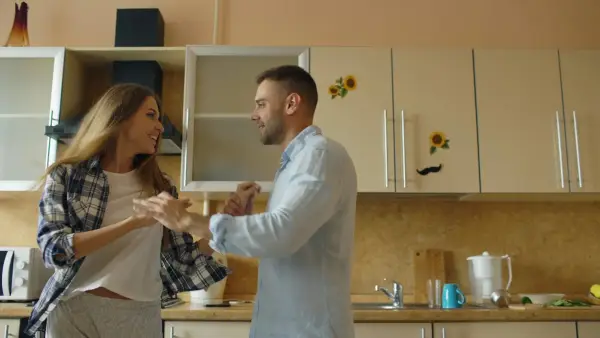
But every single time my mother walked through the back door of our house - coming home from the grocery store, from her sister’s place, from an evening walk she took alone after dinner - my father rose from his chair at the kitchen table.
Every time. For forty-one years.
He didn’t make a production of it. There was no sweeping gesture. He’d set down his newspaper or his coffee, push his chair back with a small scrape against the linoleum, and stand. Sometimes he’d take whatever bags she was carrying. Sometimes he’d just stand there for a moment while she moved past him into the kitchen. Then he’d sit back down.
I watched this happen thousands of times. I was never told to watch it. I was never told “this is what a man does.” Nobody narrated the lesson. It simply entered me the way weather enters a house through windows left open so long you forget they’re open at all.
The body remembers what the mind never recorded
Psychologists have a term for this. It’s called observational learning, and it was first described in depth by Albert Bandura in the 1960s through his work on social modeling. But Bandura focused largely on aggression - on how children learn to hit by watching adults hit. What gets less attention is the quieter inheritance. The gentle behaviors. The reverence transmitted through ten thousand unremarkable repetitions.
A 2019 study published in the Journal of Personality and Social Psychology found that nonverbal expressions of respect within families - physical gestures, spatial orientation, postural changes - were among the most reliably transmitted behaviors across generations. More reliably transmitted, in fact, than verbal expressions of love.
Which means the son who watched his father stand was learning a language. Not a rule. Not an etiquette lesson he could recite or rebel against. A language that lived in his muscles and his posture and the particular way his weight shifted forward when he heard footsteps approaching from behind.
The body learned it. The body kept it. And decades later, the body speaks it fluently in rooms the father never entered.
What people get wrong about the standing
Here is what the standing is not.
It is not chivalry. Chivalry is a performance directed outward - it says something about the man to the room. The standing doesn’t care about the room. Half the time, nobody notices.
It is not formality. Formal gestures are conscious. They require thought, intention, the small internal rehearsal of “I should do this now.” The standing happens before thought arrives. The chair is already pushed back by the time the mind catches up.
It is not compensation. The man who stands is not trying to prove something about his character. He’s not making up for failures elsewhere. He’s not performing respect because he lacks it internally.
What the standing actually is - and this is what psychology points to when it examines inherited nonverbal behavior - is embodied belief. The man stands because his body holds a belief that was never spoken aloud in his childhood home but was demonstrated so consistently that it became architecture: the arrival of someone you love is an event. Not a footnote. Not background noise. An event worth interrupting yourself for.
Dr. Bessel van der Kolk, whose research on how the body stores experience has reshaped trauma psychology, has written extensively about how physical patterns encode emotional truths. “The body keeps the score,” he says - and most people apply that to pain, to trauma, to the things we wish we could forget.
But the body also keeps the score of love. It keeps the score of every time a father stood up and a mother smiled and a boy at the table absorbed, without knowing it, the physical vocabulary of what it looks like when one person treats another person’s presence as sacred.
The vulnerability nobody talks about
Standing up when someone walks in is not a power move. It’s the opposite.
Think about what happens physically. You push your chair back. You leave whatever you were doing. You make yourself fully vertical - fully visible, fully exposed, fully present. You cannot stand up for someone while also hiding. The posture is open. The chest is forward. The hands are empty.
There is a nakedness to it that gets overlooked because the gesture looks, from the outside, like confidence. But confidence would let you stay seated. Confidence would let you nod from where you are, acknowledge the arrival without disrupting your own comfort.
The standing is not confidence. It’s surrender. It’s the body saying: your arrival matters more than my comfort. Your presence in this room changes the room, and I refuse to let that change happen while I’m still sitting down as though nothing shifted.
A 2022 study in Frontiers in Psychology examining postural changes in intimate relationships found that partners who physically oriented their entire body toward their spouse during moments of reunion - as opposed to partial turns or verbal-only greetings - reported significantly higher relationship satisfaction and felt more securely attached. The researchers noted that full-body orientation signals what they called “arrival recognition” - the nonverbal communication that says you have been seen, completely, and your being here matters.
The man who stands is doing arrival recognition with his whole body. And he has been doing it so long he doesn’t know how to stop.
The moment you realize you never chose this
I asked my brother once if he does it too. He looked at me like I’d asked him if he breathes.
“Of course I do,” he said. “Don’t you?”
And then we both sat there for a minute, two grown men realizing that neither of us ever decided to stand. We never had a conversation about it. Our father never pulled us aside and said, “When a woman walks into the room, you get on your feet.” He just did it. For decades. In a kitchen that smelled like coffee and dish soap and whatever our mother was making for dinner.
The realization that you inherited a behavior you never consciously chose is a strange one. It makes you wonder what else lives in your body that you didn’t put there. What other gestures are running on a program written by someone who may no longer be alive to explain what the code means.
But here’s what I’ve come to understand about the standing: it doesn’t need to be explained. It doesn’t need to be defended against people who call it old-fashioned. It doesn’t need to be updated or modernized or examined for political correctness.
It is a man’s body refusing to remain seated while someone worth rising for walks into the room.
That’s it. That’s the whole thing.
The language the mouth was never taught
We live in a culture that privileges verbal communication. We talk about love languages. We talk about emotional expression. We go to therapy to learn how to say the things we feel.
And all of that matters. I’m not dismissing it.
But there’s a kind of man - and I know him because I am him, because my father was him, because my brother is him - who will never fully express what he feels through words. Not because he’s repressed. Not because he’s emotionally stunted. But because the deepest things he knows about love were taught to him by a body, not a voice.
His father’s body. Rising from a kitchen chair. Setting down a newspaper. Standing in a warm kitchen while a woman walked through the door carrying grocery bags and twenty years of marriage and the particular exhaustion of a Thursday evening.
Daniel Goleman, whose work on emotional intelligence reshaped how we understand interpersonal connection, has argued that the most emotionally intelligent behavior is often the least verbal. That the people who communicate love most effectively often do it through consistent, small, physical acts that never call attention to themselves.
The standing is one of those acts. It’s a man saying, with his legs and his posture and the scrape of a chair on the floor: I see you. I’m glad you’re here. Your arrival is still, after all this time, something my body wants to honor.
And the son who does it - who pushes his own chair back in his own kitchen, in a house his father never visited, for a wife his father never met - is not performing a ritual he was taught.
He is speaking a language his body learned by watching. A language his mouth was never taught. A language that says everything his father felt and never quite managed to put into words.
If you are that man - the one who stands without thinking, the one whose body rises before his mind catches up - you are not old-fashioned. You are not performing.
You are fluent in something beautiful. And somewhere, in a kitchen that exists now only in your memory, a man is still rising from his chair. Still setting down his coffee. Still standing, quietly, for the woman walking through the door.
You learned that. Not with your mind. With your whole body.
And your body has never forgotten.