Psychology says people who always calculate the per-unit price of everything - who stand in the grocery aisle dividing ounces into dollars, who know the exact cost per load of every laundry detergent, who cannot buy a bag of rice without checking whether the larger bag is actually cheaper per pound - are not cheap or obsessive but running an economic survival program that was installed by a child who watched a parent stand in that same aisle doing the same math with hands that were shaking
The pasta aisle at ten o’clock at night
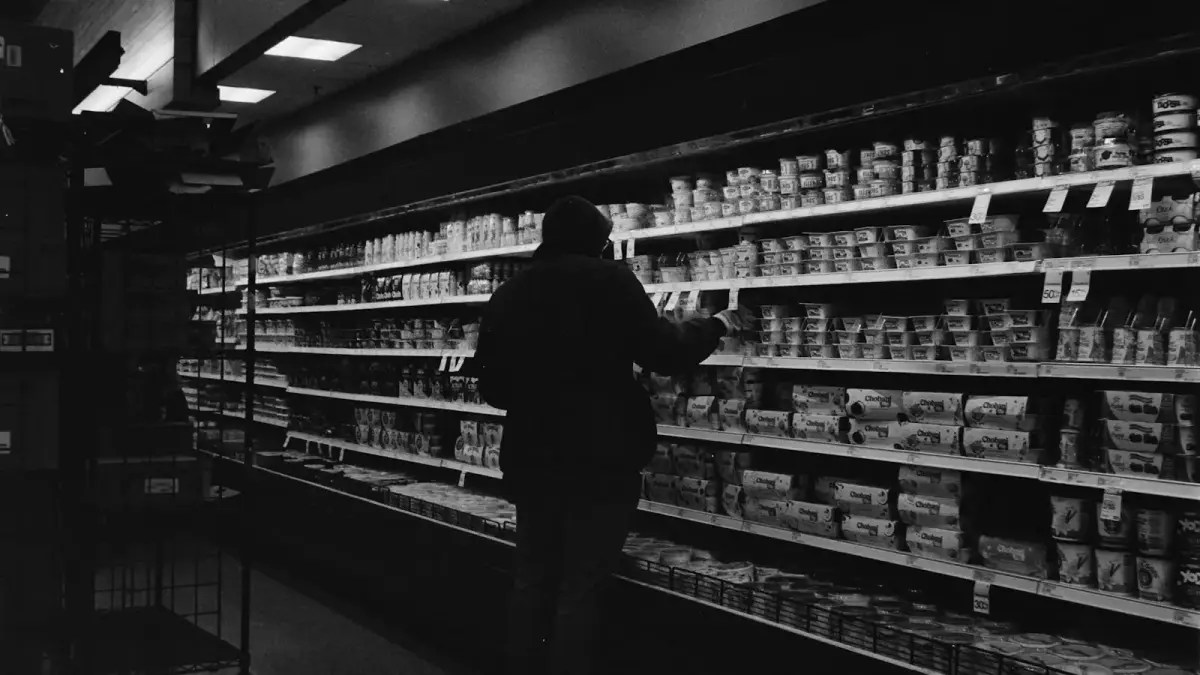
I was standing in the grocery store last Tuesday, holding two boxes of pasta. One was sixteen ounces for a dollar eighty-nine. The other was thirty-two ounces for three forty-nine. My phone was already open to the calculator before I realized what I was doing.
Eleven point eight cents per ounce versus ten point nine cents per ounce.
I bought the bigger box. Of course I bought the bigger box. But as I put it in the cart, I caught myself and stood still for a moment in that fluorescent aisle, because I make a perfectly good living. I have savings. I could buy every box of pasta on the shelf without checking a single price tag. And yet here I was, at ten o’clock on a Tuesday night, doing division in the pasta aisle like there was going to be a test.
I called my mother the next day and asked her if she still does this. She laughed. “Honey, I can tell you the per-ounce cost of every brand of peanut butter in this store without looking at the shelf.” She said it like it was a party trick. It is not a party trick. It is a thirty-year-old operating system that neither of us knows how to uninstall.
If you’ve ever stood in an aisle comparing two bottles of dish soap and felt a physical pull toward the one that costs less per milliliter, even though the difference is four cents, this is for you. Because what looks like thrift is actually memory. And the memory has a very specific origin.
The math was never really about the math
Here’s what I remember. I am eight years old and standing next to my mother in the cereal aisle of a grocery store that doesn’t exist anymore. She is holding two boxes. One has a cartoon on it that I want. The other is the store brand, in a white box with plain blue letters.
She isn’t looking at the cartoons. She is looking at the small numbers printed on the shelf tag - the ones most people never notice. She is dividing. I can see her lips moving. And then she puts the cartoon box back on the shelf and places the white box in the cart, and neither of us says anything about it.
I didn’t know then that what I was watching was a woman doing economic triage under fluorescent lights. I didn’t know that the tremble in her hand when she put the cartoon box back was not about cereal. It was about the electricity bill that was already late and the car that needed an inspection sticker and the fact that the difference between the two boxes - sixty-three cents - was a difference that mattered in a way I wouldn’t understand for another fifteen years.
But I learned the math. Not because anyone sat me down and taught me. Because I watched. Children absorb the algorithms of their household the way they absorb language - through repetition, observation, and the unspoken understanding that this is how the world works.
The scarcity program doesn’t check your bank balance
A 2017 study published in the Journal of Consumer Research found that individuals who experienced economic scarcity in childhood continued to demonstrate scarcity-driven decision-making patterns decades later, even after achieving financial stability. The researchers called it “residual scarcity processing” - a cognitive orientation that persists long after the original conditions have changed.
What this means in plain language is that the child who watched her mother compare price tags does not stop comparing price tags when she grows up and gets a good job. The program keeps running. It doesn’t care that you have a retirement account. It doesn’t care that you bought a house. It runs on a different clock - the clock of the kitchen table where the bills were spread out after you went to bed, the clock of the whispered conversations you weren’t supposed to hear about whether there was enough.
Your rational mind knows you can afford the name brand. Your body - the body that stood in that aisle at eight years old and watched a woman’s hands shake over sixty-three cents - does not agree.
It looks like a dozen different things
The per-unit calculation is just the most visible version of this program. But it runs in the background of almost everything.
It’s the person who always orders the second-least-expensive item on a restaurant menu - not the cheapest, because that would be obvious, but the next one up, which feels like a reasonable compromise between what they want and what the child inside them will allow.
It’s the person who keeps a running mental total while they shop, rounding up slightly on every item so they are never surprised at the register. Never. Because being surprised at the register - watching the number climb past what you expected - is a feeling their body recognizes as danger even though their wallet does not.
It’s the person who buys the cheaper shampoo and transfers it into the nicer bottle. The person who knows the exact price of gasoline at every station within a five-mile radius of their house. The person who calculates the tip to the penny, not because they are stingy but because money has always been something that required precision, and imprecision feels like carelessness, and carelessness was never safe.
What poverty teaches you about numbers
Sendhil Mullainathan, a behavioral economist who has studied how scarcity shapes cognition, found that poverty doesn’t just limit what people can buy - it fundamentally changes how the brain processes numerical information. People experiencing scarcity become exceptionally good at cost-benefit calculations. Their mathematical reasoning around resources becomes sharper, faster, and more automatic than their wealthier counterparts.
This is an extraordinary finding. It means the child standing in the cereal aisle watching her mother divide wasn’t just learning a habit. She was undergoing a cognitive renovation. Her brain was being rebuilt, in real time, to prioritize economic calculation above almost everything else.
A 2019 study published in Psychological Science confirmed that this cognitive orientation persists across income changes. Adults who grew up in scarcity processed price information faster and more automatically than adults who grew up in abundance, regardless of their current financial status. The researchers used eye-tracking technology and found that the scarcity-trained participants’ eyes moved to price tags before product names - a prioritization so deep it operates below conscious awareness.
Your eyes go to the price first because they were trained to go to the price first. And the training happened so early and so thoroughly that it feels like personality rather than history.
The shame lives in the gap
Here’s the part that hurts. It’s not the math. The math is actually comforting - it has rules, it produces answers, it gives you a sense of control in a world that once felt economically terrifying. The part that hurts is the gap between who you are now and who your nervous system thinks you are.
You are a person with a full refrigerator and a stable income and a child who has never once seen you tremble over a box of cereal. And yet last Thursday you spent four minutes in the detergent aisle comparing two bottles that differed by eleven cents per load, and when your partner said “just grab one” you felt a flash of something that landed between irritation and panic.
Because “just grab one” is something a person who has never counted says to a person who has always counted. And the counter cannot explain to the non-counter what it feels like to be asked to stop performing the one calculation that made the world feel manageable when nothing else did.
The shame is in not being able to stop. In knowing, intellectually, that you don’t need to do this anymore and doing it anyway. In standing in the aisle with your phone calculator open and wondering if this makes you pathetic or broken or stuck.
It does not make you any of those things.
What the math really is
It is a love letter. A strange, sideways, fluorescent-lit love letter from a child to a parent who did the best they could with numbers that never quite added up.
Every time you divide ounces into dollars, you are honoring a woman who stood in that same aisle thirty years ago and made it work. You are completing a calculation she started when the electricity bill was late and the car needed an inspection and the difference between two boxes of cereal was the difference between making it to Friday and not.
You are not cheap. You are not obsessive. You are not stuck.
You are running a program that was written by a child who loved someone enough to learn their math. And the fact that you still run it - that your hands still reach for the calculator, that your eyes still find the per-unit price before the product name, that some part of you still stands in every aisle checking whether the larger bag is really the better deal - is not a weakness.
It is the arithmetic of devotion. And it was never, not even once, really about the pasta.