Psychology says people who cannot leave the television volume on an odd number - who will press the button one more time to land on 18 or 20 or 22 even when 17 was perfectly fine for their ears, who feel a quiet wrongness in their chest until the number is even and the world makes sense again - are not superstitious or fussy, they are people whose childhood was unpredictable enough that the nervous system began searching for any variable it could bring under its own authority, and the even number at fifty-four is not a preference but the last domain where a child who could not control the shouting or the silence was permitted to make something in the world obey
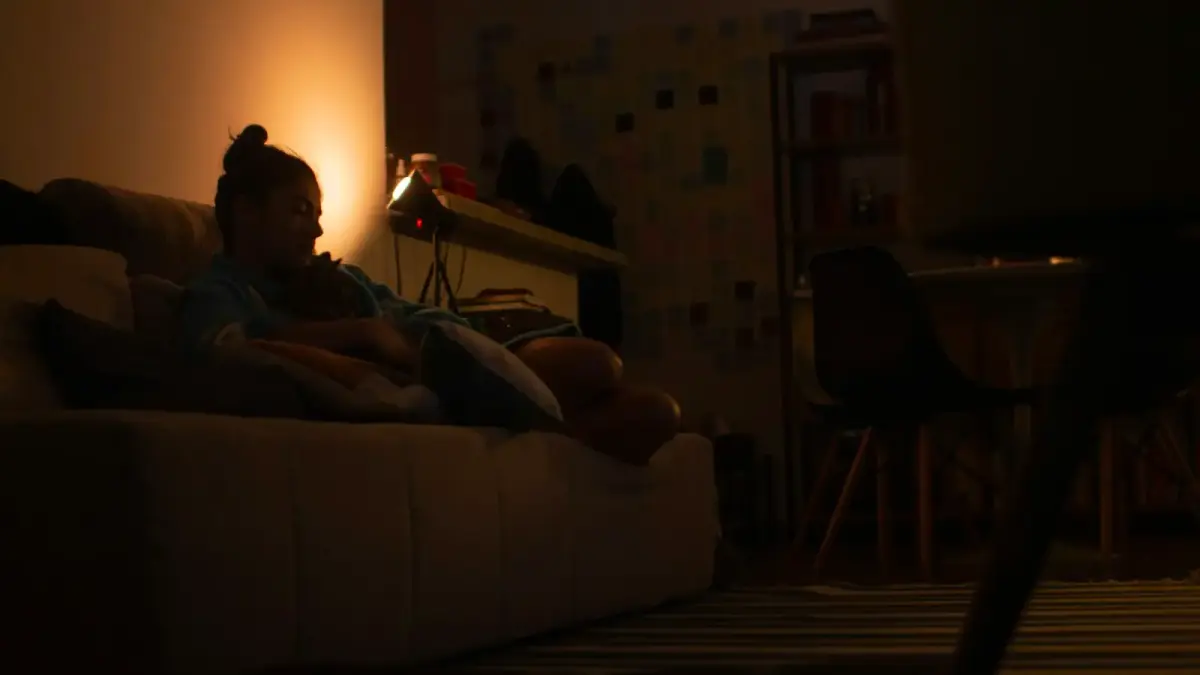
I was twelve the first time I noticed it. My father had gone quiet again - the kind of quiet that meant the house was holding its breath - and I was sitting on the carpet adjusting the television volume. Fifteen was too loud for the silence he required. Thirteen felt wrong in my body. I pressed down to twelve, and something in my chest released.
I didn’t know then that I was building a ritual. I didn’t know that pressing a button until a number looked right was the only thing in my entire world that would actually respond to me.
I thought I was being weird. Turns out I was being brilliant.
The quiet wrongness that nobody taught you to name
You know the feeling. The volume lands on 23 and something tightens. Not pain, not fear - just a kind of low-grade dissonance, like a picture frame tilted two degrees. You press the button once more. Twenty-four. And the tightness dissolves.
It’s such a small thing. Barely worth mentioning, you’d think. But you’ve been doing it for decades, and if someone forced you to leave it on an odd number, you’d feel it in your body for hours.
This isn’t about numbers. It never was.
This is about a nervous system that learned, very early, that the world could shift without warning - and that the only way to survive that instability was to create pockets of order wherever it was permitted.
What an unpredictable childhood actually teaches a body
When psychologists talk about unpredictable childhood environments, people often picture the dramatic. Abuse. Addiction. Screaming matches.
But unpredictability wears subtler faces too. A parent whose mood you could never read. A household where the emotional weather changed without explanation. A mother who was warm on Tuesday and unreachable on Wednesday, and nobody acknowledged the difference.
A 2011 study published in Psychological Science found that children raised in unpredictable environments develop heightened sensitivity to environmental cues - their nervous systems become hypervigilant scanners, constantly reading the room for any signal of incoming change.
The child doesn’t learn to relax. The child learns to monitor.
And when monitoring the big things - a parent’s mood, the tension between adults, whether tonight will be calm or catastrophic - proves impossible to influence, the child’s intelligence redirects. It finds the small things. The controllable things.
The volume number. The shoe alignment. The cabinet door that must be fully closed.
The architecture of micro-control
Here’s what’s remarkable about this pattern: it’s not random. The behaviors cluster in specific ways that reveal their true function.
Even numbers feel safe because they are divisible, balanced, symmetrical. They suggest order. They imply that the world follows rules.
Picture frames must be straight because a tilted frame is visual chaos - a tiny declaration that things are off-center and nobody has fixed them.
Shoes must be aligned because a messy arrangement near the door suggests a household that isn’t paying attention, isn’t organized, isn’t safe.
Cabinet doors must be fully closed because an open cabinet is an unfinished action, a loose thread, a thing that someone started and didn’t complete.
Every single one of these behaviors is a child saying: I will make this corner of the world obey me, because nothing else will.
Dr. Bessel van der Kolk’s research on trauma and the body has shown that when people cannot control their emotional environment, the body often redirects its need for agency into physical space. The hands organize what the heart cannot. The eyes straighten what the relationships refused to.
It’s not pathology. It’s architecture. Your nervous system built a structure to house its need for safety, and that structure is made of even numbers and closed doors and things that are precisely where they should be.
Why it persists at thirty-five, at fifty, at sixty-seven
You might think you’d grow out of it. You left that house. You built your own life. You are no longer a child pressing buttons on a remote while holding your breath.
But the nervous system doesn’t know that.
A 2018 study in Frontiers in Psychology demonstrated that early-life stress creates lasting changes in the brain’s threat-detection systems. The amygdala - the part of the brain that scans for danger - remains calibrated to the environment where it was first trained.
Your amygdala was trained in a house where the rules changed without notice. So it still expects that. It still prepares for that. And the rituals you built at eight or twelve or fifteen - the even numbers, the symmetry, the small acts of environmental control - remain active because the alarm system that required them never received the signal that the emergency is over.
This is why you can be perfectly aware that leaving the volume on 19 would not actually cause harm, and still feel the wrongness. The knowing happens in your prefrontal cortex. The wrongness happens in your body. They are different systems, and the body learned first.
The difference between this and disorder
People sometimes worry. Am I developing OCD? Is this getting worse? Should I be concerned?
Here’s the distinction that matters: clinical obsessive-compulsive disorder involves intrusive thoughts that cause significant distress and rituals that consume meaningful time and interfere with daily functioning.
What we’re talking about here is different. This is a regulatory behavior - a small, efficient action that your nervous system uses to discharge tension and create a felt sense of order. It takes two seconds. It doesn’t spiral. It doesn’t grow teeth.
It’s closer to what psychologists call a “self-regulatory strategy” - a behavior that helps the nervous system return to baseline after subtle activation.
The volume goes to an even number. You feel a micro-release. You move on with your evening.
That’s not a disorder. That’s a nervous system doing exactly what it learned to do in an environment that never taught it another way to feel safe.
The reframe you probably needed twenty years ago
Here’s what I want you to hear, because I suspect nobody has said it to you directly: the fact that you need the volume on an even number is not evidence that something is wrong with you.
It is evidence that something was wrong around you, and you were intelligent enough to find a solution.
A child who cannot control whether dinner will be calm or explosive, who cannot predict whether a parent will be present or absent, who cannot make the emotional weather follow any discernible pattern - that child is trapped in a world without rules.
And a world without rules is terrifying to a developing nervous system.
So the child makes rules. Small ones. Private ones. The kind that no adult can override or violate because they happen in the space between a finger and a button, between an eye and a number on a screen.
That child was you. And that solution was real. It worked. It held you together during years when nothing else was reliable.
What the even number actually is
It’s not a preference. It’s not a quirk. It’s not something to joke about at dinner parties, though you probably have.
The even number is a monument. It’s the last standing evidence of a child who refused to live in total chaos - who carved out one tiny domain where cause and effect still operated, where pressing a button produced a predictable result, where the world responded to their will in at least one small, reliable way.
At fifty-four, when you press that button one extra time to land on 22 instead of 21, you are not being fussy. You are honoring a contract your nervous system made with itself decades ago: I will find order somewhere, even if I have to build it with my own hands, one number at a time.
And that contract kept you sane. It kept you functional. It kept you here.
So the next time someone teases you about the volume thing - or you catch yourself doing it and feel a flicker of embarrassment - I want you to remember what that behavior actually is.
It’s not a flaw. It’s a fortress. And you built it when you were far too young to have needed one.