Psychology says people who cannot fall asleep without checking that every door in the house is locked - who will get out of bed three times to test handles they already know are secure - are not paranoid or obsessive, they are people who grew up in homes where the boundary between safe and unsafe was someone else's mood, and the deadbolt at midnight is not about intruders but about finally being able to close something that stays closed
I check the front door every night before bed. Then I check it again.
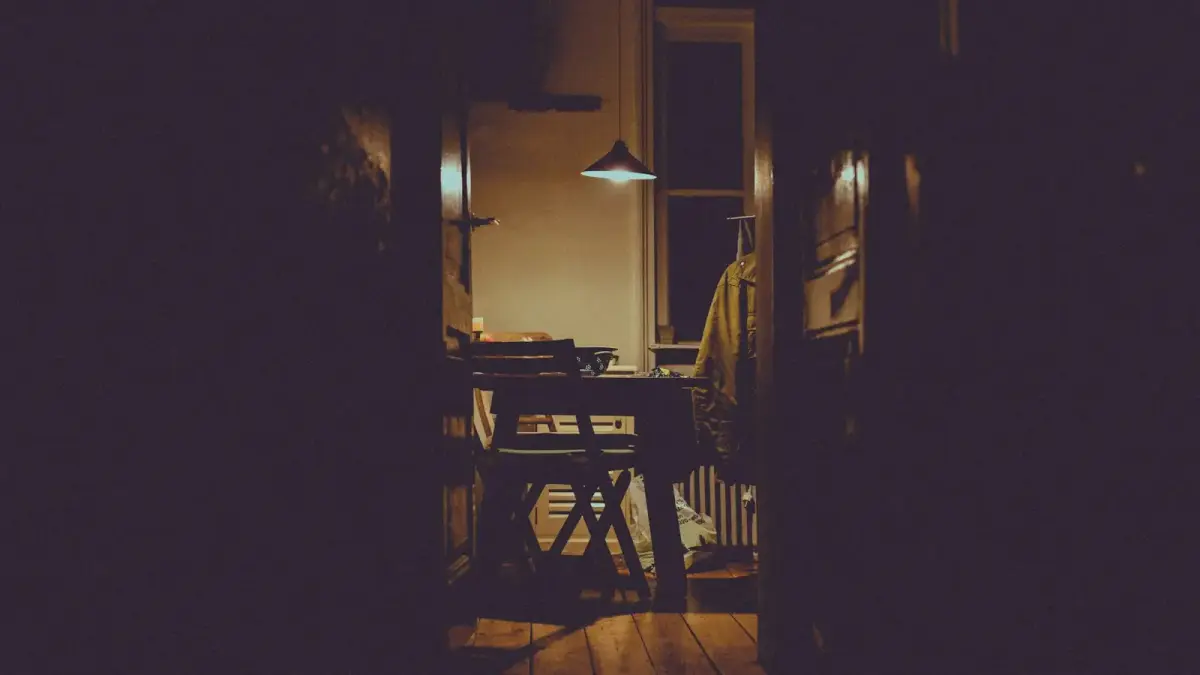
I stand in the hallway in my socks, one hand on the deadbolt, and I turn it. It’s locked. I know it’s locked. I locked it twelve minutes ago. But something in my chest won’t settle, so I press my palm flat against the door like I’m testing whether it’s real, whether the barrier between me and everything outside will hold through the night.
My partner used to watch me do this from the bedroom doorway. “You already checked,” he’d say. Not unkindly. Just confused. Because to him, a locked door is a locked door. You turn it, it clicks, you go to sleep.
But for me, a locked door has never been just a locked door. It has always been a question. And the question was never “is someone going to break in?” The question was “will this boundary still be here in the morning?”
It took me years - and a therapist who asked the right question at the right time - to understand that my nightly ritual had almost nothing to do with intruders.
The door that never held
When I was small, my bedroom door didn’t lock. That wasn’t unusual - most children’s bedroom doors don’t lock. But in my house, it mattered. Because the thing I needed protection from wasn’t outside. It was already in the house. It was my father’s temper, which could go from fine to terrifying in the time it took to pour a second drink.
There was no lock I could turn. No barrier I could test. The boundary between safe and unsafe wasn’t a door - it was his mood. And moods don’t have deadbolts.
A 2018 study published in the journal Development and Psychopathology found that children raised in environments with unpredictable emotional volatility develop what researchers call “boundary hypervigilance” - a chronic orientation toward monitoring the edges of safety. These children don’t grow up afraid of specific threats. They grow up afraid that safety itself is temporary. That it can be revoked without warning, by someone who is supposed to be the source of it.
So they learn to check. Not because they think the danger is real. Because they learned, before they had words for it, that the feeling of safety can’t be trusted unless you verify it. Again. And again. And one more time.
What the checking is actually doing
Here is what most people don’t understand about the midnight lock check: it is not a thought problem. It is a body problem.
Your thinking brain knows the door is locked. You watched yourself lock it. You heard the click. You could pass a lie detector test confirming that you locked the door. The information is not the issue.
The issue is that your nervous system - the one that was shaped during the years when you were too young to leave, too small to fight back, too dependent on the very person who made the house unsafe - that nervous system does not believe in locks. It doesn’t believe in any single action that is supposed to make danger stop. Because in your childhood, no single action ever did.
Dr. Bessel van der Kolk, whose work on trauma and the body reshaped how we understand post-traumatic responses, describes this as the body keeping a score that the mind has stopped counting. Your conscious brain moved on. It bought a house. It installed good locks. It built a life where you have control over who enters your space and when. But your nervous system is still living in the house where none of that was true.
So when you get out of bed for the third time, you are not being irrational. You are doing the only thing that ever gave you the illusion of control during a childhood where control was someone else’s to give and take away. You are closing something. And you are testing whether it stays closed.
Why “you already checked” lands like a dismissal
If you have this pattern, you’ve heard the sentence. From a partner, a roommate, a friend staying over. “You already checked.” Said with a little laugh, maybe. A gentle eye roll. Not cruel. Just baffled.
And every time you hear it, something inside you flinches. Not because you’re offended. Because for a brief, disorienting second, you feel exactly the way you felt as a child when someone told you there was nothing to be afraid of while you were standing in a house full of things to be afraid of.
“You already checked” is the adult version of “you’re overreacting.” And your body remembers what happened every time someone told you that. They were wrong. The fear was real. The environment was genuinely unsafe. And the person telling you not to worry was often the person you needed protection from.
A 2020 study in the Journal of Anxiety Disorders found that adults with repetitive checking behaviors tied to childhood adversity don’t respond well to simple reassurance. In fact, reassurance often increases the compulsion, because it replicates the original wound - someone with authority telling you that your survival instincts are wrong. Your nervous system hears “you already checked” and translates it into “your perception of danger is not valid.” And if there is one thing a hypervigilant child learned, it’s that their perception of danger was the only reliable thing in the house.
The ritual is not the problem
Here is where most advice gets it wrong. The internet will tell you to stop checking. Use willpower. Set a rule - one check, then bed. Resist the urge. Break the cycle.
But the checking is not the cycle. The checking is the band-aid over the cycle. The cycle is much older and much deeper. It’s the loop that says: safety is conditional. Safety depends on someone else’s state. Safety can be taken away while you sleep. And the only way to prevent that - the only way a seven-year-old could prevent that - is to stay alert. To keep watching. To never fully let go.
You didn’t develop this ritual because something is wrong with your brain. You developed it because something was wrong with your house. And your brain did exactly what it was supposed to do - it found the one small action that gave you the feeling, however brief, of being able to control the boundary between safe and not safe.
The fact that you’re still doing it at forty-five or fifty-three or sixty-one isn’t a sign of dysfunction. It’s a sign that the original wound never got tended. The fire went out decades ago, but no one told your smoke alarm.
The boundary you are actually trying to close
I asked my therapist once why it was always the front door. Why not windows? Why not the back gate? What was it about that specific lock?
She was quiet for a moment. Then she said, “Because a front door is where people come in.”
And I understood, in a way that rearranged something inside me, that I wasn’t checking whether the door was locked. I was checking whether I had the right to decide who entered my space. Whether the boundary I set at 11 p.m. would still be honored at 2 a.m. Whether anyone could override it without my permission.
Because that’s what was taken from me as a child. Not safety in the abstract. The specific, concrete right to say “this is my space, and you cannot enter it in a way that frightens me.” The right to close a door and have it mean something.
Gabor Mate has written extensively about how children in volatile homes lose their sense of what he calls “the integrity of their own boundaries.” They grow up not knowing where they end and another person’s chaos begins. They become adults who are extraordinarily attuned to other people’s moods - because they had to be - but who have almost no felt sense of their own edges.
The lock-checking ritual is your nervous system trying to rebuild those edges, one click at a time. It is you, every single night, practicing the act of closing something and having it stay closed. Something your childhood never let you do.
What it looks like when it starts to heal
I still check the door. I want to be honest about that. But something has shifted in the last few years, and I want to describe it because I think it matters.
I used to check the door and feel nothing. The click didn’t register. My body stayed wound tight, and the checking was mechanical - get up, walk, turn, press, walk back, lie down, wait for the anxiety to build again. The ritual gave me no relief. It was just the only language my nervous system had for “I am trying to feel safe.”
Now, when I check the door, I let myself feel it. I stand there for a moment and I say - not out loud, but somewhere inside - “This door is locked. I locked it. No one is going to come through it tonight who I haven’t invited. I get to decide who enters this space.”
And sometimes, not every night, but sometimes, I feel my shoulders drop.
That is not a cure. That is not a five-step program. That is the slow, patient work of teaching a nervous system that the thing it’s been checking for - a boundary that holds, a door that means what it says - actually exists now. That the house you live in today is not the house you survived as a child.
A 2022 study in Psychological Science found that adults who reframed their repetitive safety behaviors as “completion of an interrupted developmental task” rather than “symptoms to eliminate” showed significantly greater reduction in both the behavior and the anxiety underlying it. In other words, the healing didn’t come from stopping the checking. It came from understanding what the checking was trying to finish.
You are not paranoid. You are not broken. You are not making a big deal out of nothing.
You are a person who grew up in a home where the boundary between safe and unsafe was never yours to control. And every night, when the house goes quiet and the lights go off and you walk to the front door one more time, you are doing something that child never got to do.
You are closing something. And you are making sure it stays closed.
That was never obsession. That was always the point.