Psychology says people who keep every card, letter, and voicemail from someone who has died are not stuck in grief - they are holding the only evidence that a voice which shaped their entire nervous system existed at all, and the box in the closet is not a refusal to move forward but a body's way of proving to itself that the love it remembers was real

I found the box again last Tuesday.
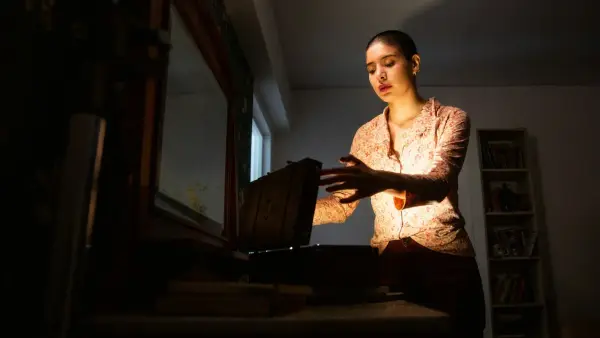
I wasn’t looking for it. I was searching for a tax document in the back of my closet, and my hand brushed the lid of a shoebox I haven’t opened in almost three years. My mother’s handwriting was on the outside - she’d used it to mail me cookies during college, and I’d never thrown it away because the box itself felt like her.
Inside: birthday cards in her looping cursive. A voicemail I transferred from phone to phone for six years before finally saving it to a USB drive. A grocery list she left on my counter the last time she visited, the word “lemons” underlined twice for no reason I ever understood.
I sat on my closet floor for twenty minutes holding a grocery list.
And I thought, for maybe the thousandth time, that something must be wrong with me. That I should have “moved on” by now. That keeping these things - cataloging them, protecting them, refusing to let anyone throw them away - meant I was stuck somewhere I shouldn’t be.
I was wrong. And if you have a box like mine, you need to know that you are too.
Your nervous system remembers what your mind can’t hold
Here’s what nobody tells you about the people who shaped you most: they didn’t just live in your memory. They lived in your body.
A 2016 study published in the journal Psychological Science found that the human brain processes familiar voices through the same neural pathways it uses for emotional regulation. The voices of people we’re deeply attached to don’t just carry information - they literally calm our nervous systems, the way a hand on your back calms a crying infant.
Your mother’s voice. Your father’s laugh. The specific way your best friend said your name, like it was the easiest word in any language.
These weren’t just sounds. They were regulators. Your body learned to feel safe in their presence, and it learned this so deeply that the pattern was written into your neurobiology long before you had words for it.
So when that voice disappears - when you can never hear it again in real time, never call and hear it pick up on the second ring - something happens that grief literature barely touches.
Your nervous system starts looking for proof.
The box is not sentimentality - it is evidence
People who don’t understand will call it holding on. They’ll use phrases like “you need to let go” or “they would want you to move on” as though love operates on a timeline and grief has an expiration date.
But what you’re actually doing when you keep that box of cards and letters has nothing to do with refusing to accept reality.
You are maintaining sensory evidence of a person whose existence your body was organized around.
Think about what a handwritten card actually is. It’s not just words. It’s pressure. It’s the specific way someone’s hand moved across paper - the slant of their letters, the size of their loops, the places where the pen pressed harder because they were thinking about what to say next.
Handwriting is a motor pattern. It’s as unique as a fingerprint, and your brain recognizes it the same way it recognizes a face. When you see your father’s handwriting on a birthday card, your visual cortex isn’t processing language first. It’s processing identity. It’s saying: this person was real. This person touched this paper. This person existed in physical space and thought about me long enough to write this down.
That’s not sentiment. That’s your brain doing exactly what it was built to do - confirming the existence of someone it was wired to track.
Why voicemails become the most guarded possession a grieving person owns
I’ve talked to dozens of people about grief over the years, and the pattern is always the same. You can let go of clothes. You can eventually donate books. You can even, in time, part with furniture and jewelry.
But the voicemail is untouchable.
A 2019 study in Frontiers in Psychology examined how bereaved individuals interact with digital remnants of deceased loved ones. The researchers found that audio recordings - voicemails, video clips, even ambient recordings where the person’s voice appeared in the background - were consistently rated as the most emotionally significant possessions, surpassing photographs.
The reason isn’t complicated, but it is profound.
Photographs show you what someone looked like. Voicemails show you what someone felt like. The cadence, the breath, the warmth in the vowels - your nervous system doesn’t process a voicemail as information. It processes it as presence.
And presence is the thing grief takes first.
You can remember what someone said. You can remember what they looked like. But the felt sense of being in a room with them - the particular texture of safety their existence created - that fades in a way that feels like a second loss. A slower, quieter one that nobody acknowledges because there’s no funeral for the moment you realize you can’t quite remember how your mother’s voice sounded when she was proud of you.
The voicemail is the last door back to that feeling. Of course you guard it with your life.
The neuroscience of why “letting go” misses the point entirely
There’s a concept in attachment neuroscience that researcher Daniel Goleman has written about extensively - the idea that our closest relationships don’t just influence our emotions. They shape the actual architecture of our brains.
The people who raised you, who loved you longest, who were present during the years your neural pathways were still forming - they are, in a very literal sense, part of your operating system. Their voices calibrated your sense of safety. Their touch patterns taught your skin what comfort felt like. Their predictable presence became the baseline against which your body measured everything else.
When someone like that dies, your brain doesn’t just lose a person. It loses a reference point.
Imagine removing the tuning fork from an orchestra. Every instrument can still play, but the shared standard they organized around is gone. That’s what happens neurologically when a primary attachment figure dies. Your system still works, but it’s lost the thing it used to calibrate itself against.
The box in your closet - the cards, the letters, the voicemail you’ve listened to eleven times this year - isn’t a shrine. It’s a tuning fork. It’s the closest thing your nervous system has to the sensory input it was built to receive.
And keeping it isn’t pathological. It’s adaptive.
What grief researchers actually say about continuing bonds
For decades, Western psychology treated grief as a process of “letting go.” The goal was detachment. Healthy grieving meant gradually severing your emotional connection to the deceased and reinvesting that energy in the living.
That model has been largely abandoned by modern grief researchers.
A 2018 study published in the Journal of Personality and Social Psychology found that maintaining a sense of ongoing connection with a deceased loved one - through objects, rituals, internal conversations, and yes, keeping physical mementos - was associated with better long-term psychological adjustment, not worse.
The researchers called these “continuing bonds,” and they found that the people who maintained them weren’t avoiding grief. They were completing it.
Because grief isn’t about forgetting. It never was. Grief is about reorganizing your inner world to accommodate a permanent absence while still honoring the fact that the absence used to be a presence. The box of letters does both simultaneously. It says: this person is gone. And it says: but they were here. Both things are true, and your body needs to hold both.
The people who tell you to throw the box away are asking you to deny one of those truths. They think they’re helping you move forward. What they’re actually asking you to do is erase the physical evidence of someone your body still references every single day.
The grocery list, the margin notes, the unsigned card
The things that undo us are never the grand gestures.
It’s not the love letter. It’s the sticky note on the fridge that says “back by 6.” It’s the book they were halfway through with a receipt from a gas station used as a bookmark. It’s the birthday card they bought but never signed because they died eleven days before your birthday and you found it in their desk drawer still in the envelope from the store.
These objects carry something that formal keepsakes don’t. They carry the ordinary. The unremarkable, Tuesday-afternoon proof that this person moved through the world doing small things. That they bought lemons. That they dog-eared pages. That they planned to come back by six.
Psychologist and author Gabor Mate has written about how love is most visible not in its declarations but in its mundane expressions - the ways we organize our daily lives around the people we care about without ever consciously deciding to.
The grocery list with “lemons” underlined twice is my mother being alive on a Wednesday. It is proof that she existed in the ordinary way, not just in the highlight reel of memory, but in the unremarkable middle of a life that included buying groceries and underlining things for emphasis and walking through my kitchen like it was partly hers.
I will never throw it away. And that is not a problem to be solved.
Your body knows something the self-help books don’t
There’s a particular kind of loneliness that belongs to people who have lost someone central. It’s not the loneliness of isolation. It’s the loneliness of carrying an experience inside your body that no one around you can verify.
You remember how they smelled. You remember the weight of their hand. You remember the exact pitch of their voice when they answered the phone and already knew it was you.
But nobody else in your current daily life carries those memories. And over time, the absence of external confirmation starts to feel like maybe you imagined it. Maybe the love wasn’t as big as you remember. Maybe you’re exaggerating how much they mattered. Maybe you’re being dramatic.
The box in the closet is your answer to that creeping doubt.
It is physical, tangible, undeniable proof that you are not making this up. The card is real. The handwriting is real. The voicemail is a recording of a real voice saying real words to you, specifically, on a real afternoon that actually happened.
You keep these things because your body needs a witness. And in the absence of the person themselves, the artifacts they left behind are the closest thing you have.
This is not dysfunction. This is not “complicated grief.” This is a nervous system doing the profoundly intelligent work of maintaining its own coherence in the face of an irreversible loss.
You are not stuck. You are not refusing to heal. You are holding the receipts of a love that shaped every part of how you move through the world, and your body knows - even when the culture tells you otherwise - that some things you simply do not put down.
The box stays. And you are allowed to be the kind of person who needs it to.