Psychology says people who re-read the same books instead of starting new ones - who return to the same novel every few years like visiting an old friend, who keep worn copies of books they first read in their twenties on the nightstand at fifty-five - are not lacking curiosity or stuck in the past. They are adults who learned that the most dangerous thing about loving something new was not knowing how it would end.
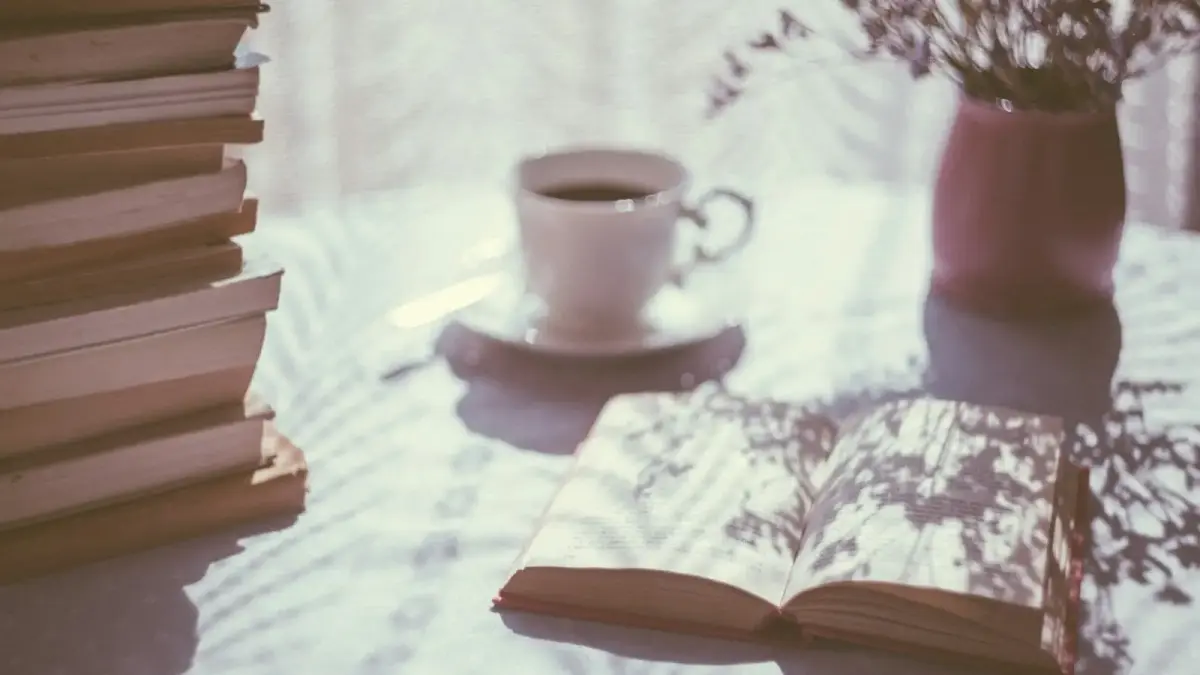
The book on my nightstand has been there for eleven years
I keep a copy of East of Eden on my bedside table. The spine is cracked in three places. There’s a coffee ring on page two hundred and something. The cover curled years ago from being left open, face-down, on porches and kitchen counters and the arm of every couch I’ve ever owned.
I have read this book six times.
Not because I forgot what happens. I remember every chapter. I know which paragraph will make my throat tighten before I reach it. I know the exact sentence where I’ll set it down for a moment and look out the window at nothing in particular.
People ask me sometimes what I’m reading, and when I tell them it’s the same novel I was reading two years ago, they get a certain look. Polite. A little confused. Like they want to say, “Don’t you want to try something new?”
And for a long time, I thought they were right. I thought something was wrong with me - some failure of intellectual curiosity, some inability to move forward. It took me years to understand what I was actually doing every time I opened that book again.
I was going home.
Why familiar stories feel different than familiar anything else
There is something particular about returning to a book you love that is unlike any other form of repetition. Rewatching a movie feels like nostalgia. Replaying a song feels like mood regulation. But re-reading a book - really re-reading it, settling into it the way you settle into a chair that has shaped itself to your body - feels like something closer to prayer.
A 2012 study published in the Journal of Consumer Research found that people who re-consumed familiar media reported deeper emotional processing than those engaging with new content. The researchers called it “re-consumption” and found that it allowed people to move from an experiential mode into a reflective one - to stop processing what was happening and start understanding what it meant.
That distinction matters more than it sounds like it should.
When you read a book for the first time, part of your attention is always scanning ahead. Your nervous system is tracking the story the way it tracks any unknown situation - watching for threat, for loss, for the moment everything turns. You are reading, but you are also bracing.
When you re-read, that vigilance dissolves. You already know the worst thing that happens. You already know who survives. Your body can finally do what it couldn’t do the first time.
It can feel the story instead of just following it.
The nervous system doesn’t distinguish between a plot twist and a life one
This is where it gets personal, and where the psychology gets uncomfortably precise.
If you grew up in a home where the emotional weather was unpredictable - where a parent’s mood could shift between breakfast and dinner, where you learned to read the room the way other kids learned to read books - then your relationship with uncertainty is different from other people’s.
It lives in your body. Not as a thought. As a sensation.
Dr. Gabor Mate has written extensively about how early unpredictability shapes the nervous system’s baseline. When safety was never guaranteed in childhood, the body learns to treat all unknown outcomes as potential danger. Not consciously. Not rationally. Deeper than that - in the place where your shoulders tighten before you even know why.
A 2021 study in Frontiers in Psychology found that adults who reported childhood environments with high emotional unpredictability showed increased physiological stress responses to ambiguous situations - even positive ones. The body had learned that not knowing what comes next was itself the threat.
Now think about what it means to start a new book.
A new book is an unknown ending. A new book is characters you might love who might be taken from you. A new book is two hundred pages of not knowing whether this story will leave you wrecked or whole.
For most people, that’s called excitement.
For some of us, it feels exactly like the living room at 6 p.m. when we were nine years old, listening for the sound of a car in the driveway and trying to guess which version of our parent was about to walk through the door.
The book you’ve read four times is not a book anymore
Here is what nobody tells you about re-reading: the story changes every time, but the ending doesn’t. And that combination - growth within guaranteed safety - is one of the rarest experiences available to a human being.
Think about that. Where else in your life can you feel something brand new and also know with absolute certainty that everything will be okay?
Not in relationships. Not in careers. Not in friendships, or family, or health, or any of the things that actually matter. In all of those, the ending is unwritten. The people you love most are the ones with the greatest power to surprise you, and surprise is not always kind.
But the book you’ve read four times?
That book is the only relationship in your life where you know exactly what is coming and it still feels like home.
You are not re-reading the same story. You are bringing a different version of yourself to a place that will hold still long enough for you to see how much you’ve changed. The book becomes a mirror with a fixed frame - the reflection shifts, but the edges stay where they are.
Research on what psychologists call “self-continuity” supports this. A 2020 study in the Journal of Personality and Social Psychology found that engaging with familiar cultural objects helped people maintain a coherent sense of identity during periods of transition or stress. The familiar object became an anchor - not because people were clinging to the past, but because it gave them a stable reference point from which to experience the present.
Your worn copy of that novel you first read at twenty-three is not a relic. It is a coordinate. It tells you where you’ve been so you can feel where you are.
What “stuck” actually looks like, and this isn’t it
People who are genuinely stuck do not return to things with tenderness. They return with compulsion. There is no new feeling in the repetition - only the desperate attempt to recreate an old one.
That is not what you are doing when you re-read a book you love.
What you are doing is choosing. Deliberately. You are choosing the book over hundreds of others, not because you cannot handle the new ones, but because this particular story earns your return. You are not avoiding the unfamiliar. You are honoring a relationship that has proven itself trustworthy.
There is a difference between hiding and resting. There is a difference between avoidance and sanctuary. And there is a vast, important difference between someone who cannot face the unknown and someone who has faced enough of it to know the value of something certain.
Susan Cain wrote about how the dominant culture rewards novelty-seeking and treats repetition as a lesser form of engagement. But she observed that many of the most thoughtful, most emotionally intelligent people she studied were drawn to depth over breadth - to knowing one thing fully rather than sampling everything once.
Re-reading is not a failure of curiosity. It is curiosity pointed inward. Each time you return to the same pages, you are asking: who am I now? What do I notice this time that I missed before? What hits differently at fifty than it did at thirty?
Those are not the questions of someone who is stuck. Those are the questions of someone who is paying attention.
The book that cannot betray you
I think the reason this matters - the reason it’s worth naming - is that so many of us carry a quiet shame about our comfort-seeking. We live in a culture that valorizes the new. New experiences, new challenges, new books on the bestseller list. To return to something old feels like admitting you’re not keeping up.
But keeping up was never the point.
The point was always to find the things that make you feel real. The things that meet you where you actually are, not where the culture says you should be. And if one of those things is a novel with a broken spine that you’ve read so many times you could recite the first paragraph from memory - that is not a weakness.
That is a person who knows what home feels like and is wise enough to go there when they need to.
Your nervous system is not broken for wanting predictable beauty. Your heart is not small for loving a story whose ending you already know. You are not lacking in adventure because the greatest adventure you can imagine some evenings is returning to chapter one of a book that has never once let you down.
The story that stays
There is a moment - maybe you know it - when you open that familiar book and the first sentence lands in your chest like a key turning in a lock. The world gets quieter. Your breathing slows. Something in you that was braced all day finally unclenches.
That is not escapism. That is regulation. That is your body remembering what safety feels like and choosing to go there on purpose.
The book you keep re-reading is not evidence of where you’re stuck. It is evidence of what you survived. It is proof that somewhere along the way, you found something beautiful that did not hurt you, and you had the good sense to hold onto it.
Some people need new stories to feel alive. You need a story that already proved it would stay.
Both of those are valid. Both of those are human. But yours - the one where you already know the ending and you choose it anyway - yours might be the braver one.
Because it takes a particular kind of courage to admit that what you need most in this world is not another surprise.
It is one good story that always ends the same way.
And it is enough.