Psychology says people who wrap both hands around their coffee cup - not the handle, not one palm resting casually, but both hands pressed against the ceramic as if the warmth is the only honest thing in the room - are not cold and are not performing coziness, they are people whose body discovered early that empty hands attract the wrong kind of attention, and the cup at forty-nine is not a drink but a dock where restless fingers can finally land without anyone asking what they are nervous about
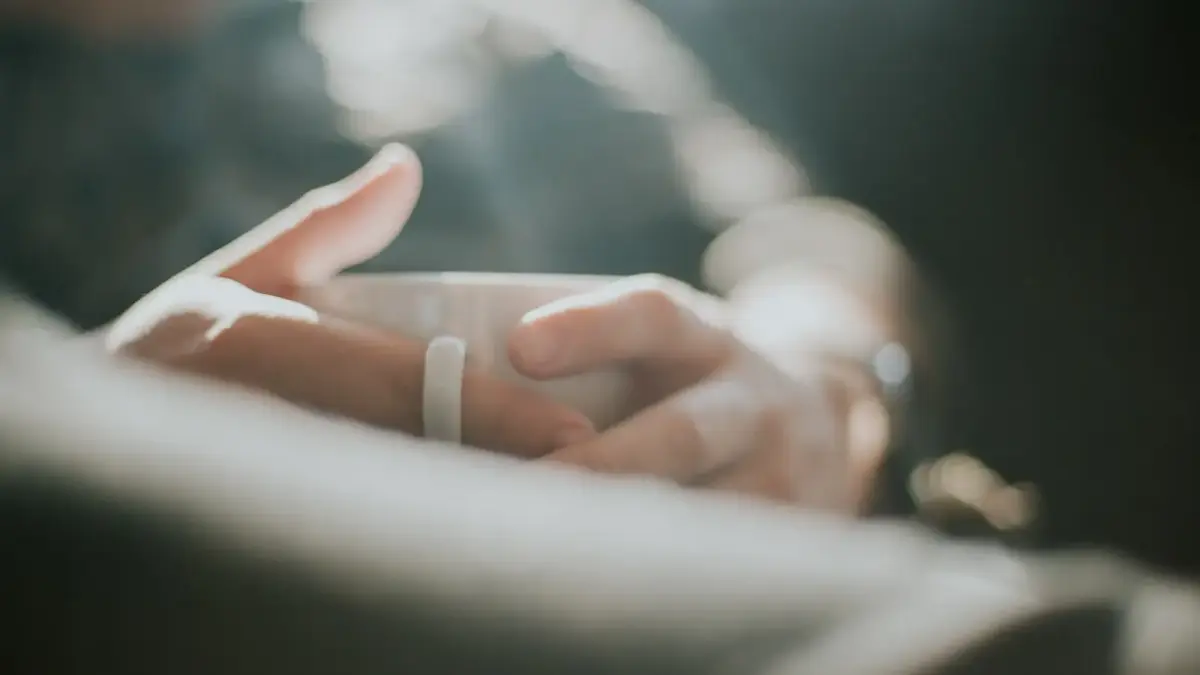
I watched my own hands this morning and caught them doing it again.
Both palms pressed flat against the ceramic. Fingers laced around the curve of the mug like it was the only solid thing in a room full of moving parts. Not because the coffee was particularly good. Not because the kitchen was cold.
My hands just went there - the way they always go there - like a dog returning to the same corner of the couch every single evening without being told.
I have been doing this for as long as I can remember. And for most of those years, I assumed it was a preference. A cozy habit. Something unremarkable and barely worth noticing.
It turns out it is worth noticing. Because what looks like a simple comfort behavior is actually something far more interesting - and far older than the coffee.
Your hands were never the problem, but someone made you think they were
Here is what most people never consider about the two-handed cup grip. It is not about temperature. It is not about coziness or some Pinterest-worthy morning ritual. It is about what happens when your hands have nothing to do.
For some of us, empty hands were never neutral. They were evidence.
Fidgeting fingers got noticed. Tapping on the table earned a look. Picking at a seam, clicking a pen, drumming on your knee - these were not just idle movements. They were invitations for someone to say something.
Stop that. Sit still. What’s wrong with you.
A 2019 study published in Frontiers in Psychology found that self-directed touching behaviors - what researchers call “self-adaptors” - increase significantly in individuals who experienced high-control or emotionally unpredictable childhood environments. The body learns to manage its own restlessness before anyone else can comment on it.
And wrapping your hands around a warm object is one of the most socially invisible ways to do exactly that.
The invention you do not remember inventing
Children are extraordinary engineers of survival. They do not sit down and design coping strategies with flowcharts and sticky notes. They stumble into solutions with their bodies and then repeat whatever worked.
At some point - probably around six or seven, probably at a kitchen table, probably holding a cup of hot chocolate that someone handed you without much thought - your hands found a dock. A place to be. A task that looked like nothing but felt like everything.
You wrapped both palms around the cup. Your fingers stopped moving. Your body went still.
And nobody said a word.
That silence was the reward. Not the warmth. Not the drink. The silence. The absence of scrutiny. The beautiful, merciful experience of being a child in a room where no one is looking at your hands.
Daniel Goleman’s work on emotional self-regulation describes this kind of adaptation as a form of body-based intelligence. Your nervous system identified a problem - visible restlessness attracts unwanted attention - and engineered a solution so elegant that it disguised itself as an ordinary preference.
You did not learn this from a book. You learned it from the specific texture of relief that came when your fingers finally had somewhere to go.
What the cup actually does for your nervous system
There is real neuroscience behind why this works, and it is not just the warmth - though the warmth matters.
When you press your palms against a warm surface, you activate thermoreceptors in the skin that send signals through the C-tactile afferent fibers. These are the same nerve pathways that respond to gentle, affectionate touch.
A 2014 study published in Psychological Science found that holding a warm object can literally make people feel more socially connected and interpersonally generous. The warmth tricks the nervous system into registering something close to human contact.
But the containment piece is equally important. When both hands are wrapped around a fixed object, the proprioceptive system - the part of your brain that tracks where your body is in space - gets a clear, stable signal. Your hands are here. They are accounted for. They are not floating, not fidgeting, not available to betray whatever is happening underneath.
This is why the mug works better than a glass. Why ceramic works better than paper. Why the two-handed grip feels different from the one-handed hold.
You are not drinking. You are anchoring.
The forty-nine-year-old who still needs the dock
I think the most striking thing about this behavior is how long it lasts. You are not seven anymore. Nobody is watching your hands across a dinner table with that particular kind of narrowed attention.
The threat is gone. But your body does not know that.
Gabor Mate writes extensively about how the body stores early adaptive responses long after the original environment has changed. The nervous system is not interested in whether a strategy is still necessary. It is interested in whether a strategy ever worked. And if it worked - if it once produced the specific chemical result of safety - the body will keep returning to it like a prayer it memorized before it understood the words.
So here you are at forty-nine, or fifty-six, or sixty-three. Sitting at your kitchen table on a Tuesday morning. Both hands around the cup.
And you think this is just how you drink coffee.
It is not how you drink coffee. It is how you hold yourself together in a world that once made you feel like your own restlessness was a character flaw.
The people who hold the handle are telling a different story
This is not about judging one grip over another. But it is worth noticing the difference, because the difference is real.
People who hold a mug by the handle tend to be people whose hands were never a source of anxiety. The handle is functional. It is a tool. You grip it, you drink, you set it down. There is no emotional architecture involved.
People who wrap both hands around the cup are doing something else entirely. They are completing a circuit. Occupying space that would otherwise feel dangerous. Creating a task for fingers that learned, very early, that idleness was not safe.
A 2021 study published in the Journal of Personality and Social Psychology found that adults who scored high on attachment anxiety were significantly more likely to engage in object-holding and self-soothing touch behaviors in social settings. Not because they were more anxious in the moment. Because their bodies had developed a larger repertoire of self-regulation tools, and those tools had become so habitual they were essentially invisible.
You are not performing coziness. You are performing containment. And you have gotten so good at it that even you forgot it was a performance.
The reframe you did not know you needed
Here is the part where I am supposed to tell you to stop doing this. To put down the cup and face your anxiety head-on. To process the childhood stuff and graduate to a one-handed grip like a person who has done the work.
I am not going to tell you that.
Because what you are doing with that cup is not a problem. It is a solution. One your body invented when you were too young to have language for what you were feeling, too small to leave the room, too dependent on the people around you to risk being visibly uncomfortable.
Your nervous system looked at an impossible situation and built a tool out of ceramic and warm water. It found a way to self-regulate that was so subtle, so ordinary, so completely unremarkable that it passed through every room you have ever sat in without drawing a single question.
That is not a flaw. That is engineering.
Susan Cain’s research on quiet temperaments reminds us that many of the behaviors we dismiss as quirks or preferences are actually sophisticated nervous system strategies operating beneath conscious awareness. The two-handed cup grip belongs in that category. It is not a habit. It is a technology your body built and never bothered to explain to you.
The warmth was never the point, but it was never nothing either
I want to be honest about one more thing. The warmth does matter. Not in the way you think - not as the reason for the grip - but as a kind of bonus your body stumbled into while solving a different problem.
When you hold something warm against your palms, your heart rate drops slightly. Your breathing slows. The muscles in your shoulders release by a fraction. These are measurable, documented physiological responses.
Your body was looking for a way to contain your hands, and it accidentally found a way to calm your entire system.
That is the kind of accident that only happens to a nervous system that has been problem-solving for a very long time. A body that has been keeping you safe in ways you never asked it to and never thanked it for.
So tomorrow morning, when you find yourself standing in the kitchen with both hands wrapped around your coffee, do not rush past it. Do not dismiss it as a preference or a habit or something everybody does.
Notice it. Feel the ceramic under your palms. Feel the warmth moving into your fingers.
And know that you are witnessing something remarkable - a child’s invention, still working, still faithful, still keeping your hands exactly where they need to be so you can sit in a room without anyone asking what you are nervous about.
You were never fidgety. You were never too much. You were a small person with a big nervous system, and you found a way to make yourself invisible in exactly the right moments.
The cup was never just a cup. It was the first place your hands ever felt like they were allowed to rest.