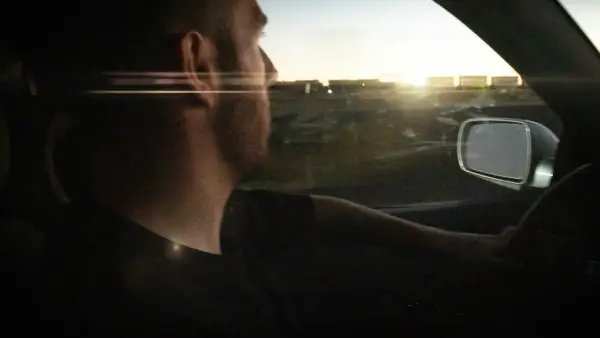
Psychology says the twenty minutes of silence between a couple on the drive home from his parents' house isn't the beginning of a fight and isn't coldness, it's the sound of two nervous systems slowly unspooling from an evening of performing composure, and the partner who finally reaches for the radio is not the one who cared least, they're the one who couldn't carry another minute of a body still bracing for a room that was always one comment away from tipping
The driveway shrinks in the rearview and neither of us says anything.
I remember the first time I noticed it. We had just pulled away from my parents’ house after a Sunday dinner that had gone, by all objective measures, fine. No raised voices. No arguments. Just the usual low static of a family that loves each other and has agreed, without ever agreeing, about which subjects we do not touch.
She was looking out the passenger window and I was watching the road and the silence inside the car was doing something I did not have a name for yet. It wasn’t the silence of being angry. It wasn’t the silence of being distant. It was, I eventually realized, the silence of two people whose bodies were finally allowed to stop.
For years I misread that silence. I thought it meant something had gone wrong. I would fill it with questions, or jokes, or a tentative “you okay?” that she would answer with a tired “yeah, just quiet.” And I would feel that answer like a small rejection, when what it actually was, I understand now, was a plea. Please let me come down. Please do not ask my body to perform one more minute.
The silence isn’t absence. It’s a body landing.
Here is the thing nobody tells you about family dinners, even good ones, even ones full of real affection.
They are work. Not the bad kind of work, not always. But work in the physiological sense - a sustained act of holding yourself together in a room where other people’s expectations and histories are pressing against you.
Your face is doing something. Your posture is doing something. Your breath is shorter than it would be on the couch at home. You are, without realizing it, running the engine of social composure at a slightly higher RPM for three or four hours. And when you get in the car and close the door, the engine doesn’t cut out instantly. It idles down.
The silence on that drive is not the two of you drifting apart. It is the two of you finally close enough to stop idling for anyone.
What a body is actually doing at a family dinner
Watch yourself at the next one, if you can bear to.
Your jaw is slightly tighter than it is at home. Your shoulders are set a half-inch higher. You are tracking voices, tones, the particular inflection your mother-in-law uses before she says the thing nobody wanted said. You are running a constant, quiet computation about whether your partner is okay, whether you are okay, whether the conversation is about to turn.
This is sympathetic nervous system work. Mild, often low-grade, but continuous. Your body is doing the social equivalent of standing in a light rain for four hours - not a storm, not dangerous, just wet and cold and slowly draining.
Stephen Porges, who developed polyvagal theory, describes the ventral vagal state as the physiological baseline of true social safety. You can only drop into it in places where your body has decided, at a level far below thought, that no threat is coming. Most of us, no matter how much we love our families, do not fully reach that state in our parents’ living rooms. We reach a close cousin of it - a performance of it - while our system keeps one foot on the brake.
A good family dinner is not unsafe. It is just not fully safe. There is a difference, and your body knows it.
The performance nobody talks about
The specific choreography is this.
You are performing composure for the people who raised your partner, or the people who raised you, while also performing composure for your partner about how you are handling the people who raised them. Two audiences. Two scripts. One body.
You swallow the comment about the politics. You smile at the joke that wasn’t quite a joke. You agree to the second helping you didn’t want. You keep your face soft when his father mentions, again, the thing about your career. You squeeze your partner’s knee under the table, a small private semaphore - I’m here, I’m okay, I saw that, we’ll talk later.
This is love, by the way. It is also labor. Both things are true, and your nervous system is not confused about which is which.
A 2021 study published in Psychoneuroendocrinology on allostatic load found that even neutral social performance tasks - situations where subjects felt observed but not threatened - produced measurable, sustained elevations in cortisol and heart rate variability markers that took significant time to return to baseline after the task ended. The body does not distinguish between “performing for a hostile audience” and “performing for a loving one.” It just registers: I am being watched. I must hold.
The drive home is the first moment you are not being watched.
The specific physiology of the on-ramp
Pay attention, next time, to the geography of your own decompression.
For me, it is the on-ramp to the highway. The moment the car picks up speed and the streetlights start to blur, something in my chest lets go. My shoulders drop maybe a quarter-inch. The breath I did not know I was holding for the last hour finally finishes exhaling.
For her, I have learned, it is different. Hers is the second streetlight after the exit back onto our side of town. The one near the closed pharmacy. I can see it happen - a small settling, her hand loosening in her lap, her head leaning back against the headrest.
This is not poetry. This is the ventral vagal system coming back online. The social engagement circuitry, which has been working overtime in performance mode, is finally standing down. Heart rate variability rises. Breathing deepens. Muscle tone releases. The body, in real and measurable ways, is putting itself back together.
Research on post-event physiological recovery - including work by Bessel van der Kolk on how bodies store and release accumulated arousal - suggests the twenty-to-thirty-minute window after a prolonged social demand is when the system actually rebalances. Not during the event. Not immediately after. In the quiet drive. In the slow walk. In the shower that follows.
Your body is not ignoring your partner in the car. Your body is healing next to them.
The person who reaches for the radio
For a long time I misread the radio.
When she reached over and turned it on, low, some old song, I used to read it as a signal that she was done with me. That something was wrong. That she needed a wall of sound between us because she could not stand the particular silence we were in.
I had it exactly backwards.
The person who reaches for the radio first is not the one who felt the least at dinner. They are the one whose body is furthest along in the decompression process. They are ready to let go of the effort, and music - soft, familiar, undemanding - is the auditory equivalent of a blanket. It is not a barrier between you. It is a permission slip. A signal that the performance is over and the evening can begin to soften into something else.
Sometimes I am the one who reaches for it. Sometimes she is. The one who reaches is not the one who cared less. It is the one who can no longer carry the shape of a person being watched, and who trusts the other person enough to say, with a dial, I am done performing now. You can be done too.
That is not distance. That is intimacy so deep it doesn’t need language.
What the silence is actually saying
I want to give you permission, if your body knows this silence, to stop reading it as a problem.
The silence on the drive home is not a fight in its chrysalis. It is not resentment building. It is not the slow erosion of a relationship. It is, almost always, two adult nervous systems doing exactly what they are supposed to do after hours of holding a shape for other people - coming unspooled, gently, side by side, in the only place in the world where neither of you has to be impressive anymore.
The couples I know who have been together for decades are not the ones who fill the car with bright postmortems of the evening. They are the ones who have learned, somewhere along the way, that the car after the family dinner is a sacred kind of quiet. You do not fill it. You let it do its work.
You ride home in it. You arrive home softer than you left. You do not talk about the uncle, or the comment, or the moment until tomorrow, if at all. You take off your coat. You pour a glass of water. You look at each other across the kitchen and something in both of you is home now, in a way it wasn’t an hour ago.
That was the silence doing its job.
A small reframe, for the road
If there is someone in the passenger seat tonight, or the driver’s seat, and the twenty minutes on the way home feel quiet in a way that used to scare you, consider this.
You are not failing at being a couple. You are being one.
You are two people who just spent an evening holding composure in a room that was always, even on its best nights, one comment away from tipping. And now you are in a small moving box together with nobody watching, and your bodies, which love each other, are finally allowed to stop pretending to be anything in particular.
Let the silence be there. Let the radio come on when one of you is ready. Let your shoulder drop against the door. Let the streetlights blur. Let the exhale finish.
The fight you were afraid of is not coming. What is coming is the softer version of both of you, the one your parents and her parents and the whole lit dining room never get to see - the one that only exists in the car, in the dark, on the way back to a place where no one is performing anymore.
That version of you is the one she married. That version of him is the one you chose.
The silence is how you find your way back to each other.