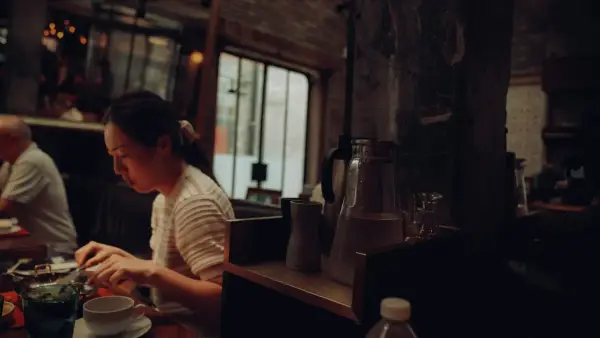
She's 47 and has realized she was never actually an introvert - she was just exhausted from decades of smiling through conversations that didn't mean anything, pretending to have energy she lost somewhere around 38, and being so constantly pleasant that silence became the only place she could hear herself think

I took an online personality quiz last year. The kind that takes four minutes and promises to explain everything about you. It told me I was an introvert, which wasn’t surprising because I’d been telling myself the same thing for twenty years.
But sitting on my couch that evening, phone in my lap, I felt something shift. Not a revelation exactly. More like a question I’d never thought to ask.
Do I actually want to be alone? Or have I just forgotten what it feels like to be around people without performing?
I thought about the dinner party I’d turned down that weekend. I didn’t skip it because the idea of conversation drained me. I skipped it because I knew exactly how it would go. I’d smile. I’d ask about everyone’s kids. I’d laugh at things that weren’t funny. I’d say “I’m good” when someone asked how I was. And I’d drive home feeling like I’d spent three hours holding my breath.
That’s not introversion. That’s something else entirely.
The inventory of small performances
If you’re a woman in your forties or fifties, I want you to try something. Make a list of every performance you deliver on an average Tuesday.
The smile you give the barista that’s slightly warmer than what you actually feel. The “no worries!” you text back when someone cancels plans you were secretly relieved about anyway. The interested face you wear during a meeting that could have been an email. The cheerful tone you use on the phone with your mother, even when you’re sitting in a parking lot trying to summon the energy to walk into a grocery store.
Now multiply that by twenty-five years.
That’s not personality. That’s labor. And the exhaustion it produces looks exactly like introversion if you don’t know where to look.
I spent most of my thirties and forties believing I was wired for solitude. That I needed to recharge after socializing because that’s just how my brain worked. I read Susan Cain’s “Quiet” and felt seen. I told people at parties - the ones I still attended - that I was an introvert, and they’d nod knowingly.
But I was misdiagnosing myself. The fatigue wasn’t coming from being around people. It was coming from being someone else around people.
When being pleasant becomes a full-time job
There’s a term in psychology called “emotional labor.” Sociologist Arlie Hochschild coined it in the 1980s to describe the work of managing your feelings to fulfill the emotional requirements of a job - flight attendants smiling through turbulence, nurses staying calm during emergencies.
But somewhere along the way, emotional labor stopped being a workplace concept and became the baseline expectation for how women move through the world.
A 2021 study published in the Journal of Personality and Social Psychology found that women consistently report higher levels of emotional suppression in social settings than men - not because they experience more emotion, but because they feel more pressure to regulate what they show. The researchers noted that this ongoing suppression was significantly associated with fatigue, decreased life satisfaction, and a reduced desire for social interaction.
Read that last part again. A reduced desire for social interaction.
Not because they didn’t like people. Because performing for people had worn them down to the bone.
I think about this constantly now. Every time I tell someone I’m “not really a people person,” I catch myself. Because that’s not true. I love people. I love real conversations - the ones where someone says something honest and the air in the room changes. I love laughing until my face hurts. I love sitting next to someone in comfortable silence where neither of us is pretending anything.
What I don’t love is the version of myself I’ve been deploying in public for decades. The one who is always fine, always interested, always available, always warm.
She’s exhausting. And she’s not even me.
The moment the label stopped fitting
It happened at a work retreat. We were doing one of those icebreaker exercises where everyone shares something about themselves, and when it was my turn, I said, “I’m a classic introvert.” People smiled. A few others nodded in solidarity.
But later that evening, I ended up talking to a woman I’d never met before. We sat on a bench outside the hotel for two hours. No small talk. No pleasantries. She told me about her divorce, and I told her about the year I almost left my husband. We talked about our mothers. We talked about the strange grief of watching your children become people who don’t need you anymore.
I walked back to my room feeling energized. Not drained. Not needing to recharge. Full.
And I realized that the introversion I’d been claiming wasn’t about needing less connection. It was about needing real connection - and having so little of it that the fake version had become the only version I knew.
The fatigue that masquerades as personality
Psychologist Gabor Mate has written extensively about how the body keeps score of emotional suppression. When you spend years overriding your authentic responses - smiling when you’re annoyed, agreeing when you disagree, performing enthusiasm you don’t feel - the nervous system doesn’t just shrug it off. It accumulates. It becomes a kind of chronic low-grade depletion that colors everything.
You stop wanting to go out. You start craving weekends with nothing on the calendar. You develop a deep relationship with your couch and your dog and the particular quality of light that comes through your kitchen window at 4 PM.
And then you call yourself an introvert, because that’s the language available to you.
A 2019 study in Frontiers in Psychology explored the relationship between what researchers called “surface acting” - displaying emotions you don’t actually feel - and burnout. They found that chronic surface acting didn’t just affect job performance. It eroded people’s sense of self. Participants who engaged in high levels of emotional performance reported feeling disconnected from their own identity, unsure of what they actually felt versus what they’d trained themselves to display.
That disconnection is what I lived inside for years. Not introversion. Identity fatigue.
What she actually needed wasn’t solitude
Here’s what I’ve started to understand at 47 that I couldn’t see at 32.
I don’t need alone time because I’m wired for solitude. I need alone time because it’s the only space where I’m not managing someone else’s comfort. Where I don’t have to calibrate my face or modulate my tone or decide whether my real answer to “how are you?” would make things awkward.
Silence isn’t my preference. It’s my recovery room.
And once I saw it that way, everything shifted. I stopped declining invitations because “I’m an introvert” and started asking myself a different question: Will I have to perform here, or can I show up as myself?
The answer changed which invitations I accepted. I said yes to the friend who lets me be quiet. I said no to the neighborhood cookout where I’d spend two hours being delightful. I said yes to a long drive with my sister where we could talk about real things or not talk at all. I said no to the work happy hour where everyone pretends to like each other slightly more than they do.
My social life got smaller. But it got honest. And for the first time in years, being around people didn’t leave me feeling like I needed three days alone to recover.
The permission nobody gives you
If you’re reading this and something is clicking into place - this quiet recognition that maybe you’re not introverted, maybe you’re just tired - I want to say something that nobody said to me.
You are allowed to stop performing.
You are allowed to let your face rest. To answer “how are you?” with “honestly, I’m kind of running on empty today.” To skip the event without giving a reason. To be warm without being bright. To be present without being on.
A 2022 study in Psychological Science found that people who allowed themselves to express authentic emotions in social interactions - even when those emotions were neutral or mildly negative - reported higher relationship satisfaction and lower psychological distress than those who maintained positive displays. The researchers called it “authentic emotional expression,” and it turned out to be more socially connecting, not less.
You don’t have to sparkle to be loved. You don’t have to perform energy to deserve connection. The people who matter will meet you where you actually are - not where you’ve been pretending to be.
I’m 47, and I’m not an introvert. I’m a woman who got so good at being pleasant that I forgot I was allowed to be anything else. The solitude I craved wasn’t a personality trait. It was a symptom. And the cure wasn’t more time alone.
It was finally, after all these years, letting myself be real.