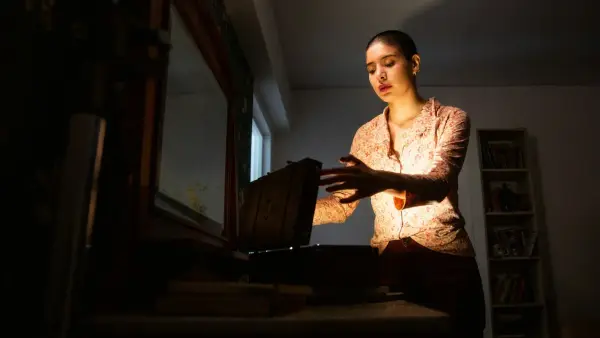
She's 49 and has finally understood that the emotional intelligence everyone has praised her entire life was never actually a gift - it was a surveillance system she built as a child in an unpredictable home, and the reason she's so exhausted at the end of every social interaction is that she has never once walked into a room without scanning it for danger first

I was at a dinner party last year when a friend introduced me to someone new. “This is Elena,” she said. “She’s the most emotionally intelligent person I know. She always knows exactly what everyone’s feeling.”
The woman smiled at me like I’d been handed a compliment. And I smiled back. But something turned over in my stomach that I couldn’t name until weeks later.
Because I do always know what everyone’s feeling. I know when the host is anxious about the food. I know when someone’s laugh has gone hollow. I know when a couple across the table is pretending they didn’t fight in the car on the way over. I catch the micro-shift in someone’s jaw before the words change. I hear the breath that comes half a second too late.
I have always known these things. And for forty-nine years, I believed it meant I was gifted.
It took me until this year to understand what it actually meant. I wasn’t reading rooms because I was wise. I was reading rooms because a very young version of me decided that her survival depended on it.
The praise that kept the pattern invisible
People have been telling me I’m empathetic since I was a teenager. Teachers noticed it. Friends relied on it. Bosses promoted me because of it. “You just get people,” they’d say. “You always know the right thing to say.”
And I leaned into it. Of course I did. When people praise you for something, you build your identity around it. I became the listener, the mediator, the one who held space.
What nobody understood - what I didn’t understand - was that this skill had a cost I was paying every single day. Not in some dramatic, visible way. In the quiet way of a body that never fully relaxes.
A 2005 study published in the Journal of Personality and Social Psychology found that individuals who score highest on measures of empathic accuracy - the ability to correctly read others’ emotions - often developed that capacity in childhood environments where emotional unpredictability was the norm. The researchers called it “adaptive attunement.” I call it what it was for me: learning to predict my mother’s mood before she walked through the door.
The house where I learned to scan
My mother wasn’t a bad person. I need to say that because the story isn’t about blame. It’s about a household that ran on an emotional logic I couldn’t predict.
Some evenings she was warm and funny and we’d cook dinner together while she told stories about her college years. Some evenings the air in the house felt like the minutes before a thunderstorm, and I’d know before she said a single word that tonight was different.
I learned to read the sound of her keys in the lock. The pace of her footsteps. Whether the grocery bags hit the counter softly or were dropped.
By seven or eight, I had a system. I didn’t know it was a system. It just felt like paying attention. If her shoulders were up near her ears, I’d be quiet. If her voice had that particular flatness, I’d make myself small. If she laughed at something on TV, the knot in my chest would loosen just enough to breathe normally.
I wasn’t developing emotional intelligence. I was building a surveillance network. And it worked. It kept the evenings calm. It kept me safe - or what a child’s body interprets as safe. And because it worked, my nervous system never got the memo that it could stop.
The cost of a gift that isn’t a gift
Here is what people don’t understand about being the person who reads every room: you can’t turn it off.
I walk into a meeting at work and within thirty seconds I’ve mapped the emotional terrain. Who’s frustrated. Who’s checked out. Who needs validation. Who’s about to say something they’ll regret. I adjust my posture, my tone, my words - all of it - to manage the temperature of the room before anyone else even notices the temperature has shifted.
My colleagues think I’m a natural leader. My friends think I’m the most present listener they know.
What they don’t see is me in my car afterward, sitting in the parking lot with my forehead against the steering wheel, completely drained. Not tired the way you get from hard work. Emptied out. Like I’ve been running a complex piece of software in the background for hours and now my whole system needs to shut down.
Dr. Gabor Mate has written extensively about how the hypervigilant child becomes the hyper-attuned adult - the therapist, the nurse, the peacekeeper, the friend everyone calls in a crisis. He describes it not as a talent but as a brilliant adaptation that outlived its usefulness. The nervous system that learned to scan for danger in childhood keeps scanning in adulthood, even when the danger is long gone.
That word - scanning - hit me like a door I’d walked past a thousand times and never opened.
What scanning actually does to a body
I went to a therapist last year who specializes in somatic work. She asked me to sit in a chair in her office and just notice what my body was doing.
I told her I felt fine. She asked me to check again.
My jaw was clenched. My shoulders were pulled forward. My eyes had already catalogued the exits, the angle of her body, the slight change in her expression when I said “fine.” I’d been in the room for two minutes and my system had already completed a full threat assessment.
She told me something I’ll never forget. She said, “Your body doesn’t know you’re safe. It’s still in the house you grew up in.”
Research published in Frontiers in Psychology in 2019 found that adults who experienced emotional unpredictability in childhood showed elevated baseline cortisol levels and heightened amygdala reactivity to neutral social cues - meaning their brains literally interpret ambiguous facial expressions as potential threats. The room doesn’t have to be dangerous. The nervous system treats every room as if it might become dangerous.
This is why I’m exhausted at forty-nine. It’s not burnout from my job. It’s not introversion, though I’ve used that label for years. It’s three decades of a surveillance system running without pause, consuming enormous amounts of energy to keep me safe in rooms where I was never actually in danger.
The grief of reframing a gift
When I first started to understand this, I expected to feel relief. Some part of me thought that naming it would neutralize it. Instead, what I felt was grief.
Because if my emotional intelligence wasn’t a gift, then who was I?
I had built a career on it. A marriage. Friendships. My whole identity was organized around being the person who understands. Take that away and what’s left? A woman who was scared as a child and never stopped being scared, dressed up in the language of empathy and wisdom.
That’s a brutal thing to sit with.
But here’s where the story turns, and it’s the part I want you to hear if any of this sounds familiar. The skill is real. The ability to read people, to hold space, to notice what others miss - that’s not fake. It’s not imaginary. You really can do those things.
The difference is understanding where it came from. Because when you know it started as survival, you can begin to separate the genuine compassion you’ve developed as an adult from the compulsive scanning that your child-self installed as a security system. One is a choice. The other is a reflex. And they feel so similar that most of us never learn to tell them apart.
Learning to enter a room without mapping it
I’m not going to pretend I’ve solved this. I haven’t. I still scan. I still walk into a room and feel my system start cataloguing. It’s forty years of neural wiring, and no amount of insight erases it overnight.
But I’ve started doing something that feels radical for someone like me. I’ve started noticing when I’m scanning and gently asking myself: “Is this room actually dangerous, or is this an old program running?”
Most of the time, the answer is obvious. The room is fine. The people are fine. The only thing that’s not fine is my nervous system, still loyal to a seven-year-old girl who needed it.
Susan Cain, in her work on temperament and sensitivity, has written about how the traits we develop in response to difficult environments can become genuine strengths when we bring them under conscious direction. The difference between empathy as compulsion and empathy as choice is enormous. One leaves you depleted. The other lets you connect without losing yourself.
I’m forty-nine, and I’m learning that difference for the first time.
The permission nobody gave us
If you recognized yourself anywhere in this piece, I want to say something to you that I wish someone had said to me thirty years ago.
You’re not broken. You’re not even damaged. You are a person whose young mind did something extraordinarily intelligent - it built a system to keep you safe in an environment that didn’t feel safe. That system has been running faithfully ever since, doing exactly what you designed it to do.
The exhaustion you feel isn’t weakness. It’s the cost of a protection system that never got the signal to stand down.
You’re allowed to give it that signal now. Not all at once. Not perfectly. But slowly, room by room, breath by breath, you can start to walk through a door without bracing for what’s on the other side.
The world will still call you empathetic. The people who love you will still say you have a gift. And they won’t be wrong. The gift is real. It just has an origin story that deserves more tenderness than you’ve probably given it.
You’ve been keeping watch for a very long time. You’re allowed to rest now.