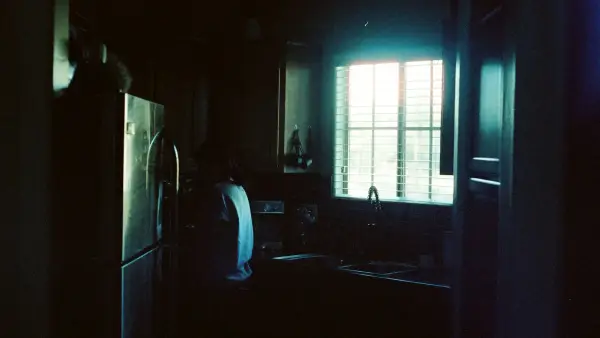
She's 55 and has finally understood that the reason she cannot leave a voicemail without hanging up and calling back to re-record it is not perfectionism - it is that a girl who grew up where the wrong sentence at dinner could change the temperature of the entire house never stopped editing herself before she speaks, and forty years later she is still rehearsing conversations for people who are not listening nearly as closely as she was trained to believe they would be

She typed the message three times before she sent it
It was a text to her sister. Four words. “Can you call me?”
She typed it, deleted it, retyped it with a period instead of a question mark, deleted that because it felt too demanding, added “when you get a chance” to soften it, then stared at the screen for another thirty seconds wondering if the whole thing sounded needy.
Four words. To her own sister.
She hit send and immediately felt a small flicker of dread - not because the message was wrong, but because she could no longer take it back.
If you have ever re-read a two-sentence email four times before pressing send, or hung up mid-voicemail and called back to re-record something that nobody was going to analyze the way you just did, this is going to feel uncomfortably familiar. And I want to tell you something that took me decades to understand: that habit is not what you think it is.
It is not perfectionism. It is not social anxiety. It is not some personality quirk you inherited alongside your eye color.
It is the residue of growing up in a home where language was weather. Where the wrong word at the wrong moment could turn a Tuesday dinner into something you spent the rest of the night recovering from.
The house where tone was everything
In some homes, the danger is loud and obvious. Doors slam. Voices rise. You learn to flinch.
But in other homes - and this is the kind almost nobody talks about - the danger is silent. It lives in pauses. In the way a fork gets set down on a plate. In the half-second shift in your mother’s expression between “fine” and whatever “fine” actually meant that evening.
You learned to read rooms the way other children learned to read books. Not because you were gifted. Because you had to.
A 2019 study published in the journal Developmental Psychology found that children raised in emotionally unpredictable households develop heightened sensitivity to vocal tone, facial micro-expressions, and conversational cadence - often before the age of six. The researchers called it “perceptual vigilance.” I call it learning that language was the most dangerous thing in your house, and your only job was to use it perfectly.
You became a translator of emotional weather systems. You could feel a storm forming in the space between your father’s words before he even finished his sentence. You knew the difference between your mother’s three versions of “that’s nice” and you calibrated your responses accordingly.
This was not a skill. This was survival.
And the thing about survival strategies is that they do not come with expiration dates.
Forty years of drafting and redrafting
She is fifty-five now. She runs a department. She has raised children who turned out kind. She has friendships that have lasted longer than some marriages.
And she still cannot leave a voicemail on the first try.
She will call, hear the beep, start talking, then stumble over a phrase that sounded too casual or too formal or too something - and she will hang up, call back, and re-record the entire thing. Sometimes twice. For a message to her dentist’s office about rescheduling a cleaning.
She rehearses phone calls in her head before dialing. Not important ones. All of them. She runs through the conversation like a dress rehearsal, anticipating responses, adjusting her tone, preparing alternate versions of sentences depending on how the other person reacts.
She re-reads text messages before sending them - not for typos, but for tone. Could this be misread? Does this sound cold? Should I add an exclamation point so they know I’m not upset? She has added more exclamation points to more messages than she can count, not because she is exclamatory by nature, but because she learned young that neutral language gets interpreted as hostile in a home where silence was a weapon.
This is verbal hypervigilance. And almost no one recognizes it for what it is.
The difference between anxiety and a pattern that kept you safe
Here is what the self-help world gets wrong: they call this anxiety. They tell you to practice mindfulness. They suggest deep breathing before phone calls. They hand you coping strategies for a problem that is not a problem at all - it is a solution that outlived its context.
You are not anxious. You are doing exactly what you were trained to do. The child who monitored every syllable at the dinner table grew into the woman who monitors every syllable in a text message. The mechanism is identical. Only the setting has changed.
Dr. Gabor Mate has written extensively about how the adaptations we develop in childhood do not disappear simply because we leave the environment that created them. They become embedded in the nervous system. They become automatic. The girl who learned to edit herself before she spoke did not stop editing when she moved out of her parents’ house. She just found new audiences to perform her careful, curated version of speech for.
And the painful part - the part that might sting a little - is that most of those audiences are not paying attention with anything close to the intensity she was trained to expect.
Your coworker is not analyzing the precise wording of your email the way your mother analyzed the precise wording of your answer when she asked how school was. Your friend is not detecting hidden hostility in your text the way your father detected hidden disrespect in your tone when you asked to be excused from the table.
You are still performing for a panel of judges that disbanded decades ago.
The translator who never got to retire
I think of it this way. Imagine a child who grows up on the border between two volatile countries. She becomes a translator - not by choice, but by necessity. She learns both languages fluently. She learns to hear what is said and what is meant. She learns that a single mistranslation could start a conflict.
She is extraordinary at this. She catches things that other people miss. She hears the subtext beneath the text, the emotion beneath the words, the real question hiding inside the polite one.
Then one day, the conflict ends. The border becomes peaceful. There is no more need for translation.
But nobody tells her. No formal announcement. No ceremony. No letter that says, “Thank you for your service. You may stop listening for danger now.”
So she keeps translating. For forty years. In grocery stores and voicemails and text messages to her sister. She keeps scanning for the wrong word, the dangerous pause, the sentence that could change the temperature of a room - even though the rooms she is in now are warm and stable and populated by people who love her imperfectly but sincerely.
A 2021 study in Frontiers in Psychology found that adults who experienced chronic emotional unpredictability in childhood show elevated activity in the brain regions responsible for social monitoring and language processing - even in low-stakes social situations. Their brains are still scanning. Still translating. Still doing the work of a child who believed that the right words could keep the peace.
What she is actually doing when she re-records the voicemail
When she hangs up and calls back, she is not being neurotic. She is being faithful to an old contract she signed as a girl - a contract that said: your words have consequences. Every sentence you release into the world will be examined, weighed, and potentially used to determine the emotional climate of this home for the next several hours.
That contract was real. In her childhood home, it was absolutely true that the wrong sentence could change everything.
But the contract expired. And nobody gave her the paperwork.
She is still honoring the terms of an agreement that the other party has long since forgotten about. She is still editing and revising and softening and calibrating for an audience that is checking their own phone while her voicemail plays, half-listening, catching maybe sixty percent of what she says before moving on with their day.
She gave every word the weight of a diplomatic cable. They gave it the weight of a Post-it note.
This is not a failure on their part. This is the natural weight that most words carry in most lives. It is just that she was never taught that most conversations are low-stakes. In her house, there were no low-stakes conversations.
The permission she has been waiting for
Here is what I want to say to her. To you, if this is you.
You can send the text without re-reading it. The person on the other end is not grading you. They are not going to go quiet for three days because you used a period instead of an exclamation point. They are probably reading your message while standing in line at the pharmacy, and they are going to respond with “ok sounds good” and not think about your word choice for a single second after.
You can leave the voicemail on the first take. It does not have to be perfect. It does not have to be carefully calibrated to avoid triggering a reaction. The person listening is not your parent. The temperature of their house is not going to change based on whether you said “just calling to check in” or “just wanted to touch base.”
You can stop rehearsing.
Not because the rehearsing is silly - it was never silly, it was smart, it kept you safe in a home where safety depended on syllables - but because the performance is over. The audience has gone home. You are still on stage, delivering a flawless monologue to an empty theater.
Research from the Journal of Personality and Social Psychology has shown that people consistently overestimate how much others notice and judge their verbal missteps - a phenomenon researchers call the “spotlight effect.” But for women who grew up monitoring language as a survival strategy, this is not just a cognitive bias. It is a deeply conditioned reflex. The spotlight felt real because, in their homes, it was.
She is not broken. She was brilliant.
The thing I need you to hear is this: the woman who cannot leave a voicemail without calling back is not fragile. She is not overthinking. She is not “too much” or “too sensitive” or any of the other labels that get pinned on women whose nervous systems were shaped by homes where words carried weight.
She is a woman who did something remarkable as a child. She learned to read an entire room from a single sentence. She learned to detect emotional shifts that most adults miss entirely. She learned to choose her words with the precision of someone who understood, at seven or eight years old, that language was the most powerful force in her home.
That skill kept her safe. That skill got her through.
And now, at fifty-five, the only thing she needs to learn is that she can put it down. Not throw it away - it is part of her, and the emotional intelligence it gave her is real and valuable and something that makes her extraordinary in her relationships and her work and her friendships.
But she can loosen her grip on it. She can send the text with one read-through instead of four. She can leave the voicemail and not call back. She can say the slightly imperfect thing and trust that the room will hold.
The forecast has been calm for a long time now. She just never got the updated report.