She's 57 and just realized she folds every towel exactly the way her mother did - thirds not halves, smoothing each fold flat with the palm before stacking, edges aligned so precisely you could measure them - because her mother grew up in a house with three towels for five people and learned that the way you care for scarce things is the way you prove they were worth having, and a girl who watched a woman turn laundry into something sacred never learned to fold anything carelessly even after the scarcity was gone
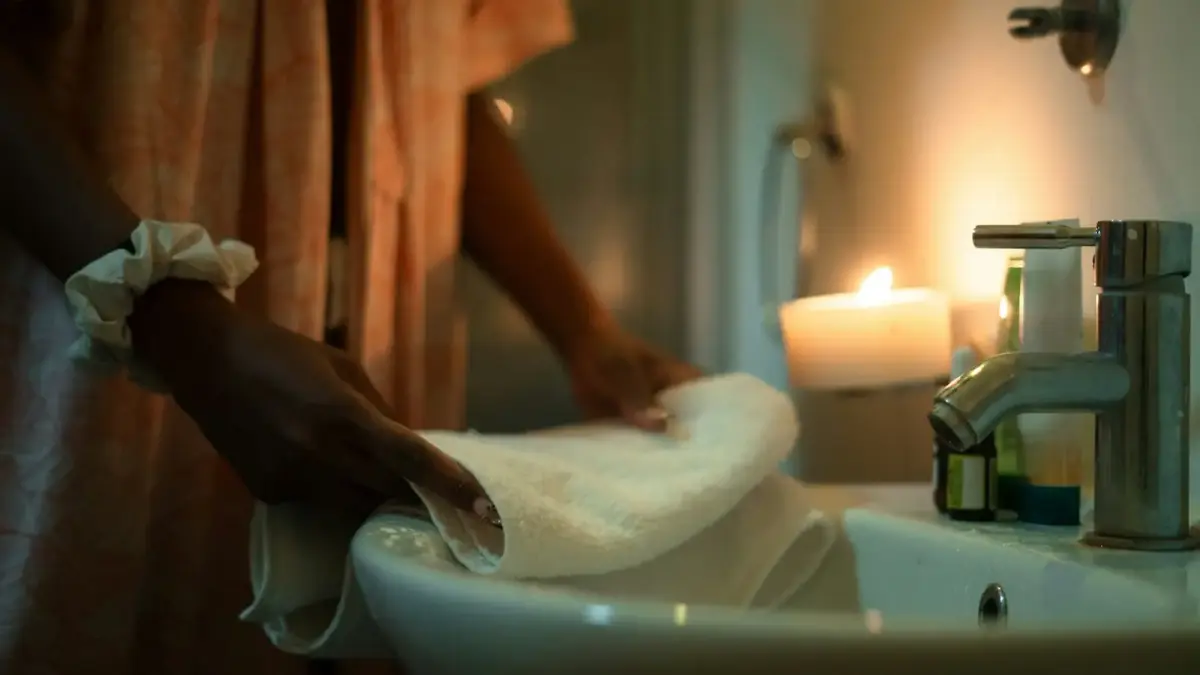
I caught myself doing it last Tuesday. Standing at the dryer, pulling out a bath towel, and without thinking - without deciding - my hands moved. Thirds, not halves. A smooth press of the palm across the fold. Edges aligned so cleanly they could pass inspection.
I have been folding towels this way for forty years. I have never once questioned it.
My husband folds in halves. My college roommate used to roll hers. I’ve seen people bunch towels into rough squares and shove them into closets, and something in my chest tightens every time - not judgment, exactly, but a flinch. Like watching someone leave a door open in winter.
I’m 57 years old, and I just understood what that flinch is. It’s not about towels. It was never about towels.
It’s about my mother. And the house she grew up in. And the fact that when you only have three towels for five people, you learn to treat each one like it matters - because it does. Because everything scarce becomes sacred when losing it means someone goes without.
The hands remember what the mind forgets
My mother grew up in a small rental house in eastern Ohio. Her father worked at the mill. Her mother cleaned other people’s homes and came back to clean her own.
There were three bath towels. Five people. The towels were washed on Sundays and hung on the line regardless of weather because the dryer cost money to run.
My mother never told me this directly. I pieced it together over decades - a comment here, a tight expression there, the way she’d run her hand over a freshly folded stack of linens like she was checking on something precious.
She folded in thirds because thirds are more compact. You can fit more into a small linen closet. She smoothed each fold with her palm because wrinkles meant carelessness, and carelessness meant you didn’t appreciate what you had. She aligned the edges because precision was the only luxury available to her.
I learned all of this without a single lesson. I learned it the way children learn everything that matters - by watching. By absorbing the choreography of a woman’s hands as she moved through her daily rituals of care.
A 2019 study published in the Journal of Personality and Social Psychology found that bodily habits and physical routines are among the most persistent forms of intergenerational transmission - more durable than beliefs, more resistant to change than values. The researchers called them “embodied inheritances.” Your mind can reject your parents’ worldview entirely and your hands will still move the way theirs did.
My hands move exactly the way my mother’s did. I have a master’s degree and a house with two linen closets and more towels than I can count, and I still fold in thirds, palm flat, edges precise. Because my body learned something my mind never had to name.
What scarcity teaches the body
There is a specific physicality to growing up without enough. It lives in the hands.
It’s the way my mother squeezed a sponge dry - completely dry, wringing it until her knuckles whitened - because a wet sponge left on the counter grows mold and a moldy sponge has to be replaced and replacements cost money.
It’s the way she smoothed aluminum foil flat after use, folded it into a neat square, and placed it in the drawer beside the stove. That foil had another life in it. Maybe two.
It’s the way she hung shirts on the line with the seams aligned to the clothespin so they wouldn’t stretch. The way she turned jeans inside out before washing because the color lasted longer. The way she wiped the counter in one efficient motion - never two passes when one would do.
None of these were things she talked about. They were things she did. And I watched her the way a daughter watches a mother - not studying, not memorizing, just absorbing the shape of what devotion looks like when it lives inside a Tuesday afternoon.
Sociologist Annette Lareau’s research on class and childrearing found that working-class families transmit values primarily through modeling rather than explicit instruction. Middle-class parents explain. Working-class parents demonstrate. The lesson isn’t spoken. It’s performed. And a child who watches a performance of care every day for eighteen years doesn’t just learn the lesson - she becomes it.
I became my mother’s theology of towels without ever knowing I’d enrolled.
The prayer no one taught you to say
I want to be careful here because I’m not romanticizing poverty. Growing up with three towels for five people isn’t charming. It’s hard. It wears a woman down. It puts lines on her face that don’t come from laughter.
But something happens inside that hardship that I think deserves to be named.
When you don’t have much, the way you handle what you do have becomes a language. It becomes the way you say: this matters. We matter. I can’t give you abundance, but I can give you this - a towel folded so precisely it feels like someone cared enough to make it beautiful.
My mother couldn’t buy us softness. So she folded it into existence.
That’s not tidiness. That’s not obsessive behavior. That’s not a personality quirk you’d laugh about at a dinner party.
That is a woman turning the only materials available to her into an act of love so quiet that her daughter didn’t hear it for forty years.
And I think a lot of women my age are carrying these silent prayers in their bodies without knowing it. The way you wipe a table. The way you stack dishes. The way you smooth a bedsheet flat with both hands before tucking the corner, the way your mother did, the way her mother did, back and back through generations of women who never had the language for what they were doing but did it anyway.
When the scarcity ends but the ritual doesn’t
Here is the part that makes me cry if I sit with it too long.
I am not scarce. I have enough towels to fill a shelf at a department store. I have a dryer that works. I have a house with closets that close.
And I still fold in thirds. Still press with my palm. Still align the edges.
Because the ritual was never about the towels. The ritual was about the woman who taught me that caring for things - really caring, with your whole body, with precision and patience and a kind of physical reverence - is how you prove something was worth having.
A 2021 study in Frontiers in Psychology explored what researchers called “phantom scarcity” - the persistence of scarcity-based behaviors long after material conditions have improved. They found that people who grew up in resource-limited households often maintain meticulous care rituals for decades, even after achieving financial stability. The rituals become untethered from necessity. They become something closer to identity.
I think that’s right, but I think it’s also not enough. “Identity” is too clean a word.
What I carry in my hands when I fold a towel is not my identity. It is my mother’s hands. It is the shape of her attention. It is a record, written in muscle memory, of every time she stood at that counter and turned laundry into something holy because holiness was the only thing she could afford to make.
The daughter’s inheritance
I have a daughter. She’s twenty-four. She rolls her towels.
The first time I saw her do it, something in me buckled. Not anger. Not disappointment. Something more like grief - the sudden awareness that a chain of transmission I didn’t even know I was part of had quietly broken.
And then something softer followed. Because my mother’s prayer was born from necessity. It was born from not having enough. And the fact that my daughter can roll a towel into a casual cylinder and shove it onto a shelf without flinching means something worked.
It means the scarcity ended. It means somewhere between my mother’s three towels and my daughter’s rolled ones, something shifted. The vigilance relaxed. The body released its grip.
My daughter doesn’t fold in thirds because she doesn’t need to. She doesn’t need to prove that things are worth having. She already knows they are, the way you know something that was given to you so early and so consistently that you can’t remember learning it.
That’s what my mother gave me. Not the folding. The underneath of the folding. The conviction that what we have deserves our attention. My mother said it with pressed edges and aligned stacks. My daughter says it differently - by actually using the towels without worry, by treating abundance as normal rather than suspicious.
Both are prayers. They just sound different.
What lives in your hands
If you’re reading this and something in your chest has gone tight, I want you to pause.
Think about the way you do one small domestic thing. The way you close a cabinet. The way you wrap leftovers. The way you hang a coat or stack the mail or wipe down the counter after dinner.
Now think about who taught you that. Not with words. With hands.
There is a woman somewhere in your history - maybe your mother, maybe your grandmother, maybe an aunt who raised you when no one else could - who poured everything she couldn’t say into the way she handled the ordinary objects of a household.
She didn’t know she was building a language. She didn’t know her daughter would still be speaking it at fifty-seven, standing at a dryer on a Tuesday, pressing a towel flat with the palm and feeling something she couldn’t name until now.
It was gratitude. It was grief. It was the particular ache of inheriting a woman’s most intimate prayer and only recognizing it decades after she stopped being able to say it.
Your hands remember things your mind never recorded. And the way you fold a towel - or don’t - is a story about where you came from, what was scarce, what was sacred, and who loved you in the only language she had.
That’s not a small thing. That might be the biggest thing there is.