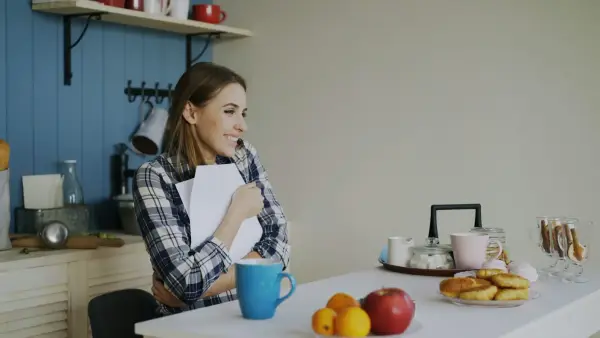
She's 57 and just realized she still checks the price of everything on the menu before ordering at a restaurant - even now that she can afford anything on it. The childhood of watching her mother's eyes scan right to the column of numbers before reading a single word of food taught a girl that a menu is not a list of choices but a ledger of consequences.

The Right Side of the Menu
I watched my mother read menus from right to left.
Not the descriptions. Not the ingredients or the little italic notes about seasonal preparations. She went straight to the numbers. Her eyes would land on the price column the way other people’s eyes land on the specials, and I could see her doing the math before she’d read a single word about what the food actually was.
She never said we couldn’t afford things. That wasn’t how it worked in our house. Instead, she’d say things like “Oh, I’m really in the mood for soup tonight” at a steakhouse. Or “I had a big lunch” when she hadn’t eaten since breakfast. Or the one that still catches in my throat - “You go ahead, sweetheart. Get whatever you want.” Delivered with a smile that didn’t reach the corners of her eyes.
I’m fifty-seven years old. I have a retirement account and a mortgage that’s almost paid off and a job that deposits a number into my bank account every two weeks that would have made my mother cry. And last Tuesday, at a perfectly ordinary restaurant with a friend, I caught myself scanning right to the prices before I’d read a single menu item.
Not because I needed to. Because it’s the only way I know how to read a menu at all.
The Algorithm Poverty Installed
There’s a specific kind of programming that happens when you grow up watching someone you love navigate scarcity. It doesn’t announce itself. It doesn’t feel like trauma. It just becomes the architecture of how you move through certain spaces - restaurants, grocery stores, anywhere that asks you to choose what your hunger is worth.
A 2019 study published in the Journal of Personality and Social Psychology found that early experiences of economic scarcity create persistent cognitive patterns that remain active even when financial circumstances improve dramatically. The researchers called it “scarcity mindset persistence” - the tendency for brains shaped by poverty to continue operating as if resources are limited long after they’ve become abundant.
But that clinical language doesn’t capture what it actually feels like to sit in a nice restaurant and feel your body tighten.
It’s not a thought. It’s not a decision. It’s something that happens below the level of choosing - a scan, a calculation, a sorting algorithm that runs before your conscious mind has any say in the matter. The prices organize themselves into a hierarchy of permission, and your eyes find the second-least-expensive entree the way a compass finds north.
You don’t even realize you’re doing it until someone at the table says “I’m getting the lobster” with the casualness of a person who has never once calculated what their appetite is allowed to cost.
”I’ll Just Have the Salad”
There’s a sentence that women who grew up poor have been saying in restaurants for decades. It sounds like a preference. It sounds like a choice. But if you grew up the way I did, you know it’s neither.
“I’ll just have the salad.”
Not because you want the salad. Because the salad is safe. The salad doesn’t ask too much. The salad doesn’t make the number at the bottom of the check do something that would have made your mother’s face change.
I have a friend - she’s done well for herself, beautiful house, kids in college - who still orders water at restaurants. Every single time. Even at birthday dinners. Even when the rest of the table is ordering cocktails. She’ll say “Water’s fine for me” with a brightness that covers something much older and much heavier than a beverage preference.
Her mother used to order water so that the children could have lemonade.
That’s how class memory works. It doesn’t live in your bank account. It lives in your body. It lives in the micro-hesitation before you tell the waiter what you want. It lives in the way you study a menu like it’s a math test you can’t afford to fail.
Gabor Mate has written extensively about how the body stores what the mind tries to forget - how early experiences of stress and deprivation create physiological responses that outlast the circumstances that created them. Poverty doesn’t just take things away from you while you’re in it. It installs a permanent guest in your nervous system who shows up every time abundance presents itself and whispers, “Are you sure you’re allowed to have this?”
The Face That Told a Different Story
My mother was a generous woman. I need to say that first, because what I’m about to describe might sound like a criticism, and it isn’t. It’s a recognition of what scarcity does to love.
She always told us to order whatever we wanted. Her mouth said it every time. But her face - her face was a different menu entirely.
There was a flicker. Just a fraction of a second when your finger landed on something expensive. A tightening around the eyes that you wouldn’t notice if you weren’t a child who had made a career out of reading your mother’s face for signs of danger.
That flicker taught me more about money than any financial literacy class ever could. It taught me that generosity and anxiety can live in the same sentence. That “get whatever you want” can mean “I love you so much I’ll hide my panic.”
And it taught me to calculate. Not on paper. In my chest. A fast, wordless arithmetic that sorted every option on a menu into two categories: what you want and what you’re allowed to want. I learned to want the cheaper thing so automatically that, decades later, I genuinely cannot tell you whether I prefer chicken to steak or whether I’ve simply trained my preferences to match my mother’s comfort level.
A 2021 study in Psychological Science found that children who grow up in economically unstable households develop heightened sensitivity to the emotional cues of caregivers around financial decisions. The researchers noted that these children don’t just learn about scarcity from explicit conversations about money - they learn it from micro-expressions, from sighs, from the particular quality of silence that descends when a bill arrives at the table.
I learned it from a face that said everything her words refused to.
The Discomfort of Being Treated
Something happens when someone else offers to pay for your meal. If you grew up with money, it probably feels like kindness. A nice gesture. You say thank you and move on.
If you grew up without it, being treated to a meal activates something closer to surveillance.
You become hyperaware of what you’ve ordered. You review your choices against an invisible standard - was the appetizer too much? Should you have skipped the second glass of wine? You eat with a low hum of guilt that tastes more familiar than the food itself.
And then there’s the check. The moment it arrives. The way your hand moves toward it reflexively, not out of generosity but out of a desperate need to know the number. To see it. Because not seeing it is worse. Not seeing it means someone else is seeing it and judging whether your hunger was reasonable.
I split checks with mathematical precision. Not because I’m cheap. Because controlling exactly what I owe means controlling exactly how much space my appetite is allowed to take up. It means no one is doing the math on my behalf and finding me excessive.
This is what people who’ve never been poor don’t understand. It’s not about the money anymore. It’s about the permission. It’s about the deeply held belief that your needs - your actual, honest, full-sized needs - are an imposition on the people around you.
The Menu Without Prices
A few years ago, a friend took me to one of those restaurants that doesn’t put prices on the menu. A tasting menu. Set courses. Someone else deciding what you eat and how much it costs.
I had a panic attack in the bathroom before the first course arrived.
Not a dramatic one. The quiet kind. The kind where you grip the edges of the sink and breathe and tell yourself that you are a grown woman with a salary and a savings account and this is just dinner. Just dinner.
But it wasn’t just dinner. It was a menu that had taken away the only coping mechanism I’d ever learned. Without prices, I couldn’t do the math. Without the math, I couldn’t sort the options into safe and unsafe. Without that sorting, I was just a woman with a hunger she’d never been taught to trust.
That night I understood something I’d never articulated before. The price column wasn’t my enemy. It was my safety net. It was the structure that made the chaos of wanting things feel manageable. Take it away, and I was eight years old again, sitting across from my mother, trying to read her face to find out what I was allowed to need.
What Prosperity Didn’t Overwrite
I make good money now. I’ve made good money for twenty years. I have paid off debt and built savings and bought myself things my mother never had. By every external metric, the scarcity is over.
But prosperity doesn’t overwrite the algorithm poverty installed. It just adds a layer of confusion on top of it - because now you have the means and still can’t access the permission.
You order the chicken. You say you’re not that hungry. You drink water. And the part of you that knows you could order anything on this menu watches the part of you that won’t, and neither part of you can explain to the other what’s happening.
Daniel Goleman’s work on emotional patterns suggests that our earliest learned responses to stress become what he calls “neural ruts” - pathways so well-worn that they fire automatically, bypassing the newer, more rational circuits that know the situation has changed. You can know you can afford the lobster. Your nervous system can still refuse to let you order it.
This is the inheritance no one talks about. Not the house you didn’t get. Not the college fund that didn’t exist. The inheritance that lives in restaurant booths and grocery store aisles and the moment someone hands you a menu and you feel your eyes pull right, toward the numbers, before you’ve given yourself permission to simply be hungry.
What the Woman at the Steakhouse Knows
She says “I’ll just have the salad” and she means it. She has made herself mean it through decades of practice so thorough that the wanting and the choosing have become the same thing.
But sometimes - not often, but sometimes - she catches herself. She notices the scan. She feels the old arithmetic starting up in her chest. And in that moment of noticing, something softens.
Not a fix. Not a breakthrough. Just a recognition. Oh. There you are. The girl at the table, watching her mother’s eyes.
If you read menus from right to left, if your hand reaches for the check before anyone else’s, if you have ever said “I’m not that hungry” when you were starving - you are not broken. You are not cheap. You are not unable to enjoy nice things.
You are someone who learned, very young, that your hunger had a price that wasn’t listed on any menu. And you’ve been calculating it ever since.
The woman at fifty-seven who orders the salad at a steakhouse is still the most generous person at the table. She’s just generous in the direction she was taught - away from herself.
And maybe the most radical thing she could do, one ordinary Tuesday at one ordinary restaurant, is to read the menu from left to right. To start with what sounds good instead of what costs least. To let herself be hungry without apology.
Not because the money has changed. Because she has.