She's 58 and has never once walked through a department store without running her fingers along the fabric of something she will never buy - the cashmere, the silk, the wool that costs more than her weekly groceries - not because she's window shopping but because a girl who grew up in hand-me-downs and discount-rack polyester learned to visit softness the way other people visit museums, with reverence and distance and her longing tucked carefully behind her teeth
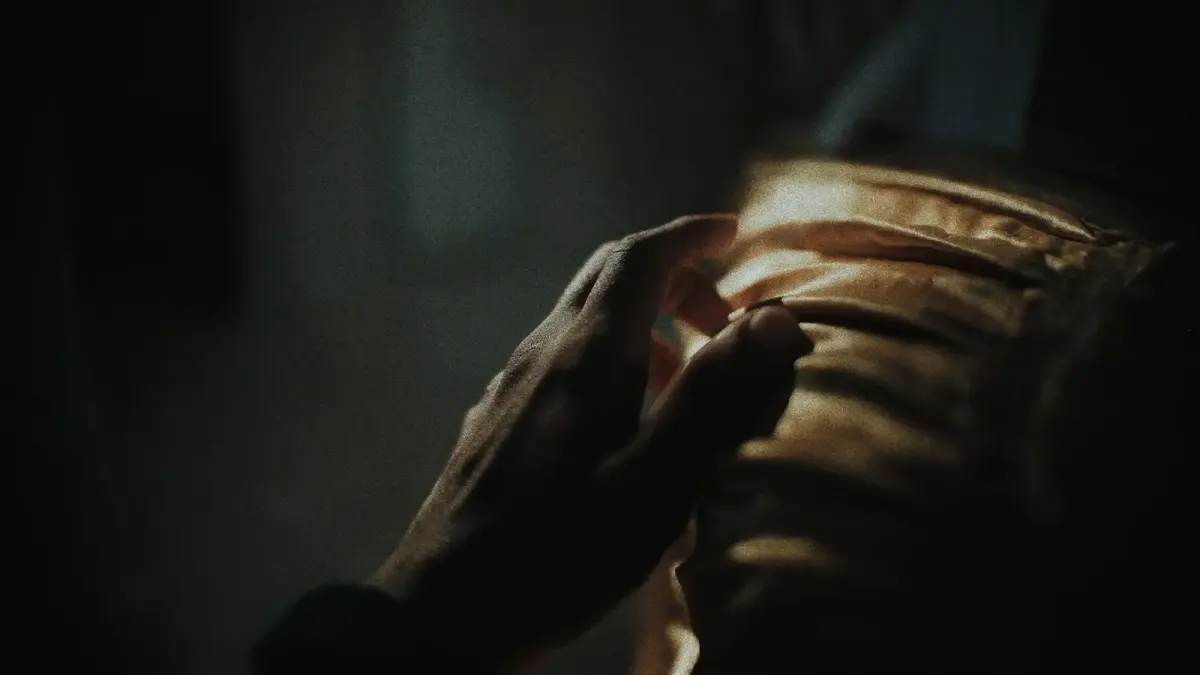
I can tell you what cashmere feels like without looking at the label.
I can tell you the difference between a wool blend and pure merino by running two fingers along the sleeve. I can identify silk charmeuse from silk crepe by the way it falls when I lift it off the hanger. I know that good linen has a weight to it - a particular kind of stiffness that softens over time - and that the linen they sell at discount stores never gets there. It stays scratchy. It stays thin.
I know all of this because I have been touching fabric in department stores for nearly fifty years, and I have purchased almost none of it.
I am 58. Last Tuesday I walked through Nordstrom on the way to return a pair of shoes my daughter had ordered online, and I did what I always do. I drifted. My hand found a rack of cashmere sweaters folded in a display, and my fingers reached out and pressed into the pile the way you’d press a piano key - gently, with the pad of the finger, feeling for the depth of it.
Forty-two dollars for socks. Eighty-nine for a scarf. Three hundred and ten for the sweater my hand was resting on.
I lifted my hand. I kept walking.
And somewhere between the cashmere display and the shoe return counter, it hit me. I have been doing this my entire life. And I have never once bought the thing my hand was reaching for.
The education of a price tag
I grew up in a house where softness was not the priority. The priority was clean, and whole, and fits.
My mother bought our clothes at Kmart and occasionally at the Salvation Army thrift store on Route 9 when the school year demanded more than the budget could cover. She was good at this. She could spot a pair of jeans in a pile of donations that still had life in them. She could find a winter coat two sizes too big and say, “You’ll grow into it,” and be right.
But what she couldn’t do - what no amount of cleverness with a limited budget can do - is change the way polyester feels against skin.
I wore it. I wore the stiff collars and the scratchy blends and the sweaters that pilled after two washes. I wore the fabric that made my skin itch during church and the tights that left red marks around my waist and the secondhand dress for the fifth-grade dance that had been washed so many times it felt like paper.
And I did not complain. Because you don’t complain about clothes that are clean and whole and fit.
But I noticed. I noticed the other girls’ sweaters at school. The ones that looked different - that draped instead of hung, that moved with the body instead of standing stiff around it. I didn’t know the word for what made them different. I just knew they were soft. And soft meant something I didn’t have a category for yet.
A 2018 study published in the Journal of Consumer Research found that tactile experiences in retail environments carry significant emotional weight for consumers from lower socioeconomic backgrounds. The researchers found that touching products - especially textiles and luxury goods - activated reward centers in the brain associated with aspiration and belonging, but also activated regions linked to social exclusion. Touching the object was pleasurable. Knowing you couldn’t own it was not.
I didn’t need a brain scanner to tell me that. I figured it out at eleven, standing in the girls’ department at JCPenney, running my fingers along a row of angora sweaters while my mother was three aisles over buying the sensible option.
The museum protocol
At some point - I don’t know exactly when - touching fabric in stores became something I did with ritual precision.
I developed rules. I didn’t realize they were rules at the time. They just lived in my body, the way good posture does in people who were corrected as children.
You walk in. You drift toward the nice section - not on purpose, but because your body knows the geography of softness in every store you’ve ever entered. You touch the fabric. You feel it between your thumb and index finger, turning the fabric slightly to test the weight and the drape.
Then you check the price tag. You always check the price tag. Even now, even though you know approximately what cashmere costs and have known since the Reagan administration. You check anyway, the way you’d check a wound you know hasn’t healed.
The number confirms what you already knew: this is not for you. And you put it back. You smooth the fold. You make sure the hanger is straight, because you don’t want anyone to know you touched it.
This is the museum protocol. You visit. You admire. You don’t take anything home.
I learned it from my mother, though she would never have named it that way. She did the same thing. I remember watching her in Macy’s once - we were there to buy a gift for someone else, not for us - and her hand found a silk blouse on a display table. She ran her fingers across it the way you’d touch a sleeping child’s hair. Gently. With a kind of tenderness that had nothing to do with shopping.
She looked at the tag. She put it back. She didn’t say a word.
I was twelve. I absorbed the entire lesson in four seconds.
The woman who can afford it and still doesn’t buy it
Here is the part that surprises people.
I can afford some of it now. Not the three-hundred-dollar sweater, maybe. But the scarf. The socks. Possibly even a blouse if I waited for a sale.
My daughter has told me this. She watches me in stores, the way I watched my mother, and she says things like, “Mom, just buy it. You deserve it.”
And I know she’s right. Logically, mathematically, practically - she is right. The money exists. The desire exists. The object is right there.
But my hand still puts it back.
A 2020 study in Psychological Science explored what researchers call persistent deprivation identity - the phenomenon in which adults who experienced economic scarcity in childhood continue to behave as if they are resource-poor, even when their material circumstances have improved substantially. The researchers found that this isn’t about irrationality or poor financial literacy. It’s about identity. When scarcity shapes your formative years, not-having becomes part of who you are. Spending on yourself feels like a violation of something fundamental - not a budget constraint but a self-concept constraint.
That’s the part my daughter doesn’t see. She sees a woman who won’t buy herself a nice sweater. What she doesn’t see is a girl who learned that nice sweaters belong to other people. And that learning runs deeper than any bank balance can reach.
What the hand knows
There is something I want to name here, because I think it gets lost in the sadness of the story.
I know fabric. I know it the way a sommelier knows wine or a musician knows tone. I can walk through any store in America and tell you what is good and what is pretending to be good. I can feel the difference between fast fashion and quality construction in the first three seconds. I can tell when a blend is lying about its percentages.
I learned this the same way I learned everything about beauty - from the outside, with my hands and my eyes and my longing.
Brene Brown has written about how belonging is not earned through acquisition but through the willingness to be seen. And I think she’s right. But I also think there’s a kind of belonging that happens through touch alone. When my fingers find cashmere in a store, I am not shopping. I am visiting a world I was never invited into. And my hands have become fluent in its language.
That’s not deprivation. That’s expertise.
The woman who can identify silk charmeuse by touch is not missing out. She has spent fifty years studying beauty with a rigor that most people who buy casually never develop. She notices weight, drape, texture, and construction the way an art historian notices brushstrokes. She didn’t miss the experience of quality. She just experienced it differently - through her fingertips instead of her closet.
The softness you carry
I went back to Nordstrom the following Saturday. Not for a return this time. I just went.
I walked to the cashmere display and I picked up the sweater I had touched the week before. Pale gray. Impossibly soft. The kind of garment that feels like it was made by someone who understood that the person wearing it deserved to be held by what they wore.
I stood there for a long time. I checked the tag. I put the sweater down.
And then I picked it back up.
I am not going to tell you I bought it. I did not buy it. But I held it longer than I have ever held anything in a store. I held it against my chest, and I let myself feel the softness against my collarbone, and I did not look around to see if anyone was watching.
That felt like something. It felt like a curtain opening half an inch.
I don’t know if I will ever be the woman who buys the cashmere sweater without checking the tag. I don’t know if the girl who grew up in polyester will ever fully believe that softness can belong to her and not just be visited.
But I know this. Every time my hand reaches out in a store - every time my fingers find the good fabric, the beautiful thing, the object that was not made for someone like me - I am not window shopping. I am not wasting time. I am not being sad.
I am remembering what beauty feels like. And I am letting my hands hold it for as long as they can, because a girl who was never given softness found a way to carry it with her anyway.
Not in her closet. In her fingertips. And nobody can price-tag that out of her reach.