She's 59 and just realized she always checks the rearview mirror one extra time after she has already parked - engine off, keys in her hand, nothing behind her but an empty street - because her mother made the same backward glance every time she turned off the car, and a girl who watched a woman look behind her before opening the door learned that leaving requires one last look at what you are about to walk away from
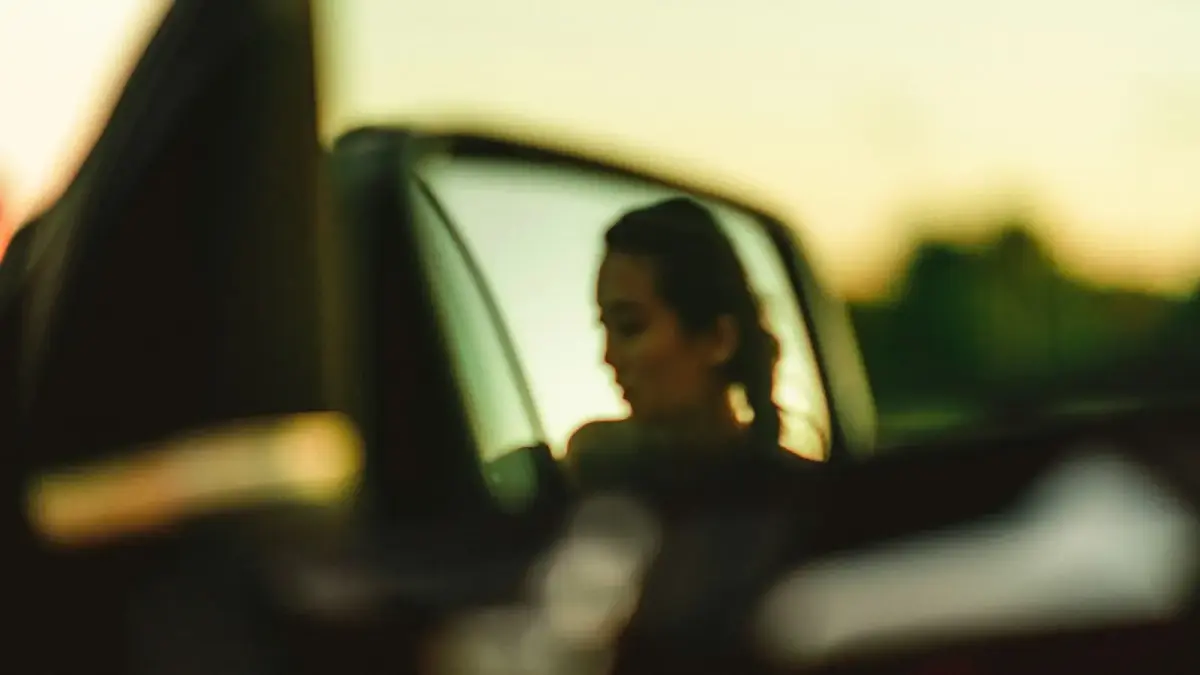
The engine was off, but I wasn’t done looking
I caught myself last Tuesday in a grocery store parking lot. The car was in park. The engine was silent. My keys were already in my right hand, my bag looped over my left wrist, my body half-turned toward the door.
And I was staring into the rearview mirror.
Not at anything. Not at anyone. The parking lot behind me held a shopping cart corral, a patch of faded asphalt, and the back end of a minivan that had been there when I pulled in. There was nothing to check. No car approaching, no pedestrian crossing behind me, no reason at all to pause.
But I paused anyway. I looked.
I have been looking into that mirror after parking for as long as I can remember. Not a quick flick of the eyes - a full, deliberate turn of my gaze upward and backward, holding it there for one beat, maybe two, before I open the door. I have done this in driveways, parking garages, rest stops on long highway drives, the narrow street in front of my daughter’s apartment. Thousands of times. Tens of thousands, probably.
I never questioned it until last Tuesday. And when I finally did, the answer arrived so fast it almost knocked the breath out of me.
My mother did this. Every single time.
The woman in the driver’s seat
I can see her now if I close my eyes. My mother, mid-fifties, pulling into the driveway after picking me up from school. The car would stop. She would shift into park with that deliberate motion she had, the way she did everything - carefully, as though each small task deserved its full attention.
Then the pause. Her eyes would travel upward to the rearview mirror. She would look for a moment - a breath, maybe two - at whatever was behind us. The street. The neighbor’s fence. The edge of the yard.
Nothing was ever there. Or maybe everything was.
I never asked her about it. It wasn’t the kind of thing a child asks. It was just something she did, like the way she always touched the front door handle twice before turning it, or the way she smoothed her skirt when she stood up, even when she was wearing pants.
I absorbed it the way children absorb everything - not through instruction, but through witness. I watched her body do this thing, and my body learned it, and by the time I was old enough to drive, the gesture was already mine. Already automatic. Already invisible to me in the way that the most inherited things always are.
The body remembers what the mind never recorded
There is a word for this in psychology, though it sounds too clinical for something so tender. Researchers call it motor mimicry - the unconscious reproduction of another person’s physical behavior. It is how we learn to hold a fork, how we absorb a parent’s walking pace, how we inherit the particular way someone tilts their head when they are listening.
A 2011 study published in Psychological Science found that children as young as fourteen months don’t just imitate actions they see - they imitate the specific style and rhythm of those actions. Not just what the parent does, but how the parent does it. The tempo. The hesitation. The small, unnecessary pauses.
That word - unnecessary - sits with me. Because the rearview mirror check is, by every practical measure, unnecessary. There is no traffic concern after you have parked. There is no safety protocol that calls for it. It is a gesture stripped of its original function, carried forward as pure form.
And that is exactly what makes it so meaningful. The body holds onto movements that the mind would have discarded long ago. Your muscles remember the shape of your mother’s caution even when you have forgotten the context that made her cautious.
What a mother’s vigilance teaches a daughter’s bones
I have spent years studying the psychology of inherited behavior, and what continues to strike me is how much of what we inherit from our mothers lives not in memory but in motion. We don’t remember being taught to scan a room when we walk in. We don’t remember learning to check behind us when we leave. But our bodies carry these patterns with an accuracy that would put conscious memory to shame.
Psychologist Daniel Stern wrote extensively about what he called “vitality forms” - the dynamic patterns of feeling that pass between mother and child through movement, rhythm, and gesture. Not what a mother says. Not what she teaches. But how she moves through the world. The speed of her hands. The tilt of her posture. The small rituals of checking and re-checking that say, without words, “I am paying attention to what is behind me, beside me, around me.”
And a daughter absorbs all of it. Not once, but thousands of times over thousands of days, until the mother’s movement pattern becomes as native as her own heartbeat.
This is not imitation. This is something deeper. This is the body saying, “I learned how to be a person who moves through the world by watching this specific woman move through the world, and now her movements live in me.”
Looking back as a form of love
Here is what I think my mother was actually doing when she checked that mirror.
She wasn’t looking for danger. She was looking back. She was taking one last moment to acknowledge what was behind her before she moved forward into the next thing. The grocery store. The house. The evening routine. Whatever came after the car.
It was a transition ritual. A tiny pause between one version of her day and the next. A small act of attention given to the space she was about to leave.
I think a lot of women do this - carry these private rituals of looking back. Of checking one more time. Of giving the moment that just ended its final due before stepping into the moment that comes next. It is not anxiety, though it might look like it. It is not hypervigilance, though someone watching might call it that.
It is care. It is the body’s way of saying, “I don’t leave without acknowledging where I was.”
A 2019 study published in the Journal of Personality and Social Psychology found that people who engage in brief transition rituals - small, repeated behaviors between activities - report feeling more grounded and emotionally regulated. The researchers framed these as acts of psychological closure. I frame them as acts of presence.
My mother was present to every departure, even the ones that lasted only the distance from the car to the front door.
The inheritance you can feel but never prove
Here is the strange thing about inheriting a gesture. You cannot point to the moment it happened. There was no lesson. There was no conversation where my mother said, “Before you get out of the car, look behind you.” There was no deliberate passing of the torch.
There was only watching. And time.
Thousands of afternoons in the passenger seat. Thousands of arrivals. Each one containing that same small movement - the eyes traveling upward, the pause, the backward look, the release. I must have watched her do it five thousand times before I ever sat behind a steering wheel myself.
And by then it was mine. Not because I chose it, but because my body had been rehearsing it in silence for years.
This is what I find most moving about physical inheritance between mothers and daughters. It bypasses every conscious filter. You cannot decide to inherit a gesture the way you decide to adopt a belief or follow advice. The gesture simply arrives in your body because you spent enough time in proximity to the body it came from.
Gabor Mate has written beautifully about how the body stores what the mind cannot process. But I think the body also stores what the mind never needed to process - the small, quiet, everyday movements of the person who raised you. Not trauma. Not pain. Just motion. Just rhythm. Just the way she checked the mirror before she opened the door.
The mirror shows you what you already carry
I called my sister the day after the parking lot moment. I asked her if she checks the rearview mirror after she parks.
She was quiet for a moment. Then she laughed - not because it was funny, but because she had never noticed it either. “Every time,” she said. “I do it every single time.”
We sat on the phone together and marveled at this. Two women, both approaching sixty, both performing the same small gesture that neither of us was taught, both carrying the same borrowed movement from a woman who has been gone for eleven years.
Our mother’s body is still in the car with us. Still pausing. Still looking back.
I used to think the things I inherited from my mother were the obvious ones - her eye color, her love of strong tea, her tendency to worry. But the rearview mirror taught me that the deepest inheritance is the one you cannot see. It lives in your muscles, not your memories. In your reflexes, not your reflections.
One last look
If you are reading this and something in you is stirring - some recognition, some half-formed memory of a gesture you perform that you cannot trace back to any decision you ever made - I want you to sit with that for a moment.
Don’t analyze it. Don’t try to explain it. Just notice it.
Notice the way you might touch your collarbone when you are nervous, the way your mother did. Notice the way you might straighten a tablecloth with both palms, the way she did. Notice the way you turn off a light - the specific way, with the specific finger, using the specific pressure that was never yours to begin with.
These are not habits. These are letters written in the language of the body, passed from one generation to the next without anyone ever picking up a pen.
You carry more of the people who raised you than you will ever be able to name. And that is not a burden. It is a form of company so quiet that you might live your whole life without recognizing it for what it is.
A woman checks her rearview mirror in an empty parking lot. Nothing is behind her but an empty street and a shopping cart corral. But she looks anyway. She looks because looking back before moving forward is the only way she knows how to leave.
She learned it from someone who is no longer in the passenger seat. And every time she does it, that someone is there again - just for a breath, just for a beat - riding along in the only way the dead can.
Through the body of the living.