She's 62 and just realized she keeps every expired bottle of medicine in the cabinet - the ibuprofen from 2019, the half-empty prescription from a surgery that healed three years ago, the children's Tylenol nobody has needed in twenty years - because her mother kept every pill in the house like a woman who knew the distance between healthy and desperate could close in a single afternoon when the money was not there for the doctor, and throwing away medicine felt exactly like throwing away the only guarantee that the next emergency would not arrive empty-handed
The cabinet I couldn’t clean
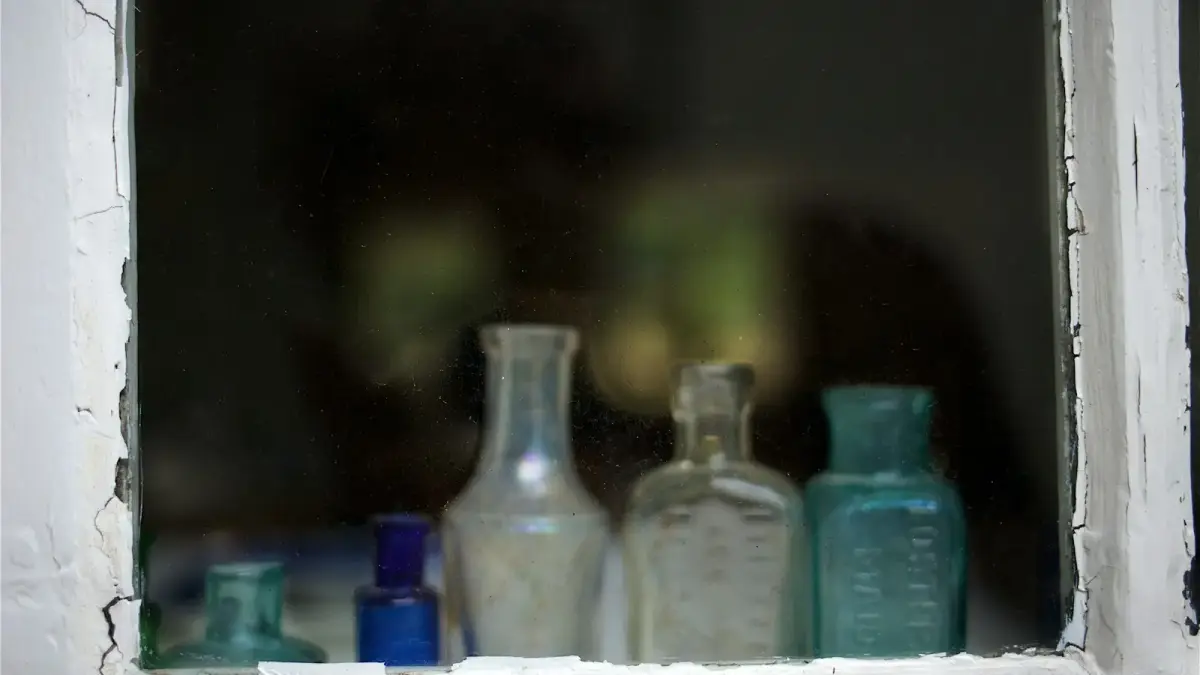
I stood in front of my bathroom cabinet last Tuesday with a trash bag in one hand and a bottle of ibuprofen in the other.
The ibuprofen expired in 2019. I knew this. I’d known it for years, the way you know something without letting yourself look directly at it. The way you step around a truth on your way to brushing your teeth every morning.
Next to it sat a prescription bottle from a knee surgery I had in 2023. Half the pills remained. My knee healed beautifully. I hadn’t touched the bottle since that winter. But there it sat, label peeling, wedged between a tube of hydrocortisone cream from a rash I no longer remembered getting and a bottle of children’s Tylenol that my youngest - who is now thirty-four - last needed when she was twelve.
I held the trash bag open. I looked at the expired ibuprofen. And I put it back on the shelf.
Then I closed the cabinet and walked away, and something about the smallness of that moment broke open a door I had been keeping shut for a very long time.
My mother’s pharmacy
My mother kept every pill that ever entered our house.
Not in any organized way. Not alphabetically or by condition. She kept them the way someone keeps cash hidden in different pockets - distributed, secret, always accounted for. The kitchen junk drawer had a small collection. Her nightstand had another. The hall closet, behind the towels, held a shoebox she thought none of us knew about.
Aspirin with no cap. A prescription antibiotic from my father’s bronchitis two winters prior. Children’s cough syrup in a sticky bottle. Benadryl tablets loose in a sandwich bag. Half a tube of athlete’s foot cream.
She never threw any of it away. Not ever.
And she rationed what she used. She split ibuprofen tablets in half with a butter knife on the kitchen counter. She gave us half-doses of cough medicine and told us it was plenty. When I had an ear infection at nine and the doctor prescribed ten days of amoxicillin, she stopped giving it to me after seven because she wanted to save the remaining three days’ worth - just in case someone else got sick and we couldn’t afford another visit.
I didn’t understand any of this then. I thought she was being careful the way all mothers were careful. It took me fifty years to realize she wasn’t being careful. She was being afraid.
The distance between healthy and desperate
Here’s what I didn’t understand as a child: the doctor cost money we did not always have.
Not that we never had it. Sometimes we did. My father worked steady jobs for long stretches, and during those stretches we had insurance cards in a drawer and co-pays we could manage. But between those stretches came gaps - layoffs, contract work, the months when the insurance lapsed and my mother would say “we’ll be fine, just be careful” with a voice that meant please, God, don’t let anyone get hurt right now.
During those gaps, the medicine cabinet was the emergency room.
A 2021 study published in the Journal of Health and Social Behavior found that adults who experienced childhood economic instability were significantly more likely to delay medical care, avoid filling prescriptions, and stockpile over-the-counter medication well into their financially stable years. The researchers called it “health resource guarding” - a behavioral pattern rooted not in the present reality of abundance but in the embodied memory of scarcity.
My mother practiced health resource guarding before anyone had a name for it. She practiced it the way she breathed - automatically, constantly, without ever stopping to ask whether she still needed to.
Because the distance between healthy and desperate in our house was not measured in medical severity. It was measured in dollars. A broken arm wasn’t a broken arm. It was four hundred dollars. A fever that wouldn’t break wasn’t a symptom - it was a calculation. Can we wait one more day? Will it come down on its own? Do we have enough Tylenol to get through the night?
Medicine, in our home, was not a consumable. It was an asset. You did not use an asset and discard it. You preserved it. You stretched it. You made it last because the next time someone was sick, the cabinet might be the only thing standing between you and a bill you could not pay.
What the body inherits
I have good health insurance now. I have had good health insurance for over thirty years. My husband and I are comfortable. More than comfortable - we are the kind of comfortable where I could walk into any pharmacy in this country and buy whatever I needed without checking the price.
And yet.
My hands will not throw away expired medicine. My hands, which belong to a woman who has not worried about a co-pay in decades, still operate according to rules my mother’s hands taught them.
This is what researchers in developmental psychology call intergenerational transmission of scarcity behavior. A 2019 study in Psychological Science demonstrated that economic hardship in one generation creates behavioral adaptations that persist in subsequent generations - even when the economic conditions that produced them no longer exist. The children of parents who experienced resource scarcity showed measurably higher rates of hoarding behavior, difficulty discarding items with perceived future utility, and anxiety responses triggered by waste.
The researchers noted something I found particularly devastating: these patterns were most resistant to change when the original scarcity had been intermittent rather than constant. If you were always poor, you adapted to poverty. But if you moved in and out of poverty - if sometimes there was enough and sometimes there wasn’t - your nervous system never learned to trust abundance. It stayed permanently braced for the next gap.
That was my childhood exactly. Sometimes enough. Sometimes not. Always the not arriving without warning, the way weather arrives - you could feel it coming but you couldn’t stop it.
So my body learned. Not my mind. My body. My hands learned to hold onto medicine the way my mother’s hands did, because holding on was the only form of medical insurance my body ever believed in.
The things I cannot waste
It’s not just medicine.
I keep food past its expiration date. I save plastic bags. I fold wrapping paper after birthdays and store it in a drawer I never open again. I have three half-used bottles of shampoo in the shower because I cannot bring myself to finish one and throw the empty container away.
But the medicine is different.
The medicine carries a specific weight that the other things don’t. Because the other things - the food, the bags, the paper - those are about general scarcity. The medicine is about something more precise and more frightening. The medicine is about the moment when someone you love is in pain and you cannot help them.
That is what my mother was guarding against. Not inconvenience. Not waste. The specific terror of watching your child run a fever at two in the morning and knowing that the cabinet is empty and the pharmacy is closed and the emergency room costs more than you will make this week.
The expired ibuprofen in my cabinet is not expired ibuprofen. It is a promise I am making to a version of reality that no longer exists - a promise that if someone gets sick, I will not be empty-handed. I will not be my mother at two in the morning with a sick child and nothing to give her.
Gabor Mate has written extensively about how the body stores survival responses long after the threat has passed. He describes it as the body keeping the score of every emergency that ever went unmet - not as memory in the narrative sense, but as a set of instructions encoded into muscle and reflex and instinct. My hands don’t throw away medicine because my hands still carry my mother’s instructions. And my mother’s instructions were not irrational. They were the most rational response available to a woman whose children’s health depended on a cabinet that might or might not be full when the next crisis arrived.
Scarcity is not a mindset - it is a geography
I have grown tired of people calling scarcity a mindset, as though you could meditate your way out of it. As though the women and men who grew up watching their parents split tablets and ration cough syrup could simply decide to think differently about abundance.
Scarcity is not a thought pattern. It is a geography your body learned to navigate. It is a landscape with specific landmarks - the kitchen counter where the pills were split, the hall closet where the shoebox was hidden, the car ride to the emergency room that you took only after every other option had been exhausted and the fear in your mother’s eyes told you this was going to cost something the family could not afford.
A 2023 study in Frontiers in Psychology found that adults raised in economically unstable households showed heightened amygdala activation when presented with scenarios involving medical waste - throwing away unused medication, discarding medical supplies, letting a prescription expire. Their brains processed medical waste as threat. Not preference. Not habit. Threat.
Your brain learned this. Your body learned this. And the learning was not a mistake. The learning kept you alive in a world where the cabinet being empty meant the difference between getting through the night and not.
The mistake is not that you learned it. The mistake is believing you are broken for not having unlearned it yet.
The full cabinet
I went back to the bathroom later that evening. I opened the cabinet again.
The expired ibuprofen sat where I had returned it. The knee surgery prescription. The children’s Tylenol from two decades ago. All of it arranged on the shelves like a small museum of every fear my mother ever carried and every fear I inherited without knowing I was inheriting it.
I did not throw any of it away.
But I did something I had never done before. I looked at all of it and I understood what I was looking at. Not clutter. Not laziness. Not the disorganized cabinet of a woman who can’t be bothered to clean. I was looking at love. Desperate, resourceful, terrified love. The love of a mother who could not always take her children to the doctor and so kept every pill as a small act of defiance against a world that did not care whether her family could afford to be sick.
And I was looking at my own love - the inherited version, passed down through hands and habits and the quiet reflex of putting a bottle back on the shelf instead of into the trash.
If you recognize yourself in this - if your cabinets hold their own museums, their own quiet archives of a childhood spent watching someone stretch what little they had across too many needs - I want you to know something.
You are not disorganized. You are not irrational. You are not hoarding out of carelessness.
You are the child of someone who loved you enough to save every last pill against the possibility that you might need it. And your body has never stopped honoring that love, even now, even here, even in the middle of all this abundance your hands still don’t quite believe is permanent.
That cabinet is not a mess. It is a memorial. And you are allowed to keep it for as long as you need to.