She's 62 and just realized the way she holds her phone - shoulder raised, head tilted, receiver trapped between ear and collarbone so both hands stay free to stir, wipe, fold, and write - is the exact posture her mother held the kitchen phone in for thirty years, and the daughter who inherited that tilt was never multitasking but performing the only posture in which a woman could hold everything together
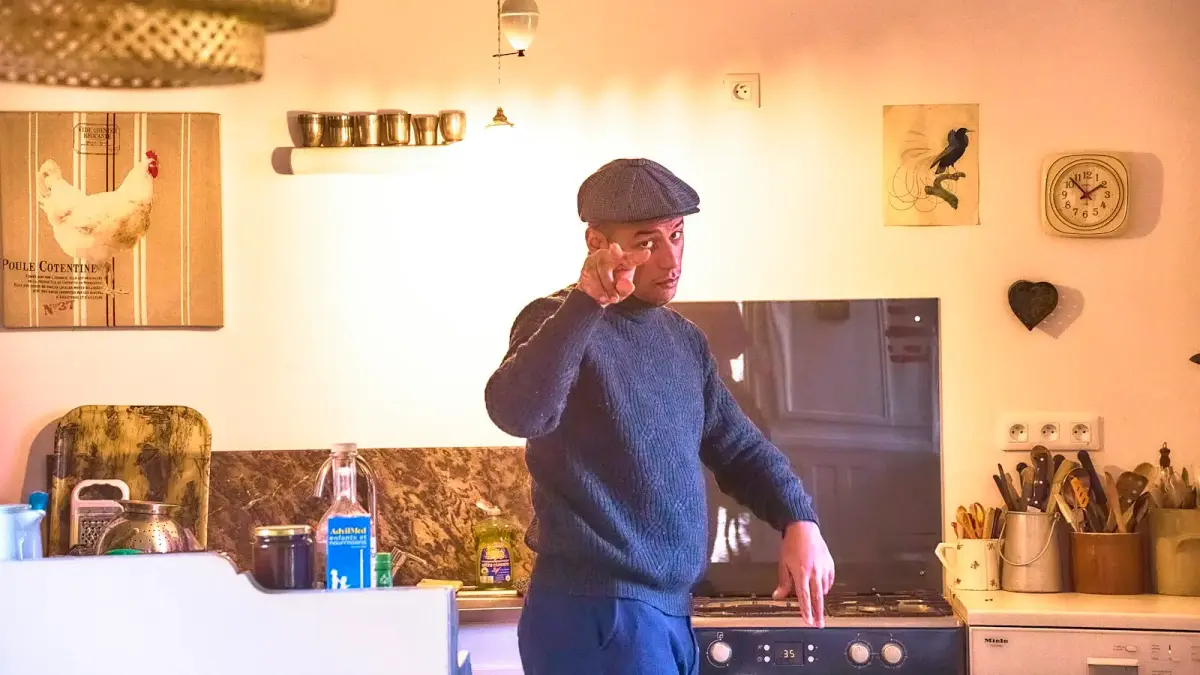
I was standing at my kitchen counter last Tuesday, phone pressed between my ear and my left shoulder, head tilted at what must have been a forty-five-degree angle, stirring marinara with one hand and wiping down the stovetop with the other. My neck had already started to ache. The phone was a modern smartphone - thin, light, barely heavier than a cracker - and there was no reason on earth I needed to pin it to my shoulder like that.
I could have put it on speaker. I could have used earbuds. I could have simply held it to my ear with one free hand and let the sauce sit for a minute.
But I didn’t. I never do.
And in that moment, standing over steam with a damp rag in one hand and a wooden spoon in the other, I saw my mother. Not a memory of her. I saw her in my own body. The tilt of my head was hers. The raised shoulder was hers. The particular angle at which my jaw clamped against the phone was the exact geometry she held for three decades in her own kitchen, with a rotary receiver that weighed ten times more than this little glass rectangle.
I am sixty-two years old, and I have been carrying my mother’s posture my entire adult life without once noticing it.
The Kitchen Phone Was Her Office
My mother’s phone was avocado green, mounted to the wall between the refrigerator and the doorframe that led to the hallway. The cord was coiled and stretched and coiled again so many times that it had a permanent kink about halfway down, a little knot of plastic that would catch on the drawer handle if you walked too far.
She would pick up the receiver, tuck it into the crook of her neck, and begin. Not begin talking - begin everything. The talking was just one layer. While her mouth carried the conversation, her hands moved through the kitchen in a choreography so practiced it looked effortless.
She would stir a pot. Wipe a counter. Open the oven door with her knee and peer in without bending, because bending would shift the receiver. She would gesture to me or my brother to come here, sit down, stop running, eat this, with a pointed finger or a tilted chin, never pausing the conversation, never dropping the phone.
I remember watching her write a grocery list during one of those calls. Her handwriting slanted hard to the left because her head was tilted that way, and the pen moved at the same speed as her voice, both of them steady and purposeful.
I thought she was impressive. I didn’t think about why she had to be.
What the Cord Couldn’t Reach
The coiled cord on that wall phone gave her about six feet of range. Enough to reach the stove, the counter, the kitchen table. Not enough to sit down in the living room. Not enough to step outside. Not enough to be alone with the conversation.
That cord was a leash dressed up as a convenience. It meant that every phone call happened inside her workspace, surrounded by the evidence of everything still left to do. She could never just talk. She could never just stand still and hold the phone with both hands and give her full attention to whoever was on the other end.
There was always a pot. Always a counter that needed wiping. Always a child appearing in the doorway with a question about homework or a scraped knee or a demand for juice.
The shoulder-tilt was her solution. Not to the phone - to the impossibility of being expected to do everything at once. If she could trap the receiver against her collarbone, her hands were free. And free hands meant she could keep going. Keep stirring. Keep wiping. Keep mothering while she talked to her sister, or scheduled a dentist appointment, or listened to a neighbor describe a surgery.
She never complained about it. She never even named it. It was just what you did.
The Body Remembers What the Mind Forgets
I left my mother’s house at eighteen. I got my own apartment, my own phone - a cordless one, cream-colored, from RadioShack. And the very first time someone called while I was cooking, I tucked that cordless phone into my shoulder and tilted my head to the left, and my hands went free, and I began.
I didn’t decide to do this. I didn’t think about my mother. My body simply knew the posture the way it knew how to walk or how to catch a ball someone throws at you without warning. The tilt was already in me, written into muscle and bone from years of watching.
A 2019 study published in Psychological Science found that children don’t just learn behaviors from their parents through instruction or imitation - they absorb what researchers call “motor resonance,” a mirroring of physical patterns that becomes embedded in their own neuromuscular memory. We don’t just watch our parents. Our bodies rehearse what they do, silently, unconsciously, thousands of times before we ever perform the action ourselves.
I had rehearsed my mother’s shoulder-tilt for eighteen years before I ever needed it. And when the moment came - when I was alone in my own kitchen with something on the stove and a phone ringing - my body already knew what to do.
It knew that a phone call was never just a phone call. It was a phone call and dinner. A phone call and a counter. A phone call and a child who would need something in ten minutes.
My body knew, before my mind could have articulated it, that I was going to have to hold everything at once.
The Posture of Women Who Could Not Put Anything Down
Here’s what I’ve come to understand about that tilt: it was never about efficiency. It was never a clever life hack for busy people. It was the physical shape of a particular kind of expectation - the expectation that certain people, almost always women, would never be doing just one thing.
Dr. Darcy Lockman, in her research on the division of domestic labor, found that even in households where both partners work full-time, women perform roughly sixty percent more unpaid domestic work. But the numbers don’t capture the texture of it. The numbers don’t capture the phone-shoulder tilt. They don’t capture the way a woman learns to hold a conversation in her neck so her hands can hold everything else.
The tilt isn’t multitasking. Multitasking is a word that makes it sound like a skill, a talent, something to be proud of on a resume. The tilt is something else. The tilt is the posture of a woman who understood, in her muscles if not in her words, that putting one thing down meant something else would fall.
The dinner would burn. The child would wait. The counter would stay sticky. The caller would hear the chaos and know.
And so she tilted. And held. And stirred. And wiped. And kept the conversation going in a voice that sounded, to anyone listening, perfectly calm.
I Caught My Daughter Doing It Last Month
My daughter is thirty-four. She has two children, a job she loves, and a kitchen that is much nicer than mine was at her age. She has AirPods. She has a phone that can sit on the counter and project a voice into the room without being held at all.
And last month, when I visited, I walked into her kitchen and found her standing at the stove with her phone wedged between her ear and her left shoulder, head tilted at that exact angle - my angle, my mother’s angle - stirring something with one hand and reaching for a paper towel with the other.
She was talking to a friend. Her daughter was doing homework at the kitchen table. A timer was counting down on the oven.
I didn’t say anything. I just stood in the doorway and watched the inheritance pass through her body the way it had passed through mine, the way it had passed through my mother’s, the way it probably passed through my grandmother’s, back when the phone was a heavy black thing bolted to the wall and the cord gave you barely three feet.
Three generations of women, tilting their heads to the left, freeing their hands so they could carry everything that was asked of them without ever being asked.
A 2021 study in Frontiers in Psychology confirmed what many of us already feel in our bones: physical habits are among the most durable forms of intergenerational transmission, outlasting verbal lessons, outlasting conscious memories, outlasting even the relationships in which they were learned. We forget what our mothers told us. We never forget how they stood.
The Weight of a Weightless Phone
My phone weighs six ounces. My mother’s receiver weighed over a pound. But I hold them the same way. The weight was never the point.
The point was that the phone was always ringing during dinner. The point was that dinner still had to happen. The point was that someone always needed something, and the phone call was never the only thing, and a woman’s hands were never allowed to be occupied with just one task.
I don’t hold my phone on my shoulder because I need to. I hold it there because my body learned, decades ago, that love looks like never having two free hands. That competence means managing the conversation and the sauce and the child and the timer simultaneously, without dropping any of them, without asking for help, without even acknowledging that what you’re doing is hard.
My mother never called it hard. She called it Tuesday.
What I Want My Daughter to Know
I’m not going to tell my daughter to stop tilting her head. I’m not going to lecture her about the division of labor or the invisible weight of domestic expectations. She already knows. Her body already knows.
What I want her to know is that the tilt is not a flaw. It’s not a sign that she’s stretched too thin or doing too much or failing to set boundaries. It’s the posture of women who loved fiercely enough to hold everything at once - the conversation and the dinner and the child and the mess - without ever making it look like a sacrifice.
But I also want her to know that she’s allowed to put the phone down. She’s allowed to let the sauce sit. She’s allowed to say, “Hang on, let me call you back,” and stand in her own kitchen with both hands free and nothing balanced on the side of her face.
Not because the tilt is wrong. But because she deserves to know what it feels like to hold nothing for a moment. To stand still. To let her shoulders be even.
Our mothers gave us this posture. We can honor it and still, sometimes, set it down.