She's 63 and has finally understood that the reason she buys birthday cards weeks in advance and stores them in a drawer organized by month is not thoughtfulness - it is a girl who watched her own birthday be forgotten twice and decided at nine that if she made sure every person she loved felt remembered, the universe might eventually return the favor

The Drawer
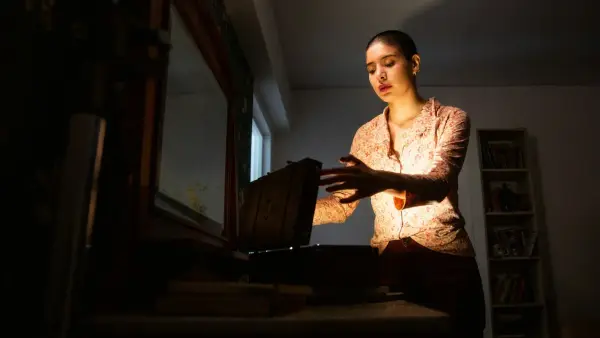
There is a drawer in her kitchen - second one down, left of the stove - that no one in her family thinks about.
Inside it, there are forty-three birthday cards. They are organized by month, held together with small binder clips she bought in bulk from the office supply store ten years ago. January through December. Each clip has a tiny label. Each card already has a name penciled lightly on the back in her handwriting.
There is a pen clipped to the edge of the drawer with a piece of string. There is a sheet of paper taped to the inside of the cabinet door - a handwritten list of dates. Birthdays. Anniversaries. The day her neighbor’s husband passed. The day her coworker’s daughter graduated.
She updates it in January. She buys cards in batches - usually during the after-holiday sales, when Hallmark puts the good ones at forty percent off. She picks each one with terrifying precision. Not just “Happy Birthday” but the right birthday. The one that says what she would say if she could sit across from you and hold your hands.
If you asked her why she does this, she would say she just likes being organized.
She would be wrong.
What Happened at Nine
Her ninth birthday fell on a Wednesday.
She had told her mother about it twice that week. Not in a demanding way - she was never demanding. She mentioned it the way a child tests whether the ground is still solid. Casually. Like it didn’t matter.
On Wednesday morning, she came downstairs in the dress she had picked out the night before. Her mother was on the phone. Her father had already left for work. There was no cake. There were no candles. There was cereal in the cabinet and a note on the counter about picking up her brother from practice.
Nobody said it. Nobody said happy birthday. The day just moved forward like every other day, and she sat at the kitchen table eating Cheerios in her good dress, slowly understanding something she didn’t have the words for yet.
It happened again at eleven. Her father remembered three days late. He brought home a stuffed animal from the gas station and said, “Sorry, kiddo - this week got away from me.” She smiled and told him she loved it. She did love it. She also understood, with the clarity that only a twice-wounded child possesses, that she was the kind of person whose birthday could get away from people.
That was the year she started keeping a list.
The List Became a System
It started small. She wrote down three birthdays in a spiral notebook - her best friend, her teacher, her cousin. She made cards out of construction paper. She delivered them early, always early, because she had learned that late was the same as forgotten.
By high school, the list had grown. She remembered the birthdays of every girl in her friend group, every teacher she liked, her dentist’s receptionist who always gave her an extra sticker.
By thirty, she was the person everyone described the same way: “She never forgets.”
They meant it as a compliment. They didn’t know it was a scar.
A 2019 study published in the Journal of Personality and Social Psychology found that people who experienced emotional neglect in childhood often develop what researchers call “hypervigilant caregiving” - an unconscious pattern of monitoring and anticipating others’ emotional needs as a way of maintaining relational safety. The study noted that this behavior is frequently misread as generosity, when it is more accurately understood as a survival strategy that became permanent.
She didn’t know any of that language. She just knew that forgetting someone’s birthday felt like a violence she could prevent.
The Expansion
The cards were only the beginning.
By her forties, the system had expanded into every corner of her relational life. She was the one who remembered that her coworker’s mother had died on March 14th - and sent a card on the one-year anniversary. Not the funeral card. The one-year card. The one nobody else thinks to send, because by then, the world has decided your grief should be quieter.
She remembered that her neighbor’s son was applying to colleges and asked about it in October, before the results came in, so he would know someone was paying attention to the waiting and not just the outcome.
She remembered that her sister-in-law hated roses but loved peonies. She remembered that her husband’s business partner had a daughter named Eloise, not Eleanor. She remembered the name of the nurse who held her hand during her first mammogram.
Brene Brown once described this kind of attention as “the most profound form of love” - the willingness to see another person’s life in its specific details. And she would agree with that, if she ever allowed herself to frame what she does as love rather than obligation.
But she doesn’t.
Because somewhere in the architecture of her own mind, what she does is not love. It is insurance. It is the premium she pays against the possibility that the people she cares about might one day feel the way she felt at nine, sitting in a dress nobody noticed.
The Quiet Accounting
Here is the part she doesn’t talk about.
She is sixty-three years old. She has sent thousands of cards. She has remembered hundreds of birthdays, dozens of anniversaries, at least thirty condolence notes timed to the exact day the grief circled back.
And she can count on one hand the number of times someone has remembered hers without a prompt.
Her husband remembers - most years - because she puts it on the shared calendar. Her daughter calls, usually in the evening, after she’s already spent the day in a quiet house telling herself it doesn’t bother her. A few friends text. One sends flowers.
But nobody has ever organized a drawer for her.
Nobody has ever bought her card in advance, weeks before the date, and held it in their hands in the store and thought: this one. This is what I would say to her if I could sit across from her and hold her hands.
A 2021 study in Frontiers in Psychology found that individuals who score high on what the researchers called “relational attentiveness” - the tendency to track and respond to the emotional details of others’ lives - often report the lowest satisfaction with their own sense of being known. The more precisely you remember other people, the more visible it becomes when no one remembers you with the same precision.
She has been the most-remembered friend in every room and the least-remembered person at every table.
She knows this. She has known this for years. She just didn’t let herself say it until now.
What Fifty-Four Years of Remembering Teaches You
There was a morning last October - a Tuesday, her birthday - when she woke up and the house was quiet.
Her husband had gone to work early. There was no note on the counter. No flowers. No card leaning against the coffee maker. She stood in her kitchen, sixty-three years old, and opened the drawer. Forty-one cards stacked neatly. Binder clips. The list taped to the door.
She had been doing this for fifty-four years.
Fifty-four years of buying cards in advance. Fifty-four years of writing names on the backs in light pencil. Fifty-four years of making sure that every person in her orbit felt seen on the one day a year that is supposed to say: you matter to someone.
And in that quiet kitchen, she finally understood what the drawer actually was.
It was not organization. It was not thoughtfulness. It was not even love, exactly - though love was certainly in it.
It was a nine-year-old girl standing in a dress nobody noticed, making a decision that would shape the next five decades of her life: I will never let anyone feel this.
Adam Grant once wrote about how our deepest wounds often become our greatest contributions - that the pain we refuse to pass on becomes the gift we give the world. She didn’t know she was doing that. She thought she was just being a good friend.
The Reframe She Deserves
Here is what I want to say to the woman with the drawer.
You did not build that system because you are broken. You built it because something broke around you, and instead of letting the sharpness of it cut everyone else, you turned it into something soft. You took the worst feeling a child can have - the feeling of being invisible on the one day you are supposed to be seen - and you spent fifty-four years making sure it never touched another person.
That is not a wound you are still carrying.
That is a gift you built from pain.
The universe did not return the favor. That is true. The drawer is lopsided. The accounting doesn’t balance. You have given more remembering than you have ever received, and some part of you has always known that.
But the remembering was never really about being remembered back.
It was about making sure that no one else ever sat at a kitchen table on their birthday, in their best dress, eating cereal alone, slowly understanding that they were the kind of person the world could forget.
You made sure of it. For fifty-four years, with binder clips and Hallmark cards and a handwritten list taped inside a cabinet, you made sure of it.
That is not a deficit. That is not people-pleasing. That is not a scar you need to heal.
That is the most beautiful thing a wounded child has ever built.
And if no one has said it to you yet - not on your birthday, not on any ordinary Tuesday, not with a card bought weeks in advance and held carefully in someone’s hands - let me say it now.
You were never forgotten. You were just the one doing all the remembering. And the people you remembered? They carry you in ways you will never see - in the cards they kept, in the feeling of being known, in the quiet certainty that someone in this world was paying attention.
You gave them that.
The drawer was never about you.
And that, somehow, is the most you thing about it.