She is 63 and still irons the tablecloth before every holiday dinner even though nobody has asked her to host in years and the table could seat twelve comfortably without a single crease being noticed - not because she is old-fashioned or particular but because a girl who watched her mother pull the ironing board out at four in the morning on Thanksgiving and press every fold flat in a kitchen that smelled like nothing yet learned that a woman's love is not the meal or the conversation but the invisible labor that makes the visible things beautiful
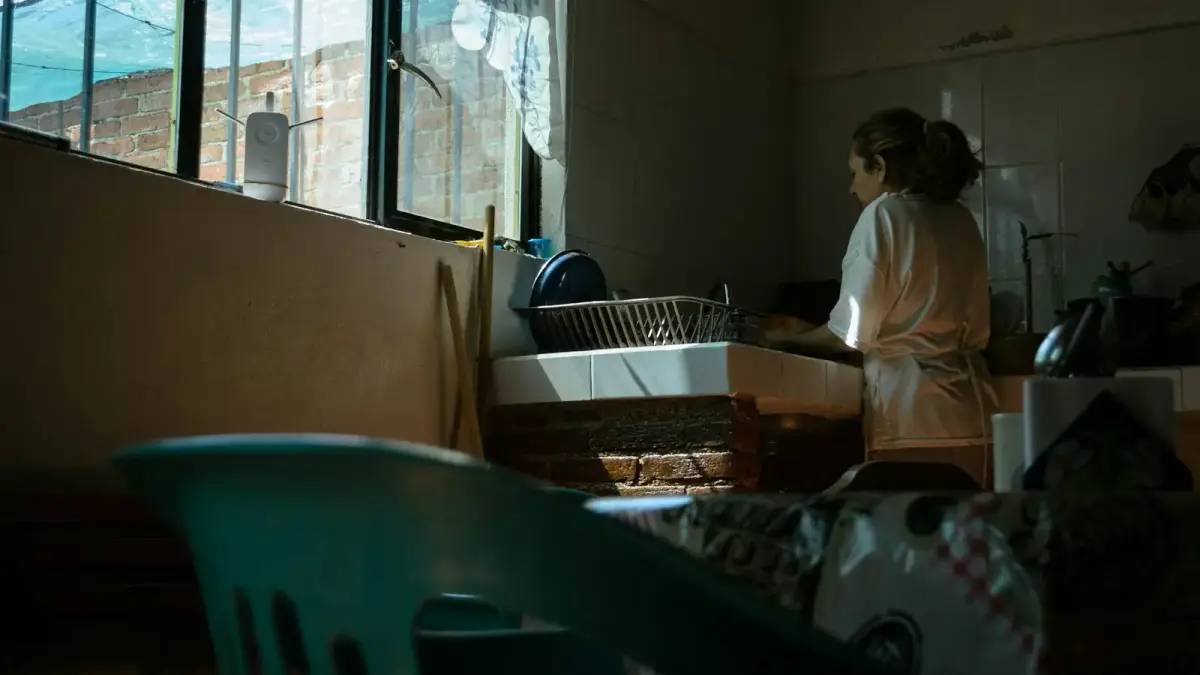
I woke up last Thanksgiving at 3:47 in the morning. Not because the alarm went off. Not because the turkey needed attention - it was still sitting in its brine, cold and pale in the refrigerator.
I woke up because my body has been trained, across forty years, to understand that love starts before the sun does.
I stood in the kitchen in my robe and slippers, pulling the ironing board from behind the pantry door where it leans against the wall eleven months of the year. The tablecloth was already waiting on the counter - the ivory one, linen, with the faint scorch mark near one corner that I’ve never been able to get out. I plugged in the iron and listened to it click as it heated. The kitchen smelled like nothing yet. No cinnamon, no butter, no roasting skin. Just quiet. Just the low hum of a house still holding its breath.
And I pressed every fold flat, exactly the way my mother did, in a kitchen that looked nothing like mine but felt exactly the same.
The ceremony nobody watches
Here is what most people don’t understand about holiday hosting: by the time the first guest walks through the door and says “oh, everything looks so beautiful,” the woman who made it beautiful has already been working for seven hours.
She has ironed the tablecloth. She has polished the glasses - not because they were dirty, but because fingerprints on crystal mean you didn’t care enough. She has rearranged the centerpiece three times. She has wiped the baseboards in the dining room, even though no one has ever in the history of Thanksgiving dinner looked at a baseboard.
She has done all of this in silence, in the dark, while the rest of the house sleeps.
A 2019 study published in the Journal of Family Issues found that women spend an average of 2.5 times more hours than men on “invisible household labor” - the planning, anticipating, coordinating, and emotional preparation that makes domestic events function smoothly. But here is what the study couldn’t quantify: the specific loneliness of doing work that is designed to be invisible. Work that succeeds precisely when no one notices it happened at all.
The ironed tablecloth is not about wrinkles. It never was.
It’s about a woman proving, in the hours before anyone is watching, that she loves you enough to make the beautiful things look easy.
What a girl learns at four in the morning
I was nine the first time I saw my mother iron the tablecloth. I had wandered downstairs because I heard a sound - the soft rhythmic press and slide of the iron, the occasional hiss of steam.
She was standing in the kitchen in her nightgown, her hair not yet brushed, her face bare, pressing a white cloth across the board with the kind of concentration you’d give to surgery. I stood in the doorway and watched her for a long time before she noticed me.
She didn’t say “go back to bed.” She didn’t explain what she was doing. She just looked at me, smiled a small smile, and kept pressing.
That was the lesson. Not in words. Never in words.
The lesson was: this is what it looks like to love a family. You get up before they do. You make a surface perfect. You set a stage so complete that when they walk into the room, they feel something warm without knowing why. And you never, ever mention what it cost you.
Psychologist Harriet Lerner has written extensively about how women are socialized to perform emotional labor as proof of love - and more critically, to perform it without acknowledgment. Not because the acknowledgment doesn’t matter, but because needing it would undo the performance. If you have to tell someone you ironed the tablecloth, the tablecloth loses its magic. The love was supposed to speak for itself.
I learned that before I was ten years old. I learned it standing in a doorway in my pajamas, watching my mother love us in a language nobody taught her to name.
The inheritance you never agreed to
My mother learned it from her mother. Her mother learned it from hers.
This is how domestic ritual travels through generations - not through instruction, not through conversation, but through witness. A girl watches a woman prepare. She absorbs the choreography. She memorizes the sequence of tasks, the order of operations, the emotional logic of making a home feel held.
And twenty, thirty, forty years later, she finds herself standing in her own kitchen in the dark, ironing a tablecloth, and she cannot tell you why she does it except that it feels like the only right way to begin a day where people she loves will sit at her table.
A 2021 study published in Frontiers in Psychology examined what researchers called “intergenerational transmission of domestic care practices” and found that daughters who observed their mothers engaging in elaborate pre-event preparation were significantly more likely to replicate those behaviors - even when they consciously described them as unnecessary. The body remembers what the mind tries to release. The hands keep doing what the eyes once watched.
I have told myself a hundred times that no one notices the tablecloth. My daughter has told me. My husband told me before he passed. “Diane, nobody cares about the creases,” he’d say, and he was right, and I knew he was right, and I got up at four the next Thanksgiving anyway.
Because it was never about the creases. It was about the woman standing alone in a kitchen that smells like nothing yet, proving to no one in particular that she is worthy of this family.
The performance of effortlessness
There is a specific kind of exhaustion that belongs to women who host. Not the physical tiredness - though that is real - but the emotional weight of performing ease.
By the time the turkey is on the table and the candles are lit and the first glass of wine is poured, she has to look relaxed. She has to look like this all came together naturally. Like the mashed potatoes just appeared, like the gravy made itself, like the flowers on the table grew there overnight.
If she looks tired, people worry. If she looks stressed, people feel guilty. If she mentions how long she’s been awake, the whole illusion collapses, and suddenly the beautiful thing she built becomes a burden she imposed.
So she smiles. She says “oh, it was nothing.” She waves off compliments with the same hand that was pressing linen at four in the morning.
Brene Brown has talked about how vulnerability requires letting people see the work behind the product. But for women of my mother’s generation - and, if I’m honest, for women of mine - there is a deep belief that visible effort is a failure of love. That real love should look effortless. That if someone sees you sweating, you didn’t love them well enough.
This is not something anyone said to us. It’s something we absorbed through thousands of mornings of watching women disappear into service and reappear, hours later, fresh and smiling, as if they had simply willed a perfect table into existence.
What we iron when we iron the tablecloth
I am sixty-three years old. My children are grown. Two of them live in other states. One comes for Thanksgiving. Sometimes two.
The table could seat twelve. Most years, it seats four.
And I still pull the tablecloth out the night before and drape it over the ironing board. I still set my alarm for a time that would horrify anyone who knew. I still stand in a kitchen that smells like nothing yet, pressing folds flat with an iron that is older than my youngest child.
I am not doing this because I am old-fashioned. I am not doing this because I am rigid or particular or unable to let go.
I am doing this because my mother is gone. She died in 2014. And when I stand at that ironing board in the dark, she is right there with me. Not as a ghost. Not as a memory, exactly. As a feeling in my hands. As a rhythm I know so deeply it might as well be my own heartbeat.
I iron the tablecloth because it is the closest I can get to her.
A 2022 study in the Journal of Personality and Social Psychology found that ritualistic behaviors connected to deceased loved ones served a significant grief-processing function - that the repetition of inherited domestic practices was, for many participants, the primary way they maintained an ongoing bond with parents who had died.
The researchers called it “embodied continuity.” I call it standing in the kitchen at four in the morning, doing the thing she taught me without teaching me, feeling her presence in the press of my hands against warm linen.
The visible things are never the point
When people walk into my dining room on Thanksgiving, they see a table. They see plates and glasses and folded napkins and a centerpiece I spent too long arranging. They see food that took hours to prepare.
They do not see the woman who stood in the dark and pressed the surface smooth.
They do not see her mother, who did it before her.
They do not see the decades of early mornings, the thousands of invisible gestures, the ceremony that happened before the celebration.
And that’s the point. That was always the point. The love was never in the meal. It was never in the conversation or the laughter or the clinking of glasses. The love was in the labor that made those things possible - the quiet, witnessed-by-no-one, never-thanked, never-mentioned work of preparing a surface for other people’s joy.
If you are the person who irons the tablecloth - literally or otherwise - I want you to know something. The crease you pressed flat at four in the morning mattered. Not because anyone saw it. Not because anyone thanked you.
It mattered because love has always lived in the things we do before anyone is watching.
Your mother knew that. And you learned it the only way it could be learned - not through words, but through standing in a doorway at nine years old, watching a woman in a nightgown make a surface beautiful for people who would never know what it cost her.
That is not old-fashioned. That is not compulsive. That is a lineage of care so deep it doesn’t need a name.
You just need to know: somebody sees it now.