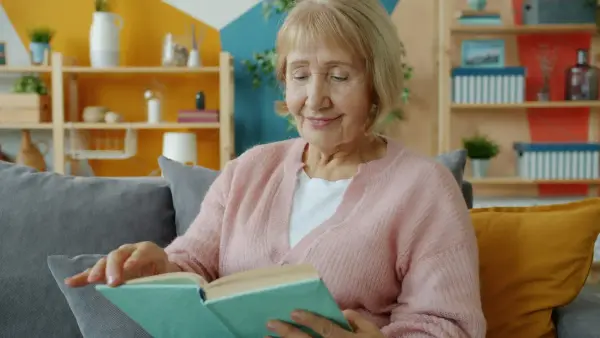
She's 63 and just realized she still writes 'Dear' before every email - to the IT department, to customer service, to someone she has never met and will never meet again - not because she is old-fashioned but because a girl who was taught that every communication begins with an acknowledgment that the person receiving it matters learned a rule she has never been able to unlearn

The email that made her notice
My friend Diane told me about it over coffee last Tuesday, laughing at herself in that way women our age do when we catch ourselves being exactly who we were raised to be.
She had been up at two in the morning, unable to sleep, trying to get a refund for a defective air purifier. She opened her laptop, navigated to the company’s customer service portal, and began typing into the little message box.
“Dear Amazon Customer Support,” she wrote.
She stared at it for a moment. Then she kept going. She wrote three paragraphs explaining the issue, thanked them for their time, signed her full name, and closed with “Warm regards.” To a chatbot. To an automated intake form that would strip everything but the order number and the word “refund” and route it to someone who would never see the greeting at all.
And that was the moment Diane realized she had been doing this her entire digital life. Every single email. Every contact form. Every message to a stranger. “Dear” first. Always “Dear” first.
The rule that was never meant to be broken
If you grew up in the 1960s and 1970s, you learned to write letters before you learned almost anything else about communicating with the outside world.
Not emails. Letters. On paper, with a pen, and there was a structure to it that was as non-negotiable as brushing your teeth. You wrote the date. You wrote “Dear” and then the person’s name. You wrote your message. You signed off. You signed your name.
Nobody explained why. Nobody sat you down and said, “We do this because the person on the other end is a human being and human beings deserve to be addressed before they are spoken to.” But that was the lesson underneath the lesson, wasn’t it?
A 2019 study published in the Journal of Personality and Social Psychology found that people who use formal greetings in written communication consistently score higher on measures of perspective-taking - the cognitive ability to consider another person’s experience before asserting your own. The researchers called it “social scaffolding.” I call it something simpler.
It was respect, installed at the level of muscle memory.
What “Dear” actually means
Here is what I think people misunderstand about that word.
“Dear” is not an endearment. When I write “Dear IT Support,” I am not telling the IT department that they are precious to me. I am not confused about my relationship with them.
“Dear” is a door. It is the act of knocking before you enter. It is the half-second pause where you acknowledge that you are about to take up space in someone’s day, and you are asking - even just ritualistically - for permission to do so.
My mother wrote “Dear” on everything. Letters to the electric company. Notes to my teachers. A complaint to the town council about a pothole. And there was something in that word that I absorbed long before I understood it: that every exchange between two people, no matter how small or transactional, has a beginning. That skipping the beginning is skipping the person.
Daniel Goleman wrote about something like this when he described emotional intelligence as the ability to recognize that other people exist in the same full, complicated way that you do. I don’t think my mother had read Daniel Goleman. But she knew it instinctively, and she taught it to me with a word.
The two-sentence email and the silence it leaves
I noticed the shift about ten years ago, when the emails I received at work started getting shorter.
Not shorter as in more efficient. Shorter as in absent. No greeting. No sign-off. Just the content, appearing in my inbox like someone had thrown a note through my window.
“Need the Q3 numbers by Thursday.”
That was the whole email. From a colleague I had worked with for six years.
I remember reading it and feeling something I couldn’t name at first. It wasn’t offense exactly. It was more like the feeling of someone walking into your kitchen without knocking. Technically fine. Nothing wrong with it. But you notice the absence of the knock.
A 2022 study in Frontiers in Psychology examined generational differences in email communication norms and found that adults over 55 were significantly more likely to interpret emails without greetings as rude or dismissive, while adults under 35 were significantly more likely to interpret emails with formal greetings as distant or insincere. The same words, read through completely different filters, producing completely opposite emotional responses.
This is not about who is right. I want to be clear about that. The younger people in my office are not rude. They grew up in a world where communication is constant and fast and informal, where a text that says “k” is a perfectly reasonable response. Their efficiency is not cruelty. It is just a different operating system.
But mine is still running. And I cannot seem to shut it down.
The persistence of things we were taught with our hands
There is something about learning a behavior physically - with your fingers, with a pen, with the actual motion of forming words on paper - that makes it almost impossible to unlearn.
I still capitalize the first word after a greeting. I still leave a line break between the salutation and the body. I still sign emails to my dentist’s office with my first and last name, as if they might not know which Julia is confirming her Thursday cleaning.
These are not choices I make. They are reflexes. And I think that is the part that surprises me the most - not that I still do these things, but that I cannot stop doing them even when I know they are unnecessary.
Susan Cain once described how introverts often carry social scripts from childhood that persist decades after the original context has disappeared. The behavior outlasts the reason. The pattern survives the world that created it.
That is what “Dear” is, for me and for millions of women my age. It is a pattern that survived the world that created it. The letters became emails. The emails became messages. The messages became texts. And somewhere in there, the greeting became optional.
But my fingers didn’t get the memo.
She is not quaint
I want to say something about the word “quaint,” because I have heard it used to describe women like me and women like Diane, and it bothers me in a way I am only now able to articulate.
Quaint means outdated in a charming way. It means cute but irrelevant. It means we smile at you the way we smile at a rotary phone in an antique store - with fondness, but no intention of using you.
But writing “Dear” before an email to a stranger is not quaint. It is not a fossil of a bygone era. It is a woman carrying a value system into a space that no longer requires it but has not offered anything to replace it.
What replaced “Dear”? Nothing. That is the answer. We did not replace formal courtesy with informal courtesy. We replaced it with absence. The emails got shorter, and then the greetings disappeared, and then the sign-offs disappeared, and now we communicate in fragments that arrive without context and leave without closure.
I am not saying that is wrong. I am saying that the woman who still types “Dear” is not clinging to the past. She is holding a space that nobody else is holding anymore.
The acknowledgment that the person receiving it matters
My daughter is 34. She is brilliant and funny and kind, and her emails look like this:
“Hey - can you send me grandma’s recipe for the potato thing? Thx”
No greeting. No sign-off. No full sentences. And I love her for a thousand reasons, but when I get those emails, some small, trained part of me flinches. Not because she is being rude. Because the architecture is missing. The structure that says: I see you. I am beginning this conversation with you. I will end it with you. You are not a search engine. You are my mother.
She would laugh if I told her this. She would say, “Mom, you know I love you. I don’t need to prove it in an email.” And she would be right.
But there is a difference between knowing something and performing it. And my generation was taught that the performance matters. That you say “please” even when you could demand. That you write “Dear” even when you could skip it. That the ritual of acknowledgment is not decorative - it is structural. It is load-bearing. Take it away and the interaction still functions, but something invisible has shifted.
What she carries
Diane still writes “Dear” before every email. So do I. So does every woman I know who learned to write letters before she learned to type.
We do it at two in the morning to customer service bots. We do it in three-line emails to the pharmacy. We do it when we know - we absolutely know - that nobody on the other end cares whether we wrote “Dear” or “Hey” or nothing at all.
We do it because we cannot not do it. Because somewhere between the lined paper and the laptop, a girl learned that every person you address deserves to be addressed. That communication is not just information transfer. That the greeting is not wasted space - it is the part where you say, before anything else, I know you are there.
And maybe that is old-fashioned. Maybe it marks us. Maybe the twenty-something reading this is smiling the way you smile at your grandmother’s handwriting on a birthday card - with love, but also with the quiet awareness that this is a language that is leaving the world.
But I will tell you something. At two in the morning, when the house is quiet and the screen is glowing and you are typing a message to someone you will never meet, there is something that happens when you write “Dear” first. Something settles. Some small courtesy is extended into the dark. And for just a moment, the transaction becomes a conversation, and the stranger becomes a person, and the woman at the keyboard becomes exactly who she was taught to be.
She is not quaint. She is not outdated. She is not performing for an audience.
She is just a girl who learned that every communication begins with an acknowledgment that the person receiving it matters. And the woman she became never found a good enough reason to stop.