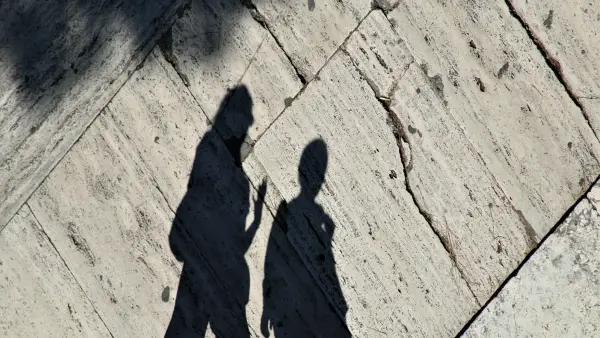
She is 63 and just realized she still smooths her hair before anyone takes her picture - not a quick pat but a full sweep behind both ears and a hand pressed flat across the crown as though something is always out of place - because a girl whose mother said "fix yourself" before every family photograph, every church entrance, every visit to anyone's house learned that a woman's appearance is always one correction away from being presentable, and the hand that reaches for her hair fifty years later is not vanity but a reflex that outlived the woman who installed it
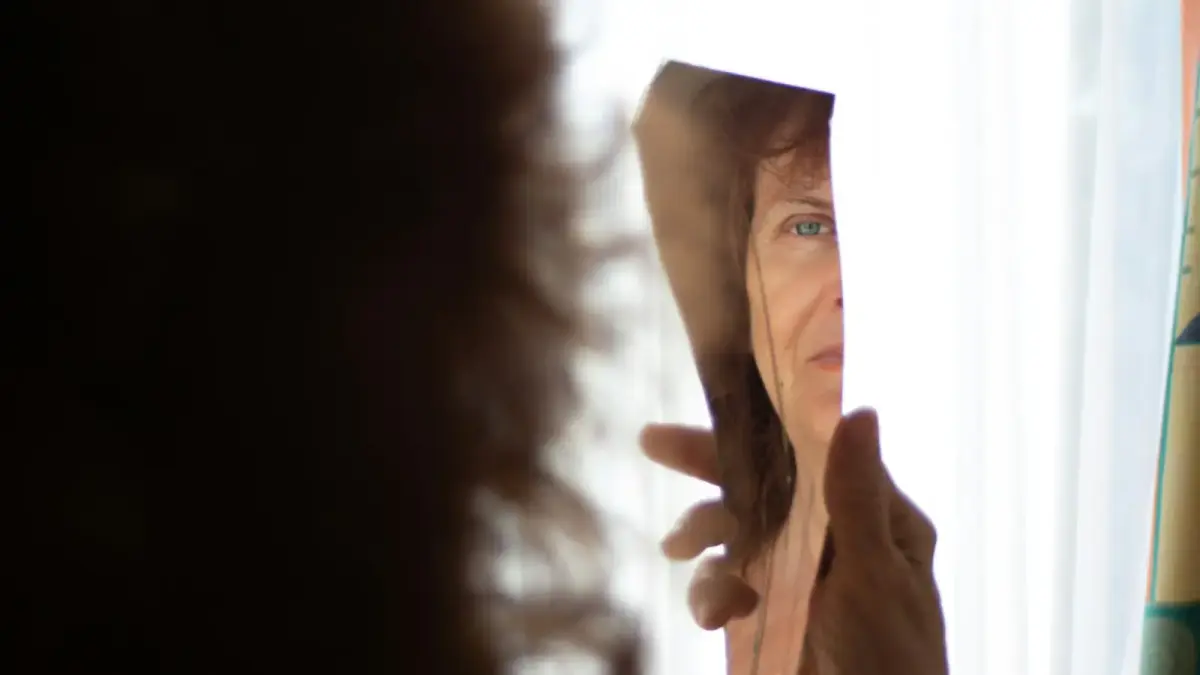
I watched my aunt do it at Thanksgiving last year. Someone pulled out a phone to take a group photo in the kitchen, and before anyone had even said “squeeze in,” her right hand went straight to the side of her head. She tucked her hair behind one ear, then the other. Then she pressed her palm flat against the crown, smoothing down something that was already smooth.
It took maybe three seconds. Nobody noticed.
But I noticed because I had just done the exact same thing.
I am 63 years old. I have gray streaks I stopped coloring two years ago. I wear my hair in a low bun most days because it is easy and I stopped caring about easy being elegant somewhere around fifty-five. And yet the moment a camera appears - the moment I know I am about to be looked at and recorded - my hand flies to my head like it was summoned.
Not a casual touch. A full correction. Behind both ears. Flat palm across the top. A quick tug at the back. As though something has been wrong this entire time and I only just caught it.
I used to think it was vanity. I do not think that anymore.
The hand remembers what the mind forgot
My mother had a phrase. Two words that preceded almost every public moment of my childhood: “Fix yourself.”
She said it in the car before we walked into church. She said it in the hallway before we opened the front door for company. She said it while she adjusted my collar, smoothed my skirt, licked her thumb to press down a flyaway near my temple.
“Fix yourself” was not angry. It was not cruel, exactly. It was procedural. Like checking that the oven was off before leaving the house.
The implication was always the same. You are not yet ready to be seen. Something about the way you currently exist needs adjustment. The world is about to look at you, and the version of you standing here right now is not the version that should be looked at.
I did not realize until I was well into my fifties that I had internalized this as a permanent state of being. I was always one correction away from presentable. Never already there.
And my hand learned the assignment decades before my conscious mind could name it.
The body keeps the script
A 2019 study published in the Journal of Nonverbal Behavior found that self-touch gestures - particularly grooming behaviors like hair-smoothing, face-touching, and clothing adjustment - increase dramatically in situations involving social evaluation. The researchers noted that these behaviors often operate below conscious awareness, functioning as regulatory mechanisms for anxiety rather than genuine attempts at appearance improvement.
In other words, the hand is not actually fixing anything. The hand is managing a feeling.
But here is the part that stopped me: these grooming reflexes are not just responses to momentary stress. They become embodied habits. They live in the motor cortex. They fire before thought arrives.
A 2021 paper in Frontiers in Psychology examined how parental feedback about appearance during childhood shapes adult body-monitoring behaviors. Children who received frequent corrective comments about how they looked - “stand up straight,” “tuck your shirt in,” “fix your hair” - showed higher rates of habitual self-checking in adulthood, even in low-stakes social situations.
The study called it “anticipatory self-correction.” I call it the ghost of my mother’s hand, still reaching for my collar forty years after she stopped reaching.
It was never about the hair
I want to be clear about something. My mother was not a monster. She was a woman who grew up in a world that evaluated women on presentation before it evaluated them on anything else. She was doing what she believed kept her daughters safe from judgment.
She ironed our Sunday dresses on Saturday night. She kept a small compact in her purse and checked it before walking into any room that mattered. She reapplied lipstick in the rearview mirror at stoplights, not because she was vain but because she understood something about the cost of being a woman who looked like she had not tried.
She was preparing us for a world she had not invented but had certainly suffered in.
The problem is that the preparation outlives the context. The world has changed - at least somewhat. I am sixty-three. Nobody is grading me on my flyaways. Nobody cares whether my hair is tucked or untucked when my granddaughter takes a selfie of the two of us at the park.
But my hand does not know that.
My hand still lives in 1971, standing in the front hallway of our house on Maple Drive, waiting for my mother to look me over one final time before we were allowed to be seen.
The women who fix themselves before being looked at
I started noticing it everywhere once I saw it in myself.
My sister does it. She reaches for her hair the moment anyone points a phone in her direction. She does not even look at her hand while it moves. Her eyes stay on the camera. Her smile is already in place. But her right hand sweeps from forehead to the nape of her neck in one practiced motion, like a pianist playing a scale she learned at seven.
My colleague does it. She is fifty-eight, accomplished, runs a department of forty people, commands a room with absolute authority. But when someone pulls out a camera at a work dinner, she tilts her head, and her fingers go to the part line. Every time.
My daughter does it. She is thirty-four.
That one stopped my heart.
Because I do not remember saying “fix yourself” to her. I do not remember reaching for her hair before photographs. I do not remember making her appearance conditional on correction.
But I did not have to say it. She watched me do it to myself a thousand times. She learned the gesture the way children learn everything - not from instruction but from observation. Not from what we say but from what our hands do when we think nobody is paying attention.
Psychologist Albert Bandura called this social learning. Children do not need to be told to adopt a behavior. They need only to see it modeled. Repeatedly. By someone they love.
My hand taught my daughter’s hand without a single word exchanged.
The difference between vanity and vigilance
People sometimes dismiss this kind of thing. “Oh, everyone fixes their hair for photos. That is just normal.”
And they are right that it is common. But there is a difference between a casual adjustment and a compulsive one. There is a difference between a woman who pats her hair because she wants to look nice and a woman whose hand moves before her brain has even registered that a camera exists.
The first is preference. The second is programming.
The first says, “I would like to look my best.” The second says, “I am not yet acceptable as I currently am.”
That distinction matters. Because the women I am talking about - the women who do the full sweep, the double ear-tuck, the crown press, the back-of-the-neck check - they are not trying to be beautiful. They are trying to be safe. They are trying to pass an inspection they were trained for so long ago that they cannot remember the training, only the test.
And the test never ends. That is the cruelest part. There is no moment when the hand rests and says, “You are fine now. You were fine before. You have been fine this whole time.”
The reflex that outlived the woman who installed it
My mother passed away eleven years ago. She was eighty-one. In her last year, she stopped caring about her hair entirely - the first time in her life, as far as I could tell. She wore it however it fell. She let it go white without apology. She sat in her chair by the window and did not reach for a mirror when someone came to visit.
I remember thinking: she is finally free of it.
But I am not. Not yet.
I still smooth my hair when someone takes my picture. I still press my palm flat against the crown as though something is perpetually askew. I still feel, in the half-second before a shutter clicks, that I am not quite ready. That there is one more thing to fix. That the version of me standing here is not the version that should be recorded.
The difference now is that I can see the hand moving. I can feel the old script firing. And even though I cannot always stop it, I can at least recognize where it came from.
It came from love. Strange, imperfect, anxious love. The kind of love that believes the world will be gentler to a girl whose hair is in place. The kind that teaches daughters to fix themselves not because they are broken but because the world was.
What the hand is really saying
If you are a woman who does this - who reaches for her hair, her collar, her hem, her face in the split second before being seen - I want you to know something.
That gesture is not vanity. It is not insecurity, at least not the kind anyone should be ashamed of. It is a piece of history stored in your muscles. It is your mother’s worry, or your grandmother’s worry, or the worry of whatever woman first showed you that being female in public required a final check.
You do not have to stop doing it. You might not even be able to. Motor patterns that old do not respond to willpower.
But you can start noticing it with tenderness instead of judgment. You can feel your hand rise and think, “There she is again. The girl who was told to fix herself.” And then you can let the photo be taken anyway - hair imperfect, hand still hovering, all of it still unfinished.
Because you were never one correction away from being presentable.
You were already there. You were always already there.
The hand just never got the message.