There is a particular kind of man who checks his rearview mirror one extra time before changing lanes even when nothing is behind him - who glances left, signals, glances left again, and then checks the mirror a third time not because he is a careful driver but because a boy who sat in the passenger seat while his father scanned every intersection like it contained a threat learned that a man who does not see what is coming deserves what hits him
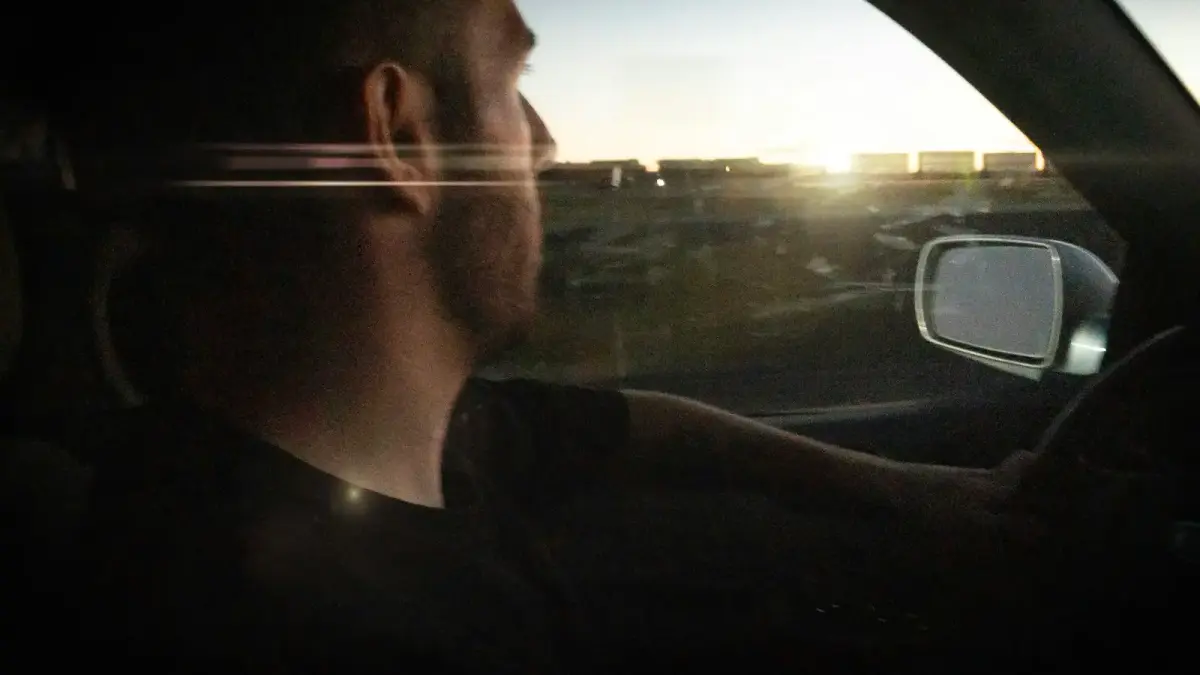
The Passenger Seat Classroom
I was fourteen the first time I noticed my father’s head move in a pattern that had nothing to do with curiosity and everything to do with survival.
We were driving home from a hardware store on a Saturday afternoon. Nothing remarkable about the road, the weather, the traffic. But his eyes moved like a man walking through a room full of strangers in the dark. Rearview. Side mirror. Rearview again. Over the shoulder. Back to the road. And then, just before the lane change - one more glance at the rearview, as if something might have materialized in the two seconds since he last looked.
I remember thinking he was the most careful driver I had ever seen. I remember feeling safe. I did not yet understand that what I was watching was not carefulness. It was a man who had decided, somewhere in his bones, that the world was always one missed detail away from catastrophe.
And I did not understand that I was memorizing it.
The Inheritance Nobody Talks About
We talk about inheriting our fathers’ eyes, their jawlines, their bad knees. We talk about inheriting their tempers, their silences, their taste in music. But we rarely talk about inheriting their nervous systems.
Not in the genetic sense - though that plays a role - but in the behavioral sense. The way a boy who spends ten thousand hours in the passenger seat of his father’s truck absorbs not just how to drive, but how to scan for danger. How to hold his body when he is responsible for other people’s safety. How to treat every moment of forward motion as a calculation that cannot afford a single error.
A 2019 study published in the Journal of Anxiety Disorders found that children of parents with hypervigilant tendencies were significantly more likely to develop heightened threat-monitoring behaviors themselves - not through direct instruction, but through observational learning. The children did not learn to be afraid. They learned to watch. They learned that watching was how you proved you cared.
And for boys watching their fathers, the lesson was even more specific. They learned that a man’s awareness of what surrounded him was not just a skill. It was a moral quality.
What the Mirror Actually Holds
Here is what happens when you check your rearview mirror for the third time before a lane change on an empty highway.
You are not looking at the road behind you. You are looking for proof that you did not miss something. You are completing a ritual that began before you were old enough to reach the pedals, a ritual that says: if you are thorough enough, nothing bad will happen. If you are vigilant enough, everyone in this car will survive.
The mirror does not show you traffic. It shows you your own competence. And every time you look and find the lane clear, you feel a tiny pulse of relief that has nothing to do with driving and everything to do with a boy who once believed that his father’s constant scanning was the only thing standing between his family and disaster.
You have probably never told anyone about the extra check. Why would you? It happens in less than a second. Nobody in the passenger seat notices. But you notice. You notice because, somewhere deep in the architecture of your attention, you know that the check is not optional. Skipping it would feel the way leaving the house without locking the door feels - not dangerous exactly, but irresponsible. Like letting your guard down in a world that punishes people who let their guard down.
Daniel Goleman’s work on emotional learning describes this as a kind of somatic inheritance - the body absorbs the emotional logic of its earliest environment long before the conscious mind can name what it has learned. You do not decide to check the mirror again. Your hands and eyes and neck muscles decide for you. They are still following instructions written by a man who may no longer be in the car.
The Competence Test That Never Ends
My father never said the words “a man who does not see what is coming deserves what hits him.” He did not have to. He said it every time he braked two seconds earlier than necessary. He said it every time he took a longer route to avoid an intersection he did not trust. He said it every time he muttered under his breath about another driver who changed lanes without looking.
The message was clear, even without language. Competence meant anticipation. Safety meant suspicion. And love - though he would never have called it that - meant never allowing yourself to be surprised by anything that could hurt the people you were carrying.
This is a particular kind of masculine inheritance. Not the loud kind, not the kind that announces itself in arguments or ambition. The quiet kind. The kind that lives in the way you hold the steering wheel at ten and two even when your hands are tired. The kind that makes you scan a parking lot before pulling in, check your mirrors before starting the engine, notice the car three vehicles back that has been matching your speed for the last four miles.
A 2022 study in Psychological Science found that men who scored high on measures of protective hypervigilance - the tendency to constantly scan for threats to loved ones - often traced the behavior to a specific male role model, usually a father or grandfather. The researchers noted that these men rarely identified their behavior as anxious. They called it responsible. They called it being a good driver.
They called it what their fathers had taught them to call it.
And maybe that is the most revealing part. The relabeling. The way a whole generation of men learned to dress their inherited anxiety in the language of duty and competence, so that it never had to be examined, never had to be questioned, never had to be called what it actually was.
The Boy in the Passenger Seat
Here is what I want to say to the man who checks his mirror one extra time.
You are not a careful driver. I mean, you are - your record is probably spotless, your passengers always feel safe, your lane changes are textbook. But the extra check is not about traffic. The extra check is about a boy who sat in the passenger seat and watched his father’s head move in that particular pattern, that left-right-left-mirror-mirror-shoulder-mirror rhythm, and decided that this was what it looked like when a man kept his family alive.
That boy is still sitting in your passenger seat. He is still watching. And every time you check the mirror, you are showing him that you learned the lesson. That you are doing what his father did. That you are scanning the world for threats because that is what men do when they love people they cannot say “I love you” to.
Gabor Mate writes about how the body stores what the mind cannot process - how our physical habits become the autobiography of our unspoken emotional lives. Your driving is a chapter in that autobiography. The way you grip the wheel, the way your eyes move, the way your foot hovers over the brake just a little closer than it needs to - all of it is a letter to a man who taught you that the world was dangerous and that your job was to see it coming.
The Road Behind You
I still check my mirror one extra time. Every lane change. Every merge. Even on empty roads at three in the morning when the only headlights for miles are my own.
I catch myself doing it with my own kids in the car now. The same head movement. The same scanning pattern. And sometimes my daughter will be talking about something that happened at school, and I will be listening - I am always listening - but part of my brain is already three steps ahead, already calculating the distance to the next intersection, already noting the pickup truck in my blind spot, already rehearsing the maneuver I will make if something goes wrong. I am in two places at once, the way my father was always in two places at once. Present and watching. Here and scanning.
I used to think it was just good driving. I used to feel a small pride in it, the way you feel pride in any skill you learned from your father. Look at me, being thorough. Look at me, being responsible. Look at me, being the kind of man who does not miss things.
But I know now what I am actually doing. I am completing a ritual of inherited vigilance. I am proving to a man who is not in the car that I am paying attention. I am looking in the mirror not to see what is behind me, but to show the boy in the passenger seat that I am watching the way his father watched - and that I will not let anything come from the blind spot to hurt the people I love.
Research from Frontiers in Psychology in 2021 explored the concept of intergenerational transmission of anxiety-related behaviors, finding that protective rituals - repeated safety checks, environmental scanning, threat assessment habits - passed from parent to child with remarkable consistency, often persisting decades after the original threatening environment had changed.
The road is empty. The lane is clear. Nothing is coming.
And still your eyes go to the mirror. Not because you need to look. But because a man you loved once taught you, without words, that looking was the purest form of love he knew how to give.
You are not broken for checking again. You are not anxious. You are not paranoid.
You are the son of a man who kept his eyes on the road, and you are still honoring the only language of care he ever spoke.