She is 64 and just realized she still rinses every single dish before placing it in the dishwasher - not the plate left overnight, not the pot caked with residue, but every glass, every fork, every bowl that barely needs it - because a girl whose mother washed everything by hand and never fully trusted the machine that arrived in the kitchen when she was twelve learned that care is not something you hand to a machine without first proving with your own hands that you took the job seriously
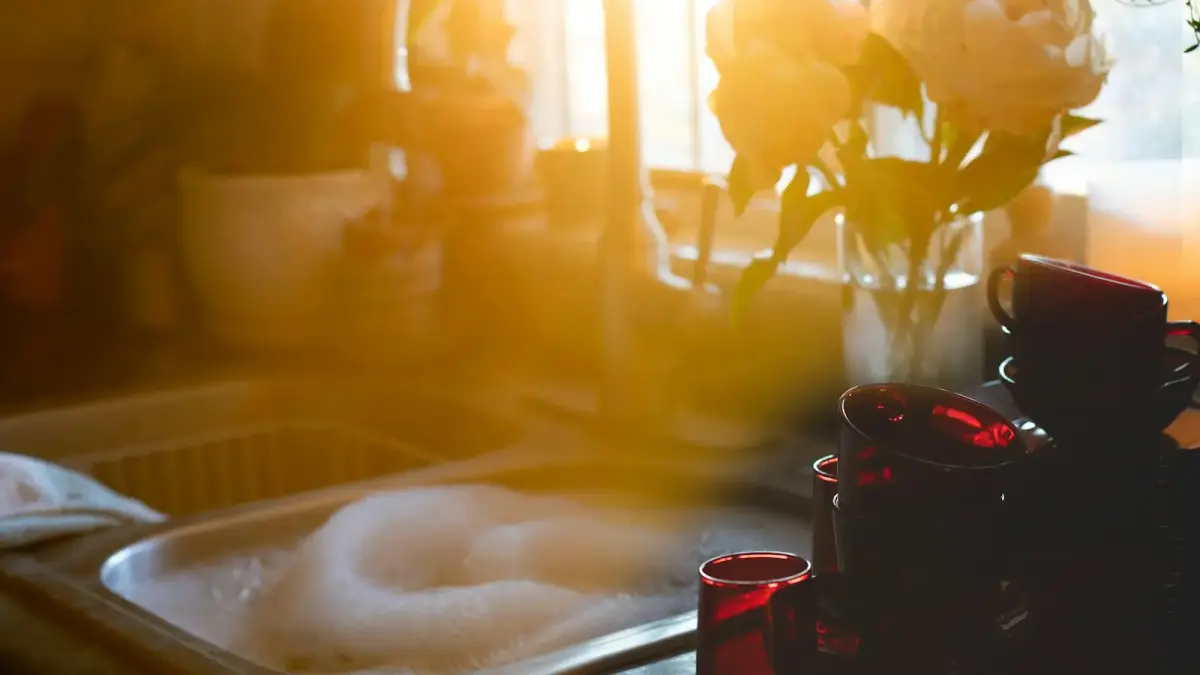
I caught myself doing it last Tuesday. Standing at the kitchen sink, warm water running over a cereal bowl that had held nothing but milk and a few flakes of bran. The bowl was practically clean. And still, my hands worked it under the faucet, turning it, rubbing the inside with my thumb, making sure every surface had been touched before I set it in the rack of the dishwasher.
I have been doing this for over forty years. Every single dish. Every fork with nothing on it but the memory of a salad. Every glass that held water and nothing else. I rinse them all like they are about to be inspected.
And standing there on Tuesday, thumb circling the inside of that bowl, I finally understood why.
The machine that arrived when she was twelve
My mother washed dishes by hand for the first thirty-seven years of her marriage. She stood at that sink every evening after dinner, and sometimes again after lunch, and always after holidays when the counter disappeared under towers of plates and serving bowls that seemed to multiply.
She had a system. Hot water first, then soap, then the scrub brush for pots and the softer sponge for glasses. She dried everything with a flour-sack towel that she bleached white every Sunday. The whole ritual took forty-five minutes on a regular night and close to two hours after Thanksgiving.
When I was twelve, my father brought home a dishwasher. It was a portable one, the kind you wheeled over to the sink and attached to the faucet with a hose. He was proud of it. He had saved for months.
My mother thanked him. She used it. But she never stopped rinsing first.
She did not trust it
I remember asking her once why she washed every dish before putting it in the machine. I was maybe fifteen, old enough to find the redundancy annoying.
She looked at me like I had asked why she locked the front door at night.
“You don’t put dirty dishes in a machine,” she said. “You clean them, and then the machine finishes the job.”
It made no sense to me at fifteen. The whole point of a dishwasher is that it cleans the dishes. That is what it does. That is its one purpose.
But my mother had spent decades being the dishwasher. She had been the machine. And when a metal box arrived in her kitchen and promised to do her job, she could not simply hand everything over and walk away. She needed to do her part first. She needed to prove - to herself, to the dish, to the kitchen - that she had not become the kind of woman who lets a machine do the caring for her.
A 2019 study published in the Journal of Consumer Research found that people who grew up watching labor-intensive domestic routines often replicate those behaviors even when technology has made them unnecessary - not out of ignorance, but out of emotional loyalty to the person who modeled them. The researchers called it “inherited effort,” the unconscious belief that shortcuts are a form of disrespect to the people who never had them.
That is exactly what my mother taught me without ever saying a word.
What the girl learned
I did not learn how to load a dishwasher. I learned something much deeper than that.
I learned that care has a sequence. First, you do the work yourself. You touch the thing. You give it your attention. You prove that you took it seriously. And only then - only after the human part is finished - do you let something else handle the rest.
This was not about dishes. This was about everything.
My mother ironed sheets before putting them on the bed, even though they would wrinkle again by morning. She re-folded towels that came out of the dryer because the dryer folded nothing and she did not believe in putting away something that had not been shaped by hands. She wiped down counters before spraying them with cleaner, as though the cleaner deserved a clean surface to work on.
Every one of these rituals carried the same message: machines assist, but they do not care. Care is the human part. Care is what you do before you hand it off.
And I absorbed every bit of it.
The woman at sixty-four
I am sixty-four years old. I have owned seven dishwashers across four homes. Every single one of them has been modern, efficient, and perfectly capable of handling a bowl with dried cereal in it.
I have never once put a dish in any of them without rinsing it first.
Not the mugs. Not the spoons. Not the plate that held a single piece of toast. I rinse everything. I run my hands over everything. I do the human part before I close the door and press the button.
For decades, I thought this was just a habit. A quirk. The kind of thing you do without thinking, like checking that the stove is off three times before leaving the house.
But it is not a habit. It is a belief system. It is the bone-deep conviction that you do not hand something to a machine and walk away. You prepare it. You show the effort. You prove, with your own hands, that you took the job seriously.
Dr. Anat Talmon, a family therapist who studies intergenerational transmission of domestic behavior, has written about how household rituals become “emotional contracts” between generations. The mother does not say “you must rinse the dishes.” She simply rinses them, every night, for years, and the daughter watches, and the watching becomes the contract. The daughter signs it without knowing she signed anything at all.
I signed mine at twelve years old, standing beside my mother at the sink, watching her rinse a plate before placing it in a machine that could have handled the plate just fine.
It is not about the dishes
My daughter-in-law does not rinse. She scrapes the food off, loads the dishwasher, and presses start. She is efficient and practical and entirely correct - modern dishwashers are designed to handle food residue. The pre-rinse is, by every engineering standard, unnecessary.
And yet when I watch her load a dish without rinsing it, something in my chest tightens. Not judgment. Not disapproval. Something closer to grief. Like watching someone skip a step in a prayer they don’t know they’re supposed to be saying.
Because that rinse was never about cleaning. It was about devotion. It was my mother’s hands saying, “I will not let a machine do what I can do first.” It was her way of staying necessary in a kitchen that was slowly learning to run without her.
A 2021 study in Frontiers in Psychology explored how adult children unconsciously preserve the domestic habits of their parents, particularly their mothers, as a way of maintaining emotional connection after loss. The researchers found that these behaviors intensify after the parent dies - as though the ritual becomes a form of continued conversation.
My mother passed away eleven years ago. And I rinse every dish like she is standing beside me.
The inheritance nobody talks about
We talk a lot about what our parents gave us. Their values. Their trauma. Their political opinions. Their fear of debt or their comfort with risk.
But nobody talks about the small physical rituals. The way you fold a towel. The way you make a bed. Whether you let the butter soften on the counter or keep it in the fridge. Whether you rinse a dish or trust the machine.
These rituals are not trivial. They are the most intimate inheritance we carry, because they live in the body, not the mind. You do not decide to rinse the dish. Your hands decide. Your hands remember what your mother’s hands did, and they repeat it, over and over, for forty years, until one Tuesday morning you finally stop and ask yourself why.
And the answer is not compulsion. It is not inefficiency. It is not stubbornness or age or resistance to change.
The answer is love.
The answer is a twelve-year-old girl standing at a kitchen counter, watching her mother’s wet hands move a plate under the faucet before placing it in a machine that promised to do the job for her. The girl did not understand what she was watching. She thought she was watching someone wash a dish.
She was watching someone refuse to let go of the idea that the most important cleaning happens before the machine starts. That the truest form of care is the part done by human hands. That a dish rinsed by a person who loved you is not the same as a dish rinsed by pressurized water, even if the result looks identical.
Still rinsing
I am sixty-four. My knuckles ache some mornings. The hot water helps, actually - another thing my mother used to say.
I will keep rinsing. I know the dishwasher can handle it. I have always known. That was never the point.
The point is that my mother stood at a sink every night for thirty-seven years before a machine showed up and offered to take over. And even then, she did not fully hand it off. She kept her hands in the work. She kept herself between the dish and the machine, one last human step before automation finished what she started.
I do the same thing. Not because I have to. Because something in me still believes that care requires a human touch first - that the work matters most when no one is making you do it, when the machine could handle it alone, when the only reason your hands are in the water is that a girl once watched her mother and learned that love looks like effort nobody asked for.
That is not a habit. That is not a quirk.
That is the quietest kind of inheritance there is.